Quraysh are associated with the North (Syria/Levant)
The Genealogical Divide and the Rise of Qusayy
| Date/Period | Event/Phase | Key Actors/Organizations | Geopolitical Forces | Evidence Type (Tier) | Key Notes/Unknowns |
| c. 380 CE | Rahmanist Revolution | Himyarite Kings (Malkikarib) | Himyar vs. Paganism | Tier 1 (Inscriptions) | State conversion to Monotheism/Judaism as a "Third Way" to avoid Byzantine/Persian vassalage. |
| c. 400-500 | Meccan Consolidation | Qusayy ibn Kilab (Quraysh) | Adnanites (North) | Tier 2 (Oral/Sira) | Expulsion of Qahtanite (Khuza'a) tribes; establishment of Quraysh hegemony over the Kaaba. |
| c. 523 CE | Massacre of Najran | Yūsuf Dhū Nuwās | Himyar vs. Christians | Tier 1 (Syriac Letters) | Casus belli for intervention. 200–20,000 killed in "burning trenches" to crush Byzantine "Fifth Column." |
| 525 CE | Aksumite Invasion | King Kaleb, Justin I | Byzantium (via Aksum) | Tier 1 (Inscriptions) | Amphibious assault utilizing Byzantine fleet; end of Jewish rule in Yemen; Red Sea becomes "Christian Lake." |
| c. 552 vs 570 | Year of the Elephant | Abraha al-Ashram | Aksum vs. Mecca | Tier 2/3 (Quran/Sira) | Failed siege of Mecca. Date disputed: Epigraphy suggests 552, Tradition 570. Likely marks collapse of Aksumite power. |
| c. 575 CE | Persian Annexation | Gen. Vahriz, Khosrow I | Sassanids vs. Aksum | Tier 2 (Tabari) | "Suicide Squad" of ~800 prisoners topples Aksumite rule. Yemen becomes Persian Satrapy (Southern encirclement). |
| c. 590 CE | Fijar War / Hilf al-Fudul | Quraysh vs. Hawazin | Tribal Economics | Tier 2 (Oral/Sira) | Quraysh secure trade monopoly. "League of the Virtuous" establishes pan-tribal justice mechanism. |
| 628 CE | Intel Coup in Yemen | Prophet Muhammad, Badhan | Islam vs. Sassanids | Tier 2 (Hadith/Sira) | Prophet uses intel on Khosrow II's death to convert Persian Governor Badhan, securing Yemen diplomatically. |
| 632-633 CE | The Ridda Wars | Abu Bakr, Khalid ibn al-Walid | Caliphate vs. Rebels | Tier 2 (Historical) | 11 Corps deployed. Musaylima (40k troops) defeated at Yamama. Unification of Peninsula militarizes the state. |
| 632 CE | Battle of Yamama | Khalid, Ansar, Musaylima | Adnanite vs. Qahtanite | Tier 2 (Historical) | Massive casualties for the Ansar (Yemenis), weakening their political power relative to Quraysh (Adnanites). |
Long before the advent of Islam, the Arabian Peninsula was defined by a genealogical drift rather than rigid political parties. The population was divided into the Northern Arabs, known as Adnanites (Adnan; 'adana; to settle or abide), and the Southern Arabs, or Qahtanites (Qahtan; q-h-t; associated with drought or scarcity, ancestor of southern tribes). The Southern tribes, hailing from civilized and often kingly societies in Yemen, had migrated northward following the catastrophic collapse of the Maarib Dam. Among these migrants were the Banu Khuza'a (Khuza'a; khaza'a; to separate or lag behind), who seized control of Mecca and the administration of the Kaaba (Ka'bah; ka'b; cube or ankle/prominence) from earlier inhabitants.
The balance of power shifted with the emergence of Qusayy ibn Kilab (Qusayy; qasa; to be far away or distant). Born in Mecca but raised in the distant lands of Syria by his mother’s tribe, Qusayy returned to his birthplace as a young man with a singular ambition. He united the scattered clans of the Quraysh, an Adnanite lineage, to challenge the Southern hegemony. Qusayy successfully defeated the Banu Khuza'a and their allies, expelling them from the administration of the Sanctuary. This victory re-established Northern dominance in the Hejaz, positioning the Quraysh as the undisputed masters of Mecca and custodians of the Holy House.
The Year of the Elephant
Generations after Qusayy, around 570 CE, the sanctity of Mecca was threatened by Abraha al-Ashram, the Abyssinian viceroy of Yemen. Seeking to divert Arab pilgrims to a magnificent cathedral he built in Sana'a, Abraha was enraged when a local Arab desecrated his church. He assembled a massive army, spearheaded by war elephants—a terrifying sight unknown to the Arabs—and marched north to demolish the Kaaba stone by stone. As the army approached, they seized livestock belonging to the locals, including two hundred camels owned by Abdul Muttalib, the chief of Mecca and grandfather of the future Prophet.
When summoned by the viceroy, Abdul Muttalib surprised Abraha by asking only for the return of his livestock rather than pleading for the temple. He famously declared, "I am the lord of the camels. As for the House, it has a Lord who will protect it." The Meccans evacuated the city, watching from the surrounding mountains. When Abraha ordered his lead elephant, Mahmud, to charge, the beast refused to move toward the sanctuary. Suddenly, the sky darkened with flocks of birds known as Ababil (Ababil; ubbulah; a bundle or flock), which dropped stones of baked clay upon the invaders. The army was decimated by a plague-like affliction, preserving the Kaaba and cementing the Quraysh’s status as the "People of God."
The Fijar War and the Alliance of Virtue
As the Prophet Muhammad grew up, the Quraysh sought to consolidate their economic power. This ambition triggered the Fijar (Fijar; fajara; to act wickedly or burst forth) War, so named because it violated the sanctity of the holy months. The conflict pitted the Quraysh and their allies against the Qays Aylan confederation in a struggle for control over the trade routes to Iraq. The young Muhammad participated in a non-combatant role, gathering stray arrows for his uncles. The war ended in a strategic victory for the Quraysh, securing Mecca as the undisputed economic hub of Arabia.
Following this era of tribal violence, a counter-movement toward universal justice emerged. When a merchant from Zubaid was cheated by a powerful Meccan chieftain, he publicly shamed the city for its lack of honor. In response, several clans gathered at the house of Abdullah ibn Jud'an to form the Hilf al-Fudul (Hilf al-Fudul; fadal; surplus of virtue or favor). Breaking with the tradition of blind tribal loyalty, the signatories pledged to stand united with the oppressed, regardless of lineage. The Prophet later praised this pact, noting that he would uphold such an alliance even in the era of Islam.
Reconstruction of the Sanctuary
Roughly five years before Muhammad received his first revelation, the Kaaba required reconstruction due to structural damage from a massive flood and a previous fire. The Quraysh resolved to rebuild the House using only "pure money," excluding earnings from usury, gambling, or oppression. However, the scarcity of honest wealth forced them to shorten the building's dimensions, leaving a portion of the original foundation exposed within a semi-circular wall known as the Hijr Ismail.
A dangerous dispute arose when it came time to place the Black Stone, with clans threatening civil war for the honor. The deadlock was broken by Muhammad, who was chosen as arbitrator because he was the first to enter the gate the following morning. Displaying characteristic wisdom, he placed the stone on a cloak and had the chiefs of every tribe lift it together. He then set the stone in place with his own hands, satisfying all parties and averting bloodshed.
The Great Shift: The Prophetic Era
The genealogical dynamic established by Qusayy underwent a profound reversal during the mission of the Prophet Muhammad. While the Adnanite Quraysh persecuted the Prophet, his greatest support came from the Yamani tribes of Yathrib, specifically the Aws and Khazraj. These tribes, descendants of the same Azd confederation that Qusayy had once expelled, were locked in a suicidal civil war and desperately needed a mediator.
Through the Pledges of al-Aqaba, these Yamani tribes vowed to protect the Prophet, effectively declaring themselves enemies of the Quraysh. Upon the migration to Medina, they earned the title Al-Ansar (Ansar; nasara; to help or aid). In a historical irony, the Southern tribes who had been pushed out of Mecca by Qusayy now welcomed his descendant to restore his power, providing the military backbone for the early Muslim community at the battles of Badr and Uhud.
The Political Fracture: Saqifah and the Ridda Wars
Following the death of the Prophet in 632 CE, ancient tribal tensions resurfaced at the portico of Saqifah (Saqifah; saqafa; to roof over). The Ansar, fearing marginalization, attempted to elect a leader from among themselves. However, Adnanite figures like Abu Bakr and Umar intervened, arguing that only the lineage of the Quraysh commanded enough prestige to hold the Arabian Peninsula together. The Ansar were politically sidelined, establishing a precedent of Adnanite executive rule.
Despite this friction, the tribes united during the Ridda (Ridda; radda; to return or apostatize) Wars to save the nascent state from rebellion. The campaign culminated in the Battle of Yamama against the false prophet Musaylimah. While the strategic command was Qurayshi, the Ansar served as the shock troops, sacrificing heavily to break the enemy lines. The victory preserved the Caliphate but decimated the Ansar's leadership class, paradoxically solidifying the administrative dominance of the Quraysh.
The Umayyad Synthesis
The "Quraysh Dominance" eventually fueled the First Fitna (Fitna; fatana; to test or tempt), a civil war between Ali and Muawiya. While both leaders were Adnanites, their armies reflected the old tribal divides. Ali’s support was heavily drawn from the sidelined Yamani tribes in Iraq, while Muawiya relied on the powerful Yamani tribe of Banu Kalb in Syria.
Ultimately, the Umayyad dynasty founded by Muawiya represented a unique synthesis. Although the rulers were Adnanite by blood, their military power was almost entirely Yamani. Through marriage alliances with the Banu Kalb, the Umayyads bridged the ancient divide, though the preference for Syrian tribes would eventually sow the seeds for future conflicts within the empire.
Summary: The history of pre-Islamic and early Islamic Arabia is driven by the shifting balance between Northern (Adnanite) and Southern (Yamani) tribes. From Qusayy's initial conquest of Mecca to the Ansar's protection of the Prophet, these genealogical loyalties shaped the political landscape of the Muslim world.
Qusayy vs. The Yaman: The Battle for Mecca
Qusayy ibn Kilab (the Prophet’s Adnanite ancestor) vs the Banu Khuza'a.
Before the Prophet’s lifetime, the "Adnanite vs. Yamani" distinction was less of a rigid political party and more of a genealogical drift between Northern (Adnan) and Southern (Qahtan)
Arabs. However, Qusayy's rise to power represented a major shift where Northern dominance was re-established in Mecca over Southern tribes.
1. The Main Rival: Banu Khuza'a
When Qusayy was born, Mecca was ruled by the Banu Khuza'a, a Yamani (Qahtanite) tribe from the Azd confederation. They had taken control of Mecca centuries earlier after the collapse of the Maarib Dam in Yemen caused Southern tribes to migrate North.
The Conflict: Qusayy united the scattered clans of Quraysh (Adnanites) and challenged the Khuza'a for custodianship of the Kaaba.
The Result: Qusayy defeated the Khuza'a (and their allies from the Banu Bakr) and expelled them from the Kaaba's administration, establishing Quraysh as the undisputed masters of Mecca.
2. Who were the "Yamani" Tribes before Islam?
In the pre-Islamic era (Jahiliyyah), the Yamani tribes were the powerful, settled, and often kingly civilizations of the South, distinct from the nomadic Northern Adnanites (like Qusayy's line).
Here are the major Yamani players Qusayy and his descendants would have known:
| Tribal Group | Description | Relation to Adnanites |
| Banu Khuza'a | The rulers of Mecca before Quraysh. | Rivals (defeated by Qusayy). |
| The Azd | A massive confederation (parent of Khuza'a). Includes the Aws and Khazraj in Yathrib (Medina). | Mixed. Later became the "Ansar" (Helpers) of the Prophet. |
| Kindah | The "Kings of Arabia." A powerful Yamani kingdom in Central Arabia (Najd). | Hegemons. They often exerted power over Adnanite tribes like Taghlib and Bakr. |
| Ghassanids | Christian Arab kings in the Levant (Syria/Jordan). Clients of Rome. | Northern Neighbors. Yamani by blood, but lived in the North. |
| Lakhmids | Kings of Al-Hirah (Iraq). Clients of Persia. | Eastern Neighbors. Also Yamani by blood. |
| Madhhij | A fierce Bedouin confederation from Yemen. | Southern Neighbors. Known for their warriors (e.g., Al-Ashtar). |
Summary of the Dynamic
Qusayy (Adnanite/North) represented the rising power of the "Ismaili" Arabs centered in the Hejaz.
Khuza'a (Yamani/South) represented the Southern dominance that had spread northwards.
By defeating Khuza'a, Qusayy reclaimed Mecca for the Northern Arabs (Adnanites), setting the stage for the Quraysh's dominance that continued into the Prophet Muhammad's time.
The Great Shift: Adnanite Persecution, Yamani Protection
While Qusayy (Adnanite) fought the Yamani tribes to secure Mecca, his descendant, the Prophet Muhammad, found his greatest support among them. When the Adnanite Quraysh persecuted the Prophet, it was the Yamani tribes of Yathrib (Medina)—the Aws and Khazraj—who saved the mission of Islam.
1. Who Were They?
Tribes: The Aws and Khazraj.
Lineage: They were Qahtanite (Yamani) Arabs from the massive Azd confederation.
Migration: Like the Khuza'a, they had migrated North from Yemen after the Maarib Dam collapse, settling in the oasis of Yathrib (later Medina).
2. Why They Accepted Islam (The Political Context)
In the years just before the Hijra, the Aws and Khazraj were locked in a suicidal civil war known as the War of Bu'ath.
Exhaustion: The war decimated their leadership and destabilized their hold on Yathrib against local Jewish tribes.
Need for a Mediator: They did not just need a religion; they desperately needed an outsider with authority to arbitrate their feuds and unite them. Muhammad (peace be upon him) offered both spiritual guidance and political stability.
3. The Pledges of al-Aqaba
The alliance was sealed in two secret meetings at al-Aqaba (near Mecca):
First Pledge (621 CE): 12 men from Aws and Khazraj accepted Islam.
Second Pledge (622 CE): 73 men and 2 women pledged not just belief, but protection of war. They vowed to protect the Prophet as they would their own wives and children. This effectively declared them enemies of the Quraysh.
4. Becoming "The Ansar"
Upon the Prophet's migration (Hijra) to Medina, these Yamani tribes earned the title Al-Ansar (The Helpers).
Shelter: They shared their homes and wealth with the Adnanite refugees (Muhajirun) from Mecca.
Military Backbone: They formed the bulk of the Muslim army at Badr and Uhud. Without their swords, the early Muslim community likely would have been wiped out by the Quraysh.
The Historical Irony
The dynamic had completely flipped from Qusayy's time:
Qusayy's Era: Adnanites expel Yamanis (Khuza'a) to seize power in Mecca.
Prophet's Era: Yamanis (Ansar) welcome Adnanites (Muhajirun) to restore power to the Prophet.
The Crisis at Saqifah Banu Sa'idah (632 CE)
Hours after the Prophet Muhammad passed away, the latent tension between the Adnanite (Quraysh) and Yamani (Ansar) lineages exploded at a gathering hall in Medina known as Saqifah.
This event marked the beginning of the political decline of the Yamani tribes in the face of renewed Adnanite dominance.
1. The Ansar’s Preemptive Strike
While the Prophet’s family prepared for his burial, the Ansar (Aws and Khazraj) gathered secretly.
Leader: They planned to elect Sa'd ibn Ubadah, the chief of the Khazraj, as the successor.
Motivation: They feared that without the Prophet's protection, the Quraysh (Adnanites) would reclaim total superiority and marginalize the Yamani "Helpers" who had hosted them.
2. The Intervention
Three Adnanite leaders—Abu Bakr, Umar ibn al-Khattab, and Abu Ubaidah—rushed to the hall upon hearing the news to prevent a split in the Ummah.
3. The Debate: Lineage vs. Merit
The arguments presented highlighted the Adnan-Yaman divide:
The Ansar (Yamani) Proposal:
"Let there be a ruler from us, and a ruler from you."
They argued for a dual executive, emphasizing their role in sheltering Islam when Mecca rejected it.
The Quraysh (Adnanite) Counter:
Abu Bakr rejected dual leadership, citing political reality over merit:
"The Arabs will not recognize this authority except in this tribe of Quraysh."
He argued that the Adnanite Quraysh held the lineage prestige required to hold the Arabian Peninsula together.
4. The Outcome
The unity of the Ansar fractured (old rivalries between Aws and Khazraj resurfaced). Umar seized the moment and pledged allegiance to Abu Bakr. The Aws followed suit to prevent a Khazraj (Sa'd) from ruling.
5. The Historical Shift
Saqifah established a precedent that lasted for centuries: The Caliphate belonged to the Adnanites (Quraysh).
Immediate Effect: The Ansar were praised religiously but sidelined politically. They became the soldiers of Islam, but rarely its governors or rulers.
Long-Term Effect: The Yamani tribes eventually grew resentful of this "Qurayshi exclusivism," which fueled later conflicts (like the Battle of Marj Rahit we discussed earlier).
Sa'd ibn Ubadah refused to pledge allegiance and left for Syria, never accepting Adnanite rule.
The Ridda Wars (632–633 CE): A Moment of Unity
Yes. The Ridda Wars (Wars of Apostasy) were the defining moment where the Adnanite (Quraysh) and Yamani (Ansar) tribes set aside their bitterness from Saqifah to save Islam from extinction.
While they argued over who should rule in Medina, they united to fight the rebellious tribes surrounding them.
1. The Enemy: Why they Fought
After the Prophet’s death, many tribes across Arabia revolted. Some refused to pay Zakat (tax), while others followed "false prophets."
The rebellion wasn't strictly "North vs. South," but it often took on an anti-Quraysh (Adnanite) flavor. The rebels resented the centralized power of Medina.
Musaylimah al-Kaddab: The "Arch-Liar" led the Banu Hanifa (a powerful rival Adnanite tribe from the Rabi'a branch) in the center of Arabia.
Al-Aswad al-Ansi: A false prophet from the Yamani tribes in Yemen, who seized power in the south.
2. The Muslim Alliance: Quraysh Command, Ansar Muscle
To defeat these rebels, the Caliph Abu Bakr (Adnanite) formed 11 army corps. The dynamic was clear:
The Generals (Adnanite): The strategic command was almost exclusively Qurayshi (e.g., Khalid ibn al-Walid, Amr ibn al-As).
The Elite Troops (Yamani): The Ansar (Aws and Khazraj) formed the shock troops. They were the most experienced veterans from the Prophet's battles (Badr, Uhud).
3. The Critical Battle: Yamama (The Garden of Death)
This was the bloodiest battle of the wars, fought against Musaylimah’s massive army. The cooperation here was legendary, but tragic for the Yamanis.
The Crisis: The Muslim army was initially routed. Musaylimah's Hanifa warriors were pushing them back.
The Yamani Hero: Baraa ibn Malik (Ansar) famously shouted, "O People of Medina! There is no Medina for you today! Only Allah and Paradise!"
The Sacrifice: The Ansar led a suicidal charge to break the enemy lines. They succeeded, but at a horrific cost.
Ansar Losses: A massive number of Ansar were killed, including hundreds of Huffaz (memorizers of the Quran).
The Result: Musaylimah was killed by Wahshi (an Ethiopian slave, who had previously killed the Prophet's uncle Hamza), fighting alongside the Ansar.
4. The Political Aftermath
The Ridda Wars saved the Caliphate, but they paradoxically weakened the Yamani (Ansar) political position further.
Decapitation of Leadership: So many Ansar leaders and Quran reciters died at Yamama that they lost much of their "elder statesman" influence.
Quraysh Dominance: With the Ansar depleted, the Quraysh (Adnanites) solidified their hold on the state's administration.
The Unraveling: Quraysh Hegemony vs. Tribal Pride
The "Quraysh Dominance" established after the Ridda Wars became the primary engine for the First Fitna (Civil War).
While the leaders of the civil war—Ali and Muawiya—were both Adnanite (Quraysh), the war was fought largely by Yamani tribesmen on both sides who were frustrated with the status quo.
1. The Catalyst: Uthman’s "Quraysh First" Policy
The third Caliph, Uthman ibn Affan (an Umayyad/Adnanite), radically centralized power.
The Grievance: He replaced popular provincial governors with his own Umayyad relatives.
The Reaction: This enraged the Yamani tribes in the garrison cities of Kufa (Iraq) and Fustat (Egypt). They felt they had conquered these lands with their blood, only to be ruled by arrogant Qurayshi aristocrats from Mecca who had fought against the Prophet until the very end.
2. The Assassination
When rebels stormed Medina and killed Uthman in 656 CE, it was not just a political assassination; it was a tribal explosion.
The Killers: The rebels were largely from Yamani tribes (like Madhhij and Kinda) based in Egypt and Iraq.
The Implications: They rallied behind Ali ibn Abi Talib because he represented religious merit over Qurayshi aristocracy.
3. The Civil War (The Battle of Siffin)
The war between Ali and Muawiya is often taught as a religious split, but purely tribally, it was a war of Two Yamans:
| Feature | Ali’s Army (The Iraqis) | Muawiya’s Army (The Syrians) |
| Core Support | The Ansar (Medina) & Kufan Tribes (Hamdan, Madhhij). | Banu Kalb (The great Yamani tribe of Syria). |
| Motivation | To break the "Qurayshi Syndicate" and restore the Prophet’s justice. | To avenge Uthman and maintain Syrian autonomy. |
| Key General | Malik al-Ashtar (A Yamani chieftain of the Nakha clan). | Amr ibn al-As (Adnanite, but relied entirely on Kalb warriors). |
4. The Crucial Irony: The "Umayyad-Yamani" Alliance
This is the most critical detail for understanding the later history:
Muawiya (Adnanite/Umayyad) could not have won without the Banu Kalb (Yamani).
Marriage: Muawiya married Maysun bint Bahdal, the daughter of the Kalb chief.
The Heir: Their son, Yazid I, was half-Yamani. He grew up in the desert with his mother's Kalb tribe, not in the palaces of Damascus.
The Consequence: The early Umayyad state was technically an Adnanite dynasty, but its sword and military power were 100% Yamani (Kalb).
5. The Aftermath
Ali was assassinated, and Muawiya founded the Umayyad Dynasty.
The Winners: The Syrian Yamanis (Kalb) became the privileged military class.
The Losers: The Iraqi Yamanis (Ansar/Hamdan) and the Qays (Northern Adnanites).
This imbalance set the stage for the bloodbath at Marj Rahit (your first question), where the sidelined Qays tribes finally exploded in rage against the privileged Yamani Kalb.
Yemen was aboriginals and antagonist.
Here is the breakdown of their origins:
1. Adnanite vs. Qahtanite Lineage
Arab tribes are traditionally divided into two distinct groups based on their origin:
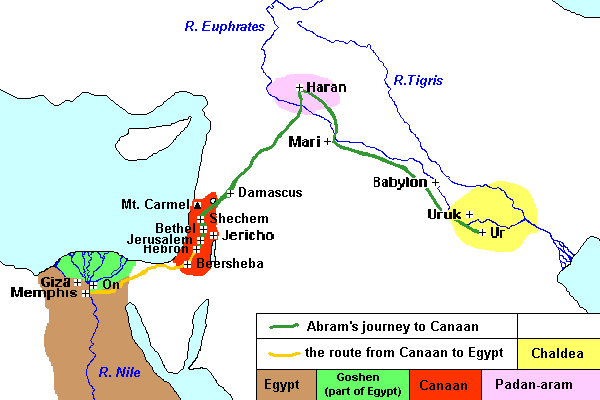
Adnanites (Northern Arabs): The Quraysh belong to this group. They trace their ancestry to Adnan, a descendant of Prophet Ismail (Ishmael) and Prophet Ibrahim (Abraham). Abraham is historically associated with the Levant (Syria/Palestine) and Mesopotamia, not Yemen.
Qahtanites (Southern Arabs): These are the tribes that originated in Yemen (such as the Banu Khuza'a and Jurhum). The Quraysh are not from this lineage.
2. The Migration of Qusayy ibn Kilab
The specific "migration" often associated with the rise of the Quraysh involves Qusayy ibn Kilab, the man who united the tribe and took control of Mecca:
Born in Mecca: Qusayy was born in Mecca but his father died when he was an infant.
Raised in Syria: His mother remarried a man from the Banu Udhra tribe and took Qusayy to live in Syria (near the borders of modern-day Palestine/Jordan).
Return to Mecca: As a young man, Qusayy migrated back to Mecca from Syria. >>>> He then challenged the Yemeni tribe (Banu Khuza'a) that was ruling Mecca at the time, eventually seizing custody of the Kaaba.
The Year of the Elephant (Am al-Fil) corresponds to approximately 570 CE, the same year Prophet Muhammad was born. It recounts a failed invasion of Mecca that reinforced the sanctity of the Kaaba in the eyes of all Arabs.
1. The Agitator: Abraha al-Ashram
Abraha was the Abyssinian (Ethiopian) viceroy ruling Yemen.
The Cathedral: To divert Arab pilgrims away from Mecca and redirect trade to Yemen, he built a magnificent cathedral in Sana'a called Al-Qullays.
The Insult: An Arab local, offended by this attempt to replace the Kaaba, desecrated the cathedral.
The Retaliation: Enraged, Abraha vowed to march to Mecca and demolish the Kaaba stone by stone.
2. The Army and "Mahmud"
Abraha assembled a massive army, which included war elephants—a terrifying sight unknown to the Arabs of the Hijaz.
The Lead Elephant: The largest elephant was named Mahmud.
The Approach: As the army approached Mecca, they captured livestock belonging to the locals, including 200 camels belonging to Abdul Muttalib (Muhammad's grandfather and the chief of Mecca).
3. The Encounter: "I am the Lord of the Camels"
Abraha summoned Abdul Muttalib, expecting him to plead for the Kaaba. Instead, Abdul Muttalib asked only for the return of his 200 camels.
Abraha's Shock: "I came to destroy your holy house, and you ask about camels?"
The Famous Reply: Abdul Muttalib responded:
"I am the lord of the camels. As for the House (Kaaba), it has a Lord who will protect it."
Abdul Muttalib then took his people to the surrounding mountains to watch, leaving the city empty.
4. The Miracle
When Abraha ordered the elephant Mahmud to charge at the Kaaba, the animal refused. It knelt and would not move towards Mecca, but would happily run in any other direction (back towards Yemen or Syria).
The Birds (Ababil): According to tradition (and Surah Al-Fil in the Quran), the sky suddenly darkened with flocks of birds.
The Stones: Each bird carried small stones of baked clay. They dropped them on the army.
The Destruction: The stones decimated Abraha's forces, causing a plague-like reaction (flesh falling from bone). The army was routed, and Abraha died shortly after retreating to Yemen.
5. Historical Significance
Divine Protection: The event convinced the Arabs that the Kaaba was divinely protected, increasing the prestige of the Quraysh as "The People of God" (Ahl Allah).
Dating System: The event was so impactful that Arabs stopped using their old calendar and began dating events from the "Year of the Elephant."
Prophetic Birth: Prophet Muhammad was born roughly 50 days after this event.
1. The Combatants
Quraysh & Kinana: Led by Harb ibn Umayya (father of Abu Sufyan).
Qays Aylan: A powerful confederation of tribes (including Hawazin and Ghatafan) that controlled territories east of Mecca.
2. The Cause: Trade Monopoly
The war was sparked by commercial rivalry, not religion.
The Incident: A man from the Kinana tribe (allies of Quraysh) killed a merchant from the Hawazin tribe who was escorting a caravan to Al-Hirah (Iraq).
The Goal: The Hawazin wanted to monopolize the trade route to Iraq. By protecting their ally, the Quraysh went to war to keep this vital trade artery open for themselves.
3. Why "Fijar"?
The word Fijar comes from fujur (wickedness/sacrilege). The war was named this because the fighting occurred during the Sacred Months (Dhul-Qa'dah), violating the ancient Arab code that forbade warfare during this time.
4. Outcome and Dominance
The war lasted intermittently for about four years.
Military Stalemate: Neither side achieved a total wipeout, but the Quraysh successfully defended their territory.
Peace Treaty: The war ended with a truce where the dead were counted; the side with fewer casualties (Quraysh) paid blood money to the side with more (Hawazin).
Strategic Victory: The Quraysh proved they could mobilize a unified army to protect their commerce. This victory secured their control over the trade routes to Iraq and Syria, cementing Mecca as the undisputed economic hub of Arabia.
5. Participation of Prophet Muhammad
Age: He was roughly 15–20 years old.
Role: His participation was mostly non-combatant. He gathered stray arrows fired by the enemy and handed them to his uncles to shoot back.
"Hilf al-Fudul"
Hilf al-Fudul (The Alliance of the Virtuous) was a landmark pact established in Mecca around 590 CE, shortly after the Fijar War. It represented a rare shift in pre-Islamic Arabia from tribal loyalty to universal justice.
1. The Catalyst: Injustice to a Stranger
The alliance was triggered by a specific incident of exploitation:
A merchant from Zubaid (Yemen) sold goods to Al-Aas ibn Wa'il (a powerful chieftain of the Banu Sahm and father of Amr ibn al-Aas).
Al-Aas took the goods but refused to pay.
Lacking tribal protection in Mecca, the merchant climbed Mount Abu Qubays near the Kaaba and recited poetry loudly appealing for justice, shaming the Quraysh for allowing such dishonor in the Holy Sanctuary.
2. The Assembly
Moved by the public shaming, several clans—specifically Banu Hashim, Banu Muttalib, Banu Zuhrah, Banu Taym, and Banu Asad—gathered at the house of Abdullah ibn Jud'an, the wealthiest and most hospitable chief of the time. Notably, the clans responsible for the injustice (like Banu Sahm and Banu Umayya) were absent.
3. The Terms of the Pact
The participants dipped their hands in water (or perfume) to seal the oath. They pledged that:
They would stand united with any oppressed person in Mecca, whether a local or a foreigner.
They would force the oppressor to restore the victim's rights, regardless of the oppressor's status or lineage.
4. Significance & Muhammad's View
Ethical Shift: This was one of the few pre-Islamic institutions that prioritized moral justice over blood kinship (asabiyya).
Prophet Muhammad's Endorsement: Muhammad attended this meeting at roughly 20 years old. Decades later, after receiving prophethood, he praised the alliance:
"I witnessed a pact in the house of Abdullah ibn Jud'an that is more beloved to me than red camels [the most valuable asset]. If I were called to it in Islam, I would accept."
The Reconstruction of the Kaaba took place roughly five years before Muhammad received the first revelation (c. 605 CE), when he was about 35 years old. This event highlights his wisdom and status as Al-Amin (The Trustworthy) even before his prophethood.
1. The Reason for Reconstruction
The Kaaba was in a fragile state due to two main factors:
Structural Damage: A massive flash flood had cracked the walls, and the structure had been weakened by an earlier fire.
Lack of Roof: The original building was just four walls with no roof, making it vulnerable to thieves who had previously stolen treasures from inside.
The Decision: The Quraysh decided to demolish it and rebuild it stronger and with a roof.
2. The Condition of "Pure Money"
The Quraysh made a remarkable vow: only money earned through honest means would be used for the construction.
No money from usury (interest).
No money from gambling.
No money from prostitution or oppression.
The Consequence: Because honest wealth was scarce among them, they ran out of funds. They could not afford to rebuild the Kaaba to its original rectangular dimensions (the foundation of Abraham). As a result, they left out a section on the north side, marking it with a low semi-circular wall now known as Hijr Ismail (or the Hatim).
3. The Dispute Over the Black Stone
The construction proceeded smoothly until the walls reached the height where the Black Stone (Al-Hajar Al-Aswad) needed to be placed.
The Conflict: Every clan wanted the honor of placing the stone. The situation escalated to the brink of civil war.
The "Bowl of Blood": Some clans dipped their hands in a bowl of blood, a pre-Islamic pledge indicating they would fight to the death. The construction halted for days.
4. The Solution
An elder, Abu Umayyah al-Makhzumi, proposed a solution: The first person to walk through the Gate of Banu Shaybah the next morning would be the arbitrator.
The Arrival: The next morning, the first person to enter was Muhammad. Seeing him, the tribes exclaimed, "This is Al-Amin (The Trustworthy One); we are content!"
The Wisdom: Muhammad did not choose one tribe over another. Instead:
He asked for a cloak (or large cloth).
He placed the Black Stone in the center of the cloth.
He asked the chief of every tribe to hold a corner of the cloth and lift it together.
Once they raised it to the correct height, Muhammad picked up the stone with his own hands and placed it in the corner.
5. The Outcome
This solution satisfied everyone's pride and prevented a bloody tribal war. It solidified Muhammad's reputation not just as an honest merchant, but as a wise leader capable of resolving complex political disputes.