101 FACTS ABOUT GOATS
3:10 PM | BY ZeroDivide
EDIT
FACTS ABOUT GOATS
1. Goats were the first animals domesticated by man in 10,000 B.C
2. The phrase Judas goat is a tern that has been used to describe
a goat that is trained to herd other animals to slaughter while
its own life is spared.
3. Most goats can be found in Asia and the Mid-East.
4. Goats were the first animals to be used for
milk by humans.
5. There are over 210 breeds of goats in the world.
6. There are approximately 450 million goats around the world.
7. Goats were first brought to America by Columbus in 1493.
8. Goats were regularly imported into America in the early 1900’s.
9. The female goat is called a “doe” or “nanny.”
10. The male goat is called a “buck” or “billy.”
11. A castrated male goat is called a “wether.”
12. A baby goat is called a “kid.”
13. The act of giving birth is called “kidding.”
14. The doe can have 1 to 6 kids per litter, however, 4 to 6 kids are
rare.
15. Goats do not have teeth in their upper front jaw.
16. Goats have 24 molars and 8 incisors.
17. Both male and female goats can have beards.
1
18. Normally goats have two teats and cows have four.
19. Goats prefer browse over grass and grass to clover.
20. Goats do not eat tin cans, clothing or
garbage, but are selective eaters when
provided with a well-balanced diet.
21. Male goats go through a period called
a “rut” when they are ready to mate. This period coincides with
the start of the breeding season.
22. The “rut” is characterized by a decrease in appetite, obsessive
interest in the does, fighting between bucks
and most notable is a strong foul-smelly
musky odor.
23. Lactating does that are kept in a pen
with a musky buck may produce milk that
taste “goaty” and can be offensive to humans.
24. Goats can be born with or without horns (polled).
25. Goats and sheep are seasonal breeders.
26. Yearlings does should be bred when they have reached 80 pounds
of body weight or when they have reached 60-75% of the adult
weight for their breed. They must also be in good body condition
and health.
27. Chevon is the French word for goat. These are animals that are
slaughtered near or shortly after weaning.
28. Goats are hollow-horned, bearded, ruminant mammals of the genus
Capra and the species Hircus. They are raised for wool, milk, and
meat in the U.S. Goats are also used to make gelatin, the manure
is used for fertilizer, they are used for research models in
biological studies, they are used to pull carts and for pack animals.
2
29. Goats are bovines and are closely related to cows and antelopes.
30. The natural life expectancy for goats is around 8 to 12 years and
in some cases, goats can live over 15 years.
31. Worldwide, more people eat and drink milk from
goats than any other animal.
32. The age of puberty for female goats is between 7-10 months and
4-8 months in male goats.
33. The breeding age for male goats is between 8-10 months
34. A mature, healthy male buck can breed 20 to 40 does.
35. The length of gestation (pregnancy) in does is between 146 to 155
days.
36. The traditional breeding season for goats in the U.S. is between
late August and the early part of January, however some goats
can breed out-of-season.
37. Goats do no like to get wet and prefer to seek shelter when it is
raining.
38. Goats are more susceptible to parasites and other infectious diseases
when they are mismanaged.
39. Cabrito is the Spanish word for little goat (slaughtered one week
or shortly after birth).
40. Goats deposits less fat externally and more fat internally (around
the organs) compared to sheep and cattle.
41. Estrus (heat) is the period in which does are receptive to mating.
42. The estrous cycle is between 18-22 days in does.
43. The duration of estrus is 12-36 hours.
44. Signs, of heat include tail wagging, mucous discharge, swollen
vulva, bleating, mounting or being mounted by other goats etc.
3
45. The normal body temperature for goats is between 101.7 to 104.5
degrees.
46. The heart rate of goats is between 70 to 135 beats per minute.
47. The normal respiration rate for goats is 12 to 15 breaths per
minute.
48. Goats are quite agile creatures and in some cases they can jump
over 5 feet.
49. Goats have a four chamber stomach that contains fermenting
bacteria and protozoan that aid in breaking down their food.
50. Most medications that are currently used on goats were developed
for use in other livestock species (i.e., cattle and swine).
51. Bucks can be quite aggressive to their handlers during the breeding
season.
52. Depending on the breed, adult female goats can weigh between 22
to 300 pounds and adult males between 27 to 350 pounds of body
weight.
53. A large group of goats is called a herd.
54. A hermaphrodite is a goat that exhibits both male and female
sexually characteristics and organs.
55. Azalea bushes are poisonous to goats.
56. Vomiting in goats is almost always due to poisonous plants.
57. Goats can become lame after an injection has hit the sciatic
nerve. This nerve runs from the hips down to the leg.
58. Blood in the milk or “pink” milk may be a sign of udder trauma and
not mastitis.
61. Before coins were used for money, goats were
traded for silver because they were so valuable.
4
62. The pharaoh Cephranes thought, so much of his goats that he had
2,234 buried with him.
63. Goats are very social creatures.
64. Wattles are those little tufts of hair that covers the skin that
dangles from the throat of some goats. Wattles serve no function
and are thought to be remnants of gill slits that mammals shared
somewhere back down the evolutionary tree.
65. A ruminant is any hoofed animal that digests its food in two steps.
First by eating the raw materials and regurgitating a semi-digested
form known as “cud” then eating the cud. Ruminants include goats,
sheep, cattle, deer, camels, llamas, giraffes, bison, buffalos etc.
66. Goat’s milk is easily digestible and less allergenic than cow’s milk.
67. Goat’s milk is higher in calcium, vitamin A and niacin than cow’s
milk.
68. Goat meat is lower in fat and cholesterol compared to beef, pork,
mutton and poultry.
69. 12,000 year old paintings of goats have been found on the walls of
caves in Europe.
70. Goats are one the cleanliest animals and is much more selective
feeders than cows, sheep, pigs, swine and even dogs.
71. Dairy goats have little subcutaneous fat.
72. Goats do not like eating food that has been soiled, contaminated
or has been on the ground.
73. Mahatma Gandhi consumed goat milk everyday for more than 30
years.
74. Carl Sandburg loved his goats so much that when Life Magazine
(1938 issue) asked him to pose for a picture with his favorite dog
he insisted the picture be taken with his goats.
5
75. Goat’s milk is naturally homogenized and it can be digested in less
than 20 minutes where as cow’s milk can take almost all day.
76. Meat goat production is the fastest growing livestock industry in
the U.S. today (2005).
77. The top ten states with the largest population of meat goats are
Texas (1,010,000), Tennessee (98,000), Georgia (77,000),
Oklahoma (65,000), Kentucky (63,500), North Carolina (52,200),
California (50,000), South Carolina (41,000), Alabama (37,800)
and Florida (36,000;NASS, 2005).
78. The top ten states with the largest dairy herds are Texas (30,000),
California (30,000), Wisconsin (28,000), Iowa (13,000), New York
(13,000), Philadelphia (13,000), Ohio (9,500), Oklahoma (9,000),
Indiana (8,800) and Missouri (8,600; NASS,2005).
79. Ethnic consumers are the backbone of the meat goat industry in
the U.S. Demand for goat meat will continue to increase as the
population in the U.S. becomes more ethnically diverse by consumers
who traditionally eat goat meat.
80. At this time, the marketing infrastructure of the goat industry in
the U.S. is relatively disorganized. Nationwide there are no
mechanisms in place by which the animal is moved from the farm,
to the processor and the product is accessible to the consumer.
81. To check for dehydration, pull the skin that is over the shoulder
area. If the skin snaps back quickly the animal is adequately
hydrated. If the skin does not snap back quickly and remains
erect the animals is dehydrated.
82. Goats are herbivores (plant-eaters) that spend most of their day
grazing.
83. Goats are usually between 17 to 42 inches tall from the shoulders.
84. Approximately 1.5 million pounds of goat meat is imported into
the U.S. every week from Australia and New Zealand because
domestic production and processing systems in this country can
not keep pace with demand.
6
85. Goats are able to consume 3 to 5% of their body weight in dry
matter (perhaps more if the forage is highly digestible). To
consume this amount of forages, goats must be pastured in an
area with a large quantity of available vegetative forage. Goats
will eat less when they are moved to poor quality pastures.
86. In the biblical town of Jericho, people kept goats as long as 6,000
to 7,000 years before Christ.
87. Healthy kids can stand within minutes after birth and are able to
move with the herd almost immediately.
88. In many parts of the world, goats are economically valuable for a
variety of purposes such as skins for leather and the pelts are
used for making rugs and robes.
89. The early explorers used goat skins for water and wine bottles
when they traveled.
90. During biblical times, goat skins were used for parchment for
writing.
91. Does can produce 3 litters of kids every 2 years.
92. Older animals store more body fat if nutritional conditions are
favorable.
93. Plant poisoning most often occurs in goats in the spring after the
herd has been released into a new pasture.
94. Goats do not grow as fast as sheep nor can they utilize feed as
efficiently.
95. Goats do not have tear ducts.
96. Some does and bucks that are
naturally polled are also infertile.
They are of no use to the owner, either
as breeding stock or milk producers.
97. Goats and octopus’ pupils of their eyes are rectangular.
7
98. Boer goats are considered the leading meat breed in the U.S.
today. Mature males can weigh between 260 to 380 pounds and
the females may weigh between 210- 300 pounds.
99. The Tennessee Stiff-Leg also known as the wooden leg or fainting
goat is native to the U.S. This breed suffers from a recessive
trait called myotonia. When frightened this animal will experience
extreme muscle stiffness causing extension of the neck and hind
legs before it topples over onto the ground.
100. Colostrum is produced in the first milk of the doe and it contains
high levels of immunoglobulins (antibodies), vitamin A, minerals,
fat and energy. Newborn kids must ingest colostrum within the
first 24 hours of life to help protect them against diseases.
101. The larger the scrotal circumference of the buck, the higher his
libido and fertility.
102. Coffee was first discovered when goat herders noticed the animals
acting very energetic after nibbling on coffee beans.
103. Abraham Lincoln’s sons had two goats that lived in the white
house with them.
104. In earlier centuries, goats were often used to nurse babies.
105. China has the most goats (over 170 Million).
106. According to Roman history, on February 15th, young men would
run around wearing only the skins of goats they sacrificed
earlier and hit women with strips of goat skin, known as februa,
to promote fertility. It is from these purification instruments
that the month of February gets its name
What are the "bucky" characteristics?
11:51 PM | BY ZeroDivide
EDIT
| Getting a buck: Often, people just starting out with goats think, "I should get a pair: a boy and girl". This is a natural way to think. But... bucks are totally different than does and are really not a good thing to get for someone first starting out (see below for more detailed information). We raised goats for about four years before we got our quality bucks. We started out with an inferior buck (please read Our First Goat), realized our mistake, got rid of him and then didn't get bucks again for 4 years. I speak from experience, it is much easier... and cheaper to take your does on "dates". Even if you think you are not interested in "papers" and "breeds", I always recommend that you try to "breed up". Use a good buck, with good genetics, that will improve your herd.
| ||||||
| Buck Behavior: | ||||||
| Bucks have their own special way of getting the ladies in the mood. Along with their smell and peeing habits (discussed above) they also have some certain behaviors that may seem odd, especially if you have never seen it before. These mannerisms are most often exhibited toward the doe in heat, but because breeding and dominance can be so closely related, you will also see does and wethers, as well as bucks asserting their dominance over each other (or you) by exhibiting these traits. Also, does in heat will exhibit these traits and we call this "acting bucky". These mannerisms are totally normal and the buck may try them on you as well as a doe. When a buck is "in the mood" he doesn't always care what sex or species he tries to breed. If a buck exhibits these traits at you, he may have a crush on you and you should be careful that he doesn't try to mount you when you aren't looking.
| ||||||
| "Should I keep him a buck or wether him" and "Should I buy that buck" Q&A: | ||||||
When do a really need to get a buck?We recommend, for most cases, that you hold off on getting your own buck until you have at least 6 does (depending on your particular situation, of course). Generally, this is really the only time a buck really approaches paying for himself. Remember, most of the year, he is doing nothing but eating and taking up space, but you still must properly feed him, house him and take care of all his health needs. This can add up to a lot of time and money. For the first couple of our goats keeping years we would drive as far as two hours, one way, over the mountains, to breed our does. This was more cost effective at the time than actually having our own buck. But, as our herd grew, it because obvious when it was time for us to get our own bucks (we started with two).Just because he has a penis is not a good enough reason to keep/buy a buck. As stated above: "The buck is half your herd". You are basing the future of your herd on this animal. You need to consider, will he improve your herd or will he have a negative effect. Just making more kids is not enough. If you are going to keep goats... any kind of goats, with papers or no papers, there is no reason why you shouldn't try to improve them. To improve your herd, you need a quality buck.Where will you keep your buck? IMPORTANT: We very strongly recommend that bucks be housed separate from your does. This is the only way you can have control over your breeding. If you "run" the buck with the does, you will have no idea when your does are going to kid. Due to this, you will not be prepared for kidding and you run the risk of loosing the kids, because you were not their the assist if needed.Do you want papers? Many people do not care whether their buck is registered or not. This is a personal choice. The first year we kept a buck, we did not worry about a buck having papers, and we have regretted it ever since. Keep in mind, it takes just as much time and money to raise a registered goat as a non-registered goat, the big difference is the price you will get for them when you go to sell them. You just cannot ask for, and expect to get, top dollar for a goat without papers.Should you get more than one? It sound extravagant, but to avoid Inbreeding, if you are going to keep one buck, you should conceder getting two bucks (since the one will need company anyway). This way you are not forced to keep breeding the same buck to all your does every year.How to choose a buck to breed your does to: Please read the information presented HERE. | ||||||
| Breeding: | ||||||
What age can a buck breed?Believe it or not, a little buck can, and will, breed a female at 2 months of age, this includes his mother and 2 month old sister!At what age should I remove the buckling from the does? You should remove bucks from all does at two months of age (unless you want everyone to get pregnant in a totally disorganized manner). Husbandry
Husbandry, or animal care and use, varies by region and culture. The particular housing used for goats depends not only on the intended use of the goat, but also on the region of the world where they are raised. Historically, domestic goats were generally kept in herds that wandered on hills or other grazing areas, often tended by goatherds who were frequently children or adolescents, similar to the more widely known shepherd. These methods of herding are still used today.
In some parts of the world, especially Europe and North America, distinct breeds of goats are kept for dairy (milk) and for meat production. Excess male kids of dairy breeds are typically slaughtered for meat. Both does and bucks of meat breeds may be slaughtered for meat, as well as older animals of any breed. The meat of older bucks (more than one year old) is generally considered not desirable for meat for human consumption. Castration at a young age prevents the development of typical buck odor.
Dairy goats are generally pastured in summer and may be stabled during the winter. As dairy does are milked daily, they are generally kept close to the milking shed. Their grazing is typically supplemented with hay and concentrates. Stabled goats may be kept in stalls similar to horses, or in larger group pens. In the US system, does are generally rebred annually. In some European commercial dairy systems, the does are bred only twice, and are milked continuously for several years after the second kidding.
Meat goats are more frequently pastured year-round, and may be kept many miles from barns. Angora and other fiber breeds are also kept on pasture or range. Range-kept and pastured goats may be supplemented with hay or concentrates, most frequently during the winter or dry seasons. |
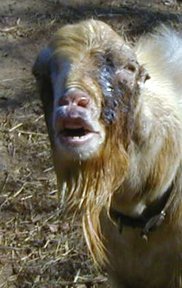
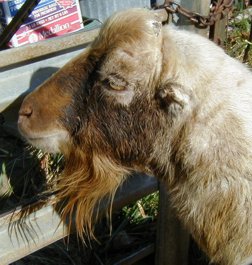
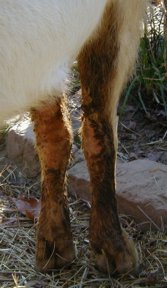
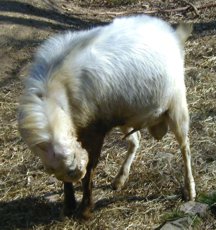
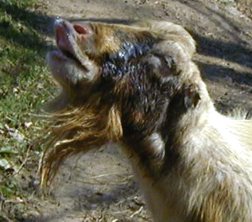 Taking a good whiff after peeing on his face.
Surplus killing or "excessive killing" and "henhouse syndrome"
4:11 PM | BY ZeroDivide
EDIT
Surplus killing is a common behavior exhibited by predators, including humans, in which they kill more prey than they can immediately eat and then cache or abandon the remainder. For example, researchers in Canada's Northwest Territories once found the bodies of 34 neonatal caribou calves that had been killed by wolves and scattered, some half-eaten and some completely untouched, over three square kilometres.[1] In Australia, over several days a single fox once killed eleven wallabies and 74 penguins, eating almost none. Up to 19 spotted hyenas once killed 82 Thomson's gazelle and badly injured 27, eating just 16%.[2]
Surplus killing has been observed among zooplankton, damselfly naiads, predaceous mites, weasels, honey badgers, wolves, orcas, red foxes, leopards, lions, spotted hyenas, spiders, brown and black and polar bears,coyotes, lynx, mink, raccoons, dogs and house cats.
In surplus killing, predators eat only the most-preferred animals and animal parts. Bears engaging in surplus killing of salmon are likelier to eat unspawned fish because of their higher muscle quality, and high-energy parts such as brains and eggs.[2]
Surplus killing can deplete the overall food supply, waste predator energy and risk them being injured. Nonetheless, researchers say animals surplus kill whenever they can, in order to procure food for offspring and others, to gain valuable killing experience, and to create the opportunity to eat the carcass later when they are hungry again.[2][3]
There are many documented examples of animals caching surplus kills. For example, in late fall least weasels often surplus kill vole and then dig them up and eat them on winter days when it is too cold to hunt.[2] Surplus killing by wolves has mainly been observed when snow is unusually deep in late winter or early spring, and the wolves have frequently cached their prey for eating days or weeks later. On February 7, 1991, in Denali National Park, six wolves killed at least 17 caribou and left many untouched. By February 12, 30–95% of each carcass had been eaten or cached, and by April 16, several had been dug up and fed upon again.[4]
Surplus killing is also known as "excessive killing" and "henhouse syndrome".[2][5] The term was invented by Dutch biologist Hans Kruuk after studying spotted hyenas in Africa[6] and red foxes in England.
Cattle in religion
6:23 PM | BY ZeroDivide
EDIT
Cattle are considered sacred in world religions such as Hinduism, Jainism, Zoroastrianism and others. Earlier religions in Ancient Egypt, Ancient Greece, Ancient Israel and Ancient Rome held similar beliefs.
Due to the multiple benefits from cattle, there are varying beliefs about cattle in societies and religions. In some regions, especially Nepal and some states in India, the slaughter of cattle is prohibited and their meat may be taboo.
In Hinduism[edit]
Origins[edit]


The cow has been a symbol of wealth since ancient days. However, they were neither inviolable nor revered in the same way they are today.[1][2]
The cow was possibly revered because Hindus relied heavily on it for dairy products and for tilling the fields, and on cow dung as a source of fuel and fertilizer. Thus, the cow’s status as a 'caretaker' led to identifying it as an almost maternal figure (hence the termgau mata). In the olden days cattle being limited to select few fortunate folks, the cows enjoyed the status that gold or money enjoys today. In addition, it has been suggested by author and orator Terence McKenna that religious reverence for the cow is a result of early humankind's association of psilocybin mushroom with it, this association having developed as a result of the discovery of said mushrooms in the animal's excrement.[3]
Hinduism is based on the concept of omnipresence of the Divine and the presence of a soul in all creatures, including bovines. Thus, by that definition, killing any animal would be a sin: One would be obstructing the natural cycle of birth and death of that creature, and the creature would have to be reborn in that same form because of its unnatural death. Krishna, one of the incarnations of god in Hindu mythology (Avatar), tended cows. The cow and bull represent the symbol of Dharma. Reverence for cows and bulls is in the major texts of the Vedic religion.[4]
In South India and some parts of Sri Lanka, a cattle festival is celebrated. It is called as Mattu Pongal.
Sanskrit term[edit]
The most common word for cow is go, cognate with the English cow and Latin bos, all from Proto-Indo-European language (PIE) cognates *gwous. The Sanskrit word for cattle is paśu, from PIE *peḱu-. Other terms are dhenu cow and uks ox.
Milk cows are also called aghnya "that which may not be slaughtered".[5] Depending on the interpretation of terminology used for a cow, the cow may have been protected.
The cow in the Hindu scriptures[edit]
- Rig Veda