| Getting a buck: Often, people just starting out with goats think, "I should get a pair: a boy and girl". This is a natural way to think. But... bucks are totally different than does and are really not a good thing to get for someone first starting out (see below for more detailed information). We raised goats for about four years before we got our quality bucks. We started out with an inferior buck (please read Our First Goat), realized our mistake, got rid of him and then didn't get bucks again for 4 years. I speak from experience, it is much easier... and cheaper to take your does on "dates". Even if you think you are not interested in "papers" and "breeds", I always recommend that you try to "breed up". Use a good buck, with good genetics, that will improve your herd.
| ||||||
| Buck Behavior: | ||||||
| Bucks have their own special way of getting the ladies in the mood. Along with their smell and peeing habits (discussed above) they also have some certain behaviors that may seem odd, especially if you have never seen it before. These mannerisms are most often exhibited toward the doe in heat, but because breeding and dominance can be so closely related, you will also see does and wethers, as well as bucks asserting their dominance over each other (or you) by exhibiting these traits. Also, does in heat will exhibit these traits and we call this "acting bucky". These mannerisms are totally normal and the buck may try them on you as well as a doe. When a buck is "in the mood" he doesn't always care what sex or species he tries to breed. If a buck exhibits these traits at you, he may have a crush on you and you should be careful that he doesn't try to mount you when you aren't looking.
| ||||||
| "Should I keep him a buck or wether him" and "Should I buy that buck" Q&A: | ||||||
When do a really need to get a buck?We recommend, for most cases, that you hold off on getting your own buck until you have at least 6 does (depending on your particular situation, of course). Generally, this is really the only time a buck really approaches paying for himself. Remember, most of the year, he is doing nothing but eating and taking up space, but you still must properly feed him, house him and take care of all his health needs. This can add up to a lot of time and money. For the first couple of our goats keeping years we would drive as far as two hours, one way, over the mountains, to breed our does. This was more cost effective at the time than actually having our own buck. But, as our herd grew, it because obvious when it was time for us to get our own bucks (we started with two).Just because he has a penis is not a good enough reason to keep/buy a buck. As stated above: "The buck is half your herd". You are basing the future of your herd on this animal. You need to consider, will he improve your herd or will he have a negative effect. Just making more kids is not enough. If you are going to keep goats... any kind of goats, with papers or no papers, there is no reason why you shouldn't try to improve them. To improve your herd, you need a quality buck.Where will you keep your buck? IMPORTANT: We very strongly recommend that bucks be housed separate from your does. This is the only way you can have control over your breeding. If you "run" the buck with the does, you will have no idea when your does are going to kid. Due to this, you will not be prepared for kidding and you run the risk of loosing the kids, because you were not their the assist if needed.Do you want papers? Many people do not care whether their buck is registered or not. This is a personal choice. The first year we kept a buck, we did not worry about a buck having papers, and we have regretted it ever since. Keep in mind, it takes just as much time and money to raise a registered goat as a non-registered goat, the big difference is the price you will get for them when you go to sell them. You just cannot ask for, and expect to get, top dollar for a goat without papers.Should you get more than one? It sound extravagant, but to avoid Inbreeding, if you are going to keep one buck, you should conceder getting two bucks (since the one will need company anyway). This way you are not forced to keep breeding the same buck to all your does every year.How to choose a buck to breed your does to: Please read the information presented HERE. | ||||||
| Breeding: | ||||||
What age can a buck breed?Believe it or not, a little buck can, and will, breed a female at 2 months of age, this includes his mother and 2 month old sister!At what age should I remove the buckling from the does? You should remove bucks from all does at two months of age (unless you want everyone to get pregnant in a totally disorganized manner). Husbandry
Husbandry, or animal care and use, varies by region and culture. The particular housing used for goats depends not only on the intended use of the goat, but also on the region of the world where they are raised. Historically, domestic goats were generally kept in herds that wandered on hills or other grazing areas, often tended by goatherds who were frequently children or adolescents, similar to the more widely known shepherd. These methods of herding are still used today.
In some parts of the world, especially Europe and North America, distinct breeds of goats are kept for dairy (milk) and for meat production. Excess male kids of dairy breeds are typically slaughtered for meat. Both does and bucks of meat breeds may be slaughtered for meat, as well as older animals of any breed. The meat of older bucks (more than one year old) is generally considered not desirable for meat for human consumption. Castration at a young age prevents the development of typical buck odor.
Dairy goats are generally pastured in summer and may be stabled during the winter. As dairy does are milked daily, they are generally kept close to the milking shed. Their grazing is typically supplemented with hay and concentrates. Stabled goats may be kept in stalls similar to horses, or in larger group pens. In the US system, does are generally rebred annually. In some European commercial dairy systems, the does are bred only twice, and are milked continuously for several years after the second kidding.
Meat goats are more frequently pastured year-round, and may be kept many miles from barns. Angora and other fiber breeds are also kept on pasture or range. Range-kept and pastured goats may be supplemented with hay or concentrates, most frequently during the winter or dry seasons. |
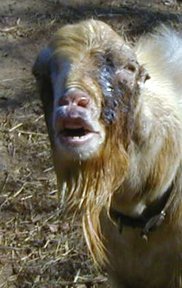
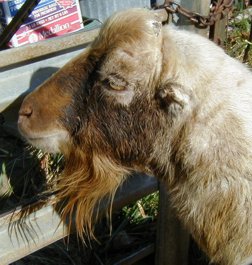
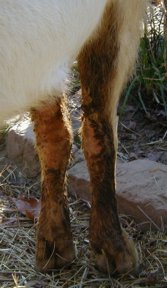
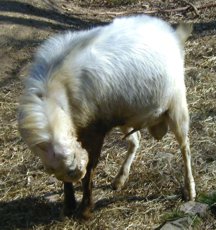
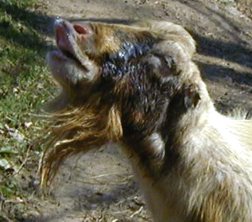 Taking a good whiff after peeing on his face.


With its pure white plumage contrasted by its black flight feathers and its yellow naked face, the Egyptian Vulture is one of the most easily recognizable birds of the Old World. Soaring on warm air currents with its broad wings, its unmistakable presence has been noted and celebrated through the history of human civilization. From southern Europe to Africa and the Middle East to India, this vulture is culturally significant in all the places where it calls home.
As its name suggests, the Egyptian Vulture was the sacred animal of the ancient Pharaohs; its appearance is immortalized in the Egyptian hieroglyphic alphabet as the letter A. Since the ancient Egyptians thought that all vultures were female and were spontaneously born from eggs without the intervention of a male, they linked these animals to purity and motherhood. In actuality, both genders happen to have the same appearance, the only difference being the larger size of the female. Nonetheless, they were held sacred to the mother goddess Isis; they were also elevated to the rank of deity in their own right as Nekhbet, patron of Upper Egypt and nurse of the Pharaoh. The priestesses of Nekhbet wore garments of white vulture feathers, and the goddess herself was often portrayed as a vulture-headed woman, her wings spread to provide protection, a circlet in her claws - the shen, symbol of infinity. Her cult was in fact linked to the eternal cycle of death and rebirth because of the vulture's role in the food chain as a scavenger and its supposed parthenogenesis; Nekhbet was venerated as the mother of mothers, who existed from the beginning.
Although the vultures carry the most weight in ancient Egyptian mythology, they are also important in other cultures. They appear in Greek mythology, where Zeus transformed two enemies - Aegypius and Neophron - into vultures: the former became a Bearded Vulture, and the latter an Egyptian Vulture. This became the source of the Egyptian Vulture's Latin name, Neophron percnopterus. Since these birds are summer visitors to Europe, they are considered a symbol of spring in Greece and in the Balkans.
In Turkey and Bulgaria, the Egyptian Vulture is commonly referred to asakbuba, "white father". There is a story about one of these birds saving Muhammad from the claws of the golden eagle; according to this legend, the vulture was rewarded with eternal life and gained its white plumage as a symbol of purity, wisdom, and bravery.
The Egyptian Vulture also appears in the Bible with the name ofrâchâm, often translated as "gier-eagle". It is only mentioned as an "unclean" bird that should not be eaten; in actuality, the Egyptian Vulture is a very clean animal, as its feathers are disinfected by the UV light of the sun during flight, and its stomach acid kills off any bacteria it might have ingested. In spite of this unfair reputation, this animal wasn't considered all bad. In fact, its name contains the root for "love": since these birds are almost always seen in mated pairs, the Hebrew thought of them as committed to each other.
The Egyptian Vulture was also considered to be a good bird in India.There is a story about two birds that visited the temple of Thirukkalukundram ("hill of sacred vultures") daily for centuries: they would appear at 11 o'clock in the morning, and were ceremonially fed sweet rice and other delicacies by the priests. According to a myth, the two birds used to be sages cursed by Shiva to live as vultures, and were visiting the temple in penance. Egyptian Vultures used to be rather common in India; what makes this case so special, however, is that it was always a pair of vultures that would visit the temple - never more. Although it is true that two birds were indeed regular visitors to the temple and photos exist of them, we can easily suppose that they were multiple generations of vultures and not incredibly long-lived individuals.
Birds in general were held in high regard by ancient Etruscan and Roman culture, where they were considered messengers of the gods. Their attempts to detect the tides of good and bad luck involved a particular form of divination, called augury, based on reading the flight of birds. One such instance of augury appears in the foundation myth of Rome, when Romulus and Remus were arguing over which hill the new city would be built on and who was to be king; they decided to settle their argument by observing the flight of vultures. The high regard in which the Egyptian Vulture was held seeps through time to its modern Italian name, "capovaccaio", which means "master of cows" - a name given because of the bird's tendency to fly together with cattle. Although the Egyptian Vulture is often a scavenger, it is also an opportunist that will eat about anything in its reach, including other animals' excrement. This is why it is particularly interested in following cows. To people, this might seem like a disgusting behavior, but the vulture is equipped with a digestive system that allows it to absorb nutrients from manure, and it is thought that the carotenoid pigments in the excrement are what give the bright yellow color to its skin. In Spain, this gives it the much less reverential names of churretero and moñiguero, "dung-eater".
Its feeding habits also reveal another aspect of this creature: its intelligence. The Egyptian Vulture seems to have a somewhat curious expression to its eyes, and is in fact a smart animal, being one of the few birds to use tools. When a vulture finds a large egg, it looks for a stone that it can hold in its bill, and repeatedly slams it against the egg until it cracks. Vultures have also been observed using twigs as tools to spin wool that they then use as lining for their nests, further showing that "bird-brained" should really be changed into a compliment.
It is saddening that such an amazing animal, and one that bears such a cultural significance through history, is currently threatened by human activities. In the last fifty years there has been a sharp decline in its numbers, and the Egyptian Vulture is currently in the IUCN Red List of Threatened Species. The population of these birds has halved in most of its range since 1980. The causes of this lightning-fast disappearance have to do with pesticide poisoning, lead poisoning, collision with wind turbines, poorly designed power lines, the use of antibiotics on cattle, poaching, and habitat destruction. A few conservation projects have been started, and the Egyptian Vulture is a protected species under many legislations. However, seen how its quick decline is not stopping, these efforts are not nearly enough. If the trend is not reversed, there is a very real chance that all that will be left of this strikingly beautiful animal will be just ancient myths.


