Article by Grace Powers
When Frederic Bartholdi unveiled his colossal sculpture of the Statue of Liberty in 1886, spectators wanted to know who the masculine-featured diva was that served as his model. Was she his mother? His wife? His mistress, perhaps? Some speculated that she was the Egyptian goddess Isis, Mary Magdalene or the Biblical Whore of Babylon.
Others argued that Lady Liberty wasn’t a lady at all, but a man in drag. Bartholdi took the secret of her identity to his grave....but he left behind evidence.
HER BODY
Bartholdi shamelessly copied three designs from other sculptors for his American monument - one for her body, one for her pedestal and another for her head. His first copied design was the Colossus of Rhodes built in 304 BC as a celebration of freedom. Like the statue of liberty, it rose to the same height from head to toe and loomed over the entrance to another busy harbor on the island of Rhodes. The Statue of Liberty’s radiating crown with its seven giant sun-ray spikes is a carbon copy of the Rhodian sculpture built in honor of the Sun God, Helios. His seven rays symbolized the seven seas and seven continents over which he ruled. It took twelve years for the sculptor, Chares of Lindos, to build his giant ‘wonder of the ancient world’. Fifty-six years later, the island of Rhodes was struck by a violent earthquake that shook the giant off his feet and cast him down like a child’s toy into a broken and ruined heap.
HER PEDESTAL
To build the pedestal, stairway, observation deck and torch, Bartholdi copied another ‘wonder of the ancient world’ - the four hundred foot tall Pharos lighthouse of Alexandria, Egypt which had been commissioned by Ptolemy I, in 290BC. Tourists could climb up to the observation platform at the first le vel and continue climbing to the very top of the tower where a smaller balcony showcased the breathtaking panorama of sea and sky. For 1500 years, it stood on Egypt’s island of Pharos in Alexandria Harbor. The multiple mirrors at the top of the lighthouse reflected sunlight during the day. At night, its leaping flames licked the star studded sky and guided seafarers into Alexandria harbor.
HER HEAD
To create his American Statue, Bartholdi used the same mystery woman that he had sketched for his failed Egyptian statue.
THE FAME
Investigative reporters in America had a reputation for digging up dirt on people. Bartholdi feared they would dig up his dirty little secret that the Statue of Liberty was a recycled version of his failed Egyptian statue. To cover up the truth, he altered the robe and hairstyle on his American statue and added spiked rays emanating from her crown like the Colossus of Rhodes.
Bartholdi built a four-foot clay miniature model first, then a complete nine foot tall (2.85 meters) cast in plaster, followed by four more proportional enlargements until it had grown to one-fourth the size of his planned masterpiece. With each increase in size, nine thousand mathematical calculations and measurements had to be painstakingly made.
Freemason Gustave Eiffel designed and engineered the intricate skeleton for the statue using four gigantic steel supports as the main structural framework. Eiffel’s claim to fame was his phallic 984-foot tall Eiffel Tower of iron and steel. By 1876, Liberty’s thirty-foot long arm traveled to the United States with Bartholdi and turned him into a household name across America. Once Americans learned that they would be able to climb up to the balcony of the sky high torch for a mere fifty cents and gaze at the million dollar view of New York harbor, they were sold on it. The gleaming copper head also went on display creating an even bigger sensation but not big enough to solve the unending problem of raising the money to complete it.
THE LIE
The American press turned ugly. Reporters tore into Bartholdi like a pack of pit bulls when they discovered that the Statue of Liberty was a dusted off version of his rejected Egyptian statue. “The Statue is not a statue of liberty at all,” they protested. “It has nothing whatsoever to do with liberty!”
By trivializing the facts, Bartholdi bobbed and weaved, ducked and side stepped the accusations. “My Egyptian statue for the Suez canal ended then and there. Any resemblance it may have had to New York’s Statue of Liberty is purely coincidental”, defended Bartholdi in broken english. The American press didn’t buy it. They reported that the French sculptor had outright lied to the American people when he told them he had fashioned only "one" terra-cotta model for the Suez Canal project. In reality, he had made five! All of them were prototypes of the future Statue of Liberty, some with a torch or lantern in her left hand, some with it in her right hand. In all of them, she is wearing a long Greek chiton (χιτών). Over the chiton, she is wearing another garment, called the himation (ἱμάτιον).
Bartholdi had already admitted on record that the model for the Egyptian project was an Egyptian woman. His earliest 1870 model with the torch-lifting pose was the most damning evidence. It proved beyond a shadow of a doubt that the American statue, ‘Liberty Enlightening the World’, was a dusted off version of the aborted Egypt statue, ‘Egypt Bringing Light to Asia’. Both were colossal, robed, torch-bearing women serving as lighthouses, both were sited for key points astride major world waterways and both passed their ‘symbolic messages’ from one continent to another.
To further Americanize his recycled Egyptian statue, Bartholdi added the date of the American Declaration of Independence onto the cover of the book held in the statue’s left hand - July IV MDCCLCCVI. No one asked why the date was written in ancient Roman numerals. No one clued in to the connection between Lady Liberty and the ancient Roman goddess ‘Libertas’ which is latin for ‘Liberty’.
PIGGYBANKS OF AMERICA
Because of the stellar costs of the French gift to America, the brotherhood decided that French and American citizens should foot the bill. French citizens would pay for the statue. American citizens would pay for the pedestal and foundation. Masonic brothers from both France and the United States formed a fund-raising committee called the Franco-American Union. By the time Libertas was ready to be shipped from France, little progress had been made on the other side of the Atlantic. Controversy continued to swirl over the origin of the statue and its mammoth costs.
Some American citizens had the good sense to ask, “why does the gift’s pedestal cost as much as the gift itself and why should we foot the bill for our own gift?” Americans living outside of New York considered it New York's statue. "Let New York pay for it!" To make matters worse, the wealthy French and American elite were allergic to the word ‘non-profit’ and wanted no part of the costly ‘non-profit’ project.
Public apathy in America became almost as monumental as the gift itself. By 1884, after years of pedestal fund-raising, only $182,491 had been raised. The fundraising committee brainstormed the idea of a public lottery. They pried open public wallets with prizes that included two works of art by Bartholdi himself. In another scheme, they sold signed clay models of his statue to both the French and American public. By the end of 1879, about 250,000 francs (approximately $750,000 U.S.) had been raised but ‘completing her’ in time for America's 100th anniversary was an impossible dream.
Lady Liberty’s trip to America had to wait until she had a pedestal to stand on. In the meantime, she was grounded in Paris. Joseph Pulitzer, a Jewish multimillionaire and owner of the American financial newspaper, The World, saw a golden opportunity to increase the size of his newspaper circulation. “Let us not wait for the millionaires to give this money,” said the multi-millionaire. “It is not a gift from the millionaires of France to the millionaires of America, but a gift of the whole people of France to the whole people of America." Pulitzer’s World newspaper circulation surged by almost 50,000 copies and single-dollar donations from grandmothers and pennies from the piggybanks of America’s schoolchildren began trickling in.
STRANGE RITUALS
By the time pedestal construction got underway, work had to be delayed until the cornerstone was laid in strict accordance with Masonic rituals. By American tradition, cornerstones of major public and private buildings like the Washington monument had to be "consecrated" first with full Masonic rites and ceremony. The tradition began in 1793 when Freemasonic U.S. President George Washington personally laid the cornerstone of the Capitol Building with the assistance of the Masonic Grand Lodge of Maryland.
It rained cats and dogs on August 5, 1884, the day of the private cornerstone ceremony. The elite guests boarded a boat draped with the red, white and blue flags of France and the United States. The vessel ferried approximately one hundred Freemason members of the Grand Lodge of New York, U.S. civic officials and the visiting French Masonic Grand Officers to Liberty (Bedloe's) Island. A United States Army band played the French National Anthem, "La Marseillaise," followed by "Hail Columbia" which named “the band of brothers joined” in its lyrics.
MYSTERY BOX
The cornerstone was laid on the raised northeast corner of Liberty’s pedestal with the same trowel used by Masonic President George Washington. Masonic men in black lowered a mysterious copper box inside the cornerstone containing a collection of strange mementos; twenty bronze medals of Masonic Presidents including Washington, Monroe, Jackson, Polk, Buchanan, Johnson and Garfield, a portrait of sculptor Bartholdi, a list on parchment of the Masonic Grand Lodge officers and a medal commemorating the erection of an Egyptian obelisk in Central Park at 81st street. Like the Washington monument, obelisks are tall, narrow, needle-like monuments built in honor of the Egyptian sun God ‘Amen’ (also spelled ‘Amun’ or ‘Amon’) meaning ‘the hidden one’.
No one questioned why a medal commemorating the erection of an Egyptian obelisk was placed inside the box. After the cornerstone was found to be square, level and plumb, the Freemason Grand Master applied the mortar and the stone containing the Masonic box of strange mementos was lowered into place. The Grand Master struck the stone three times with a gavel and declared it duly laid. Then the elements of "consecration" were presented - corn, wine, and oil known to be the "master's wages" in the days of Hebrew King Solomon.
Lady Liberty
6:01 AM | BY ZeroDivide
EDIT
Filiki Eteria or (Secret) Society of Friends
4:02 PM | BY ZeroDivide
EDIT
 | |
| Motto | Freedom or Death |
|---|---|
| Formation | 1814 |
| Purpose | Preparation of the Greek War of Independence |
| Location | |
Key people
| Emmanuil Xanthos (founder) Nikolaos Skoufas (founder) Athanasios Tsakalov (founder) Alexander Ypsilantis (leader) Alexandros Mavrokordatos Theodoros Kolokotronis Anthimos Gazis Germanos III of Old Patras Emmanouel Pappas |
Filiki Eteria or Society of Friends (Greek: Φιλική Εταιρεία or Εταιρεία των Φιλικών) was a secret 19th-century organization whose purpose was to overthrow the Ottoman rule ofGreece and establish an independent Greek state.[1] Society members were mainly young Phanariot Greeks from Russia and local chieftains from Greece. One of its leaders wasAlexander Ypsilantis.[2] The Society initiated the Greek War of Independence in the spring of 1821.[3]
Contents
[hide]Translations and transliterations[edit]
The direct translation of the word "Filiki" is "Friendly" and the direct translation of the word "Eteria" is "Society" (also "Company" or "Association"). The name of Filiki Eteria has been transliterated in numerous publications with combinations of Filiki, Filike, Philiki, Philike with Eteria, Etairia, Etaireia, Etereia, Hetairia.
Foundation[edit]

In the context of ardent desire for independence from Turkish occupation, and with the explicit influence of similar secret societies elsewhere in Europe, three Greeks came together in 1814 in Odessa to decide the constitution for a secret organization in freemasonic fashion. Its purpose was to unite all Greeks in an armed organization to overthrow Turkish rule. The three founders were Nikolaos Skoufas from the Arta province, Emmanuil Xanthos from Patmos andAthanasios Tsakalov from Ioannina.[1] Soon after they initiated a fourth member, Panagiotis Anagnostopoulos from Andritsaina.

Skoufas liaised with Konstantinos Rados who was initiated into Carbonarism. Xanthos was initiated into a Freemasonic Lodge at Lefkada ("Society of Free Builders of Saint Mavra"), while Tsakalov was a founding member of the Hellenoglosso Xenodocheio (Greek: Ελληνόγλωσσο Ξενοδοχείο, meaning Greek-speaking Hotel) an earlier but unsuccessful society for the liberation of Greece.[4]
At the start, between 1814 and 1816, there were roughly twenty members. During 1817, the society initiated members from the diaspora Greeks of Russia and the Danubian Principalities of Moldavia and Wallachia. The lord (hospodar) of Moldavia Michael Soutzos himself, became a member.[5] Massive initiations began only in 1818 and by early 1821, when the Society had expanded to almost all regions of Greece and throughout Greek communities abroad, the membership numbered in thousands.[6] Among its members were tradesmen, clergy, Russian consuls, Ottoman officials from Phanar andSerbs one of them the revolutionary Karageorge.[6][7] Members included primary instigators of the revolution, notably Theodoros Kolokotronis, Odysseas Androutsos, Dimitris Plapoutas and the metropolitan bishop Germanos of Patras.
Hierarchy and initiation[edit]


Filiki Eteria was strongly influenced by Carbonarism and Freemasonry.[4] The team of leaders was called the "Invisible Authority" (Αόρατος Αρχή) and from the start it was shrouded in mystery, secrecy and glamour. It was generally believed that a lot of important personalities were members, not only eminent Greeks, but also notable foreigners such as the Tsar of Russia Alexander I. The reality was that initially, the Invisible Authority comprised only the three founders. From 1815 until 1818, five more were added to the Invisible Authority, and after the death of Skoufas' another three more. In 1818, the Invisible Authority was renamed to the "Authority of Twelve Apostles" and each Apostle shouldered the responsibility of a separate region.
The organisational structure was pyramid-like with the "Invisible Authority" coordinating from the top. No one knew or had the right to ask who created the organisation. Commands were unquestionably carried out and members did not have the right to make decisions. Members of the society came together in what was called a "Temple" with four levels of initiation: a) Brothers(αδελφοποιητοί) or Vlamides (βλάμηδες), b) the Recommended (συστημένοι), γ) the Priests (ιερείς) and d) the Shepherds (ποιμένες).[8] The Priests were charged with the duty of initiation.[9]
| “ | I swear in the name of truth and justice, before the Supreme Being, to guard, by sacrificing my own life, and suffering the hardest toils, the mystery, which shall be explained to me and that I shall respond with the truth whatever I am asked. | ” |
—The Oath of Initiation in to the Filiki
| ||
When the Priest approached a new member, it was first to make sure of his patriotism and catechize him in the aims of society; the last stage was to put him under the lengthy principal oath, called the Great Oath (Μέγας Όρκος).[9] Much of the essence of it was contained in its conclusion:[8]
| “ | Last of all, I swear by Thee, my sacred and suffering Country,— I swear by thy long-endured tortures,— I swear by the bitter tears which for so many centuries have been shed by thy unhappy children, by my own tears which I am pouring forth at this very moment,— I swear by the future liberty of my countrymen, that I consecrate myself wholly to thee; that hence forward thou shall be the cause and object of my thoughts, thy name the guide of my actions, and thy happiness the recompense of my labours. | ” |
—Conclusion of the Great Oath of the Filiki
| ||
When the above was administered the Priest then uttered the words of acceptance of the novice as a new member:[9]
| “ | Before the face of the invisible and omnipresent true God, who in his essence is just, the avenger of transgression, the chastizer of evil, by the laws of the Eteria Filiki, and by the authority with which its powerful priests have intrusted me, I receive you, as I was myself received, into the bosom of the Eteria. | ” |
—words of acceptance into Filiki
| ||
Afterwards the initiated were considered neophyte members of the society, with all the rights and obligations of his rank. The Priest immediately had the obligation to reveal all the marks of recognition between the Vlamides or Brothers. Vlamides and Recommended were unaware of the revolutionary aims of the organisation. They only knew that there existed a society that tried hard for the general good of the nation, which included in its ranks important personalities. This myth was propagated deliberately, in order to stimulate the morale of members and also to make proselytism easier.
The Ancient Mysteries and Secret Societies
8:15 AM | BY ZeroDivide
EDIT
The Ancient Mysteries and Secret Societies
Which Have Influenced Modern Masonic Symbolism
p. 21WHEN confronted with a problem involving the use of the reasoning faculties, individuals of strong intellect keep their poise, and seek to reach a solution by obtaining facts bearing upon the question. Those of immature mentality, on the other hand, when similarly confronted, are overwhelmed. While the former may be qualified to solve the riddle of their own destiny, the latter must be led like a flock of sheep and taught in simple language. They depend almost entirely upon the ministrations of the shepherd. The Apostle Paul said that these little ones must be fed with milk, but that meat is the food of strong men. Thoughtlessness is almost synonymous with childishness, while thoughtfulness is symbolic of maturity.
There are, however, but few mature minds in the world; and thus it was that the philosophic-religious doctrines of the pagans were divided to meet the needs of these two fundamental groups of human intellect--one philosophic, the other incapable of appreciating the deeper mysteries of life. To the discerning few were revealed theesoteric, or spiritual, teachings, while the unqualified many received only the literal, or exoteric, interpretations. In order to make simple the great truths of Nature and the abstract principles of natural law, the vital forces of the universe were personified, becoming the gods and goddesses of the ancient mythologies. While the ignorant multitudes brought their offerings to the altars of Priapus and Pan (deities representing the procreative energies), the wise recognized in these marble statues only symbolic concretions of great abstract truths.
In all cities of the ancient world were temples for public worship and offering. In every community also were philosophers and mystics, deeply versed in Nature's lore. These individuals were usually banded together, forming seclusive philosophic and religious schools. The more important of these groups were known as the Mysteries. Many of the great minds of antiquity were initiated into these secret fraternities by strange and mysterious rites, some of which were extremely cruel. Alexander Wilder defines the Mysteries as "Sacred dramas performed at stated periods. The most celebrated were those of Isis, Sabazius, Cybele, and Eleusis." After being admitted, the initiates were instructed in the secret wisdom which had been preserved for ages. Plato, an initiate of one of these sacred orders, was severely criticized because in his writings he revealed to the public many of the secret philosophic principles of the Mysteries.
Every pagan nation had (and has) not only its state religion, but another into which the philosophic elect alone have gained entrance. Many of these ancient cults vanished from the earth without revealing their secrets, but a few have survived the test of ages and their mysterious symbols are still preserved. Much of the ritualism of Freemasonry is based on the trials to which candidates were subjected by the ancient hierophants before the keys of wisdom were entrusted to them.
Few realize the extent to which the ancient secret schools influenced contemporary intellects and, through those minds, posterity. Robert Macoy, 33°, in his General History of Freemasonry, pays a magnificent tribute to the part played by the ancient Mysteries in the rearing of the edifice of human culture. He says, in part: "It appears that all the perfection of civilization, and all the advancement made in philosophy, science, and art among the ancients are due to those institutions which, under the veil of mystery, sought to illustrate the sublimest truths of religion, morality, and virtue, and impress them on the hearts of their disciples.* * * Their chief object was to teach the doctrine of one God, the resurrection of man to eternal life, the dignity of the human soul, and to lead the people to see the shadow of the deity, in the beauty, magnificence, and splendor of the universe."
With the decline of virtue, which has preceded the destruction of every nation of history, the Mysteries became perverted. Sorcery took the place of the divine magic. Indescribable practices (such as the Bacchanalia) were introduced, and perversion ruled supreme; for no institution can be any better than the members of which it is composed. In despair, the few who were true sought to preserve the secret doctrines from oblivion. In some cases they succeeded, but more often the arcanum was lost and only the empty shell of the Mysteries remained.
Thomas Taylor has written, "Man is naturally a religious animal." From the earliest dawning of his consciousness, man has worshiped and revered things as symbolic of the invisible, omnipresent, indescribable Thing, concerning which he could discover practically nothing. The pagan Mysteries opposed the Christians during the early centuries of their church, declaring that the new faith (Christianity) did not demand virtue and integrity as requisites for salvation. Celsus expressed himself on the subject in the following caustic terms:
"That I do not, however, accuse the Christians more bitterly than truth compels, may be conjectured from hence, that the cryers who call men to other mysteries proclaim as follows: 'Let him approach whose hands are pure, and whose words are wise.' And again, others proclaim: 'Let him approach who is pure from all wickedness, whose soul is not conscious of any evil, and who leads a just and upright life.' And these things are proclaimed by those who promise a purification from error. Let us now hear who those are that are called to the Christian mysteries: Whoever is a sinner, whoever is unwise, whoever is a fool, and whoever, in short, is miserable, him the kingdom of God will receive. Do you not, therefore, call a sinner, an unjust man, a thief, a housebreaker, a wizard, one who is sacrilegious, and a robber of sepulchres? What other persons would the cryer nominate, who should call robbers together?"
It was not the true faith of the early Christian mystics that Celsus attacked, but the false forms that were creeping in even during his day. The ideals of early Christianity were based upon the high moral standards of the pagan Mysteries, and the first Christians who met under the city of Rome used as their places of worship the subterranean temples of Mithras, from whose cult has been borrowed much of the sacerdotalism of the modem church.
The ancient philosophers believed that no man could live intelligently who did not have a fundamental knowledge of Nature and her laws. Before man can obey, he must understand, and the Mysteries were devoted to instructing man concerning the operation of divine law in the terrestrial sphere. Few of the early cults actually worshiped anthropomorphic deities, although their symbolism might lead one to believe they did. They were moralistic rather than religionistic; philosophic rather than theologic. They taught man to use his faculties more intelligently, to be patient in the face of adversity, to be courageous when confronted by danger, to be true in the midst of temptation, and, most of all, to view a worthy life as the most acceptable sacrifice to God, and his body as an altar sacred to the Deity.
Sun worship played an important part in nearly all the early pagan Mysteries. This indicates the probability of their Atlantean origin, for the people of Atlantis were sun worshipers. The Solar Deity was usually personified as a beautiful youth, with long golden hair to symbolize the rays of the sun. This golden Sun God was slain by wicked ruffians, who personified the evil principle of the universe. By means of certain rituals and ceremonies, symbolic of purification and regeneration, this wonderful God of Good was brought back to life and became the Savior of His people. The secret processes whereby He was resurrected symbolized those cultures by means of which man is able to overcome his lower nature, master his appetites, and give expression to the higher side of himself. The Mysteries were organized for the purpose of assisting the struggling human creature to reawaken the spiritual powers which, surrounded by the flaming
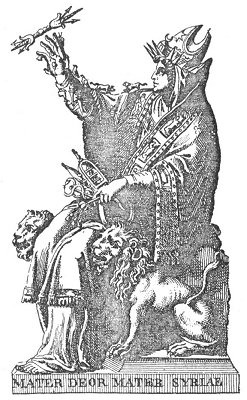
Click to enlarge
A FEMALE HIEROPHANT OF THE MYSTERIES.
From Montfaucon's Antiquities.
This illustration shows Cybele, here called the Syrian Goddess, in the robes of a hierophant. Montfaucon describes the figure as follows: "Upon her head is an episcopal mitre, adorned on the lower part with towers and pinnacles; over the gate of the city is a crescent, and beneath the circuit of the walls a crown of rays. The Goddess wears a sort of surplice, exactly like the surplice of a priest or bishop; and upon the surplice a tunic, which falls down to the legs; and over all an episcopal cope, with the twelve signs of the Zodiac wrought on the borders. The figure hath a lion on each side, and holds in its left hand a Tympanum, a Sistrum, a Distaff, a Caduceus, and another instrument. In her right hand she holds with her middle finger a thunderbolt, and upon the same am animals, insects, and, as far as we may guess, flowers, fruit, a bow, a quiver, a torch, and a scythe." The whereabouts of the statue is unknown, the copy reproduced by Montfaucon being from drawings by Pirro Ligorio.p. 22
ring of lust and degeneracy, lay asleep within his soul. In other words, man was offered a way by which he could regain his lost estate. (See Wagner's Siegfried.)
In the ancient world, nearly all the secret societies were philosophic and religious. During the mediæval centuries, they were chiefly religious and political, although a few philosophic schools remained. In modern times, secret societies, in the Occidental countries, are largely political or fraternal, although in a few of them, as in Masonry, the ancient religious and philosophic principles still survive.
Space prohibits a detailed discussion of the secret schools. There were literally scores of these ancient cults, with branches in all parts of the Eastern and Western worlds. Some, such as those of Pythagoras and the Hermetists, show a decided Oriental influence, while the Rosicrucians, according to their own proclamations, gained much of their wisdom from Arabian mystics. Although the Mystery schools are usually associated with civilization, there is evidence that the most uncivilized peoples of prehistoric times had a knowledge of them. Natives of distant islands, many in the lowest forms of savagery, have mystic rituals and secret practices which, although primitive, are of a decided Masonic tinge.
THE DRUIDIC MYSTERIES OF BRITAIN AND GAUL
MASONIC PAPERS by Dr ANDREW PRESCOTT GODFREY HIGGINS AND HIS ANACALYPSIS
8:12 AM | BY ZeroDivide
EDIT
GODFREY HIGGINS AND HIS ANACALYPSIS
In 1813, a Yorkshire magistrate found the defendant in an assault case to be insane, and ordered
that he should be sent to the public lunatic asylum in York. Sometime afterwards, the magistrate
found that the man had been badly treated while he was in the asylum, and decided to investigate
conditions there. He was appalled by what he found: ‘When the door was opened, I went into the
passage and found four cells, I think, of about eight feet square, in a very horrid and filthy
situation. The straw appeared to be almost saturated with urine and excrement. There was some
bedding laid upon the straw in one cell, in the others only loose straw … The walls were daubed
with excrement … I then went upstairs and [the keeper] showed me a room which I caused him
to measure, and the size of which he told me was twelve feet by seven feet and ten inches, and in
there were thirteen women…’
The magistrate also found evidence of massive embezzlement of funds by the asylum’s staff, the
excessive use of chains and other forms of restraint, and the rape and even murder of some of the
inmates. He wrote to the press exposing the conditions within the asylum. This prompted a
campaign to reform the asylum and led to a parliamentary commission to investigate the
conditions in local lunatic asylums. The campaign to expose the abuses at York is considered a
turning point in the modern history of the treatment of mental illness.
The kindhearted Yorkshire magistrate who became the champion of the inmates of the York
asylum was Godfrey Higgins (17731833), one of the most remarkable English freemasons, now
largely forgotten. Higgins was a member of the Yorkshire gentry whose family owned the house of
Skellow Grange in Doncaster. Higgins studied at Cambridge and was admitted to the Inner Temple
in 1794, but not called to the bar. When Napoleon threatened invasion, he joined the 3rd West
Yorkshire Militia, and served as a major from 180311. Eventually, illhealth forced him to resign
his commission. He took an interest in radical politics, campaigning for the abolition of the Corn
Laws and the laws protecting game. He was also active in promoting the cause of parliamentary
reform. In 1831, Higgins was asked by some of the radical political unions in Yorkshire to stand for
parliament, but he refused.
The reason for Higgins’s reluctance to stand for parliament was that he was immersed in some
demanding studies. As a result of his illness, he determined to devote himself to the study of
philosophy. He decided to investigate the evidence for Christianity. This developed into a study of
all religions, and eventually became an investigation of the origins of language and nations. Higgins
ruefully recollected that ‘Ultimately I came to a resolution to devote six hours a day to this pursuit
for ten years. Instead of six hours daily for ten years, I believe I have, upon the average, applied
myself to it for nearly ten hours daily for almost twenty years. In the first ten years of my search I
may fairly say, I found nothing which I sought for; in the later part of the twenty, the quantity of
matter has so crowded upon me, that I scarcely know how to dispose of it’.
Higgins’s publications on the history of religion nowadays appear extremely eccentric, but they are
important in understanding many aspects of British radical thought and have had a profound
influence on esoteric and new age movements right up to the present day. Higgins’s books
fascinated many masonic writers during the nineteenth century. Higgins himself became a
Freemason to further his researches, reporting his findings to the Duke of Sussex.
The Library and Museum of Freemasonry has recently purchased a remarkable copy of Higgins’s
magnum opus, Anacalypsis, which sheds new light on the means by which Higgins’s work was
circulated and received in British radical circles in the first part of the nineteenth century.
Moreover, this copy of Anacalypsis contains extraordinary new evidence showing how Higgins
formed a link between the highest echelons of English Freemasonry, including the Duke of Sussex
himself, and radical writers such as the notorious atheist Richard Carlile (17901843) who were at
that time publishing copies of masonic rituals and claiming that Freemasonry was a remnant of
true religion and Christianity was a blasphemous confidence trick.
In 1819, Carlile had been imprisoned in Dorchester gaol for publishing Thomas Paine’s Age of
Reason. Far from languishing in prison, Carlile used his imprisonment to continue his campaign for
freedom of speech, and published from his prison room his pioneering workingclass journal, The
Republican. In 1825, he devoted most of the twelfth volume of The Republican to an exposure of
masonic rituals. In its original form, Carlile’s attack on Freemasonry simply mocked a leisure
pursuit favoured by the aristocracy and middle classes. However, some years later, rereading
Thomas Paine’s essay on the origin of Freemasonry, Carlile realised that his initial dismissal of
Freemasonry had been overhasty. He wondered whether, as Paine suggested, Freemasonry might
contain elements of the ancient religion of which Christianity was a perversion. Reprinting his
original collection of masonic ritual as A Manual of Freemasonry, he argued that Freemasonry held
the key to recovering the ancient science of the zodiac which lay at the root of all religion. Carlile
was joined in his campaign to use Freemasonry to overthrow Christianity by Robert Taylor (1784
1844), a renegade clergyman known as the Devil’s Chaplain. Taylor preached sermons on the true
nature of Freemasonry, and with Carlile planned public performances of masonic rituals.
In the introduction to his Manual of Freemasonry, Carlile states that in 1830 Godfrey Higgins
‘observed to me, without explanation, that there were but two masons in England – himself and
the Duke of Sussex’. Carlile replied to Higgins that there were also two other masons, namely
Carlile and Taylor. Higgins ‘asked me to explain, on condition that he was not to commit himself by
any observation. I did so, as here set forth. He smiled and withdrew’. Carlile’s account of this
conversation is slightly mysterious. What did Higgins mean by his claim? What exactly were the
nature of Carlile’s links with Higgins, and how far was he influenced by Higgins’s work? Some
answers to these questions are provided by the Library and Museum of Freemasonry’s newlyacquired
copy of Anacalypsis.
In 1813, a Yorkshire magistrate found the defendant in an assault case to be insane, and ordered
that he should be sent to the public lunatic asylum in York. Sometime afterwards, the magistrate
found that the man had been badly treated while he was in the asylum, and decided to investigate
conditions there. He was appalled by what he found: ‘When the door was opened, I went into the
passage and found four cells, I think, of about eight feet square, in a very horrid and filthy
situation. The straw appeared to be almost saturated with urine and excrement. There was some
bedding laid upon the straw in one cell, in the others only loose straw … The walls were daubed
with excrement … I then went upstairs and [the keeper] showed me a room which I caused him
to measure, and the size of which he told me was twelve feet by seven feet and ten inches, and in
there were thirteen women…’
The magistrate also found evidence of massive embezzlement of funds by the asylum’s staff, the
excessive use of chains and other forms of restraint, and the rape and even murder of some of the
inmates. He wrote to the press exposing the conditions within the asylum. This prompted a
campaign to reform the asylum and led to a parliamentary commission to investigate the
conditions in local lunatic asylums. The campaign to expose the abuses at York is considered a
turning point in the modern history of the treatment of mental illness.
The kindhearted Yorkshire magistrate who became the champion of the inmates of the York
asylum was Godfrey Higgins (17731833), one of the most remarkable English freemasons, now
largely forgotten. Higgins was a member of the Yorkshire gentry whose family owned the house of
Skellow Grange in Doncaster. Higgins studied at Cambridge and was admitted to the Inner Temple
in 1794, but not called to the bar. When Napoleon threatened invasion, he joined the 3rd West
Yorkshire Militia, and served as a major from 180311. Eventually, illhealth forced him to resign
his commission. He took an interest in radical politics, campaigning for the abolition of the Corn
Laws and the laws protecting game. He was also active in promoting the cause of parliamentary
reform. In 1831, Higgins was asked by some of the radical political unions in Yorkshire to stand for
parliament, but he refused.
The reason for Higgins’s reluctance to stand for parliament was that he was immersed in some
demanding studies. As a result of his illness, he determined to devote himself to the study of
philosophy. He decided to investigate the evidence for Christianity. This developed into a study of
all religions, and eventually became an investigation of the origins of language and nations. Higgins
ruefully recollected that ‘Ultimately I came to a resolution to devote six hours a day to this pursuit
for ten years. Instead of six hours daily for ten years, I believe I have, upon the average, applied
myself to it for nearly ten hours daily for almost twenty years. In the first ten years of my search I
may fairly say, I found nothing which I sought for; in the later part of the twenty, the quantity of
matter has so crowded upon me, that I scarcely know how to dispose of it’.
Higgins’s publications on the history of religion nowadays appear extremely eccentric, but they are
important in understanding many aspects of British radical thought and have had a profound
influence on esoteric and new age movements right up to the present day. Higgins’s books
fascinated many masonic writers during the nineteenth century. Higgins himself became a
Freemason to further his researches, reporting his findings to the Duke of Sussex.
The Library and Museum of Freemasonry has recently purchased a remarkable copy of Higgins’s
magnum opus, Anacalypsis, which sheds new light on the means by which Higgins’s work was
circulated and received in British radical circles in the first part of the nineteenth century.
Moreover, this copy of Anacalypsis contains extraordinary new evidence showing how Higgins
formed a link between the highest echelons of English Freemasonry, including the Duke of Sussex
himself, and radical writers such as the notorious atheist Richard Carlile (17901843) who were at
that time publishing copies of masonic rituals and claiming that Freemasonry was a remnant of
true religion and Christianity was a blasphemous confidence trick.
In 1819, Carlile had been imprisoned in Dorchester gaol for publishing Thomas Paine’s Age of
Reason. Far from languishing in prison, Carlile used his imprisonment to continue his campaign for
freedom of speech, and published from his prison room his pioneering workingclass journal, The
Republican. In 1825, he devoted most of the twelfth volume of The Republican to an exposure of
masonic rituals. In its original form, Carlile’s attack on Freemasonry simply mocked a leisure
pursuit favoured by the aristocracy and middle classes. However, some years later, rereading
Thomas Paine’s essay on the origin of Freemasonry, Carlile realised that his initial dismissal of
Freemasonry had been overhasty. He wondered whether, as Paine suggested, Freemasonry might
contain elements of the ancient religion of which Christianity was a perversion. Reprinting his
original collection of masonic ritual as A Manual of Freemasonry, he argued that Freemasonry held
the key to recovering the ancient science of the zodiac which lay at the root of all religion. Carlile
was joined in his campaign to use Freemasonry to overthrow Christianity by Robert Taylor (1784
1844), a renegade clergyman known as the Devil’s Chaplain. Taylor preached sermons on the true
nature of Freemasonry, and with Carlile planned public performances of masonic rituals.
In the introduction to his Manual of Freemasonry, Carlile states that in 1830 Godfrey Higgins
‘observed to me, without explanation, that there were but two masons in England – himself and
the Duke of Sussex’. Carlile replied to Higgins that there were also two other masons, namely
Carlile and Taylor. Higgins ‘asked me to explain, on condition that he was not to commit himself by
any observation. I did so, as here set forth. He smiled and withdrew’. Carlile’s account of this
conversation is slightly mysterious. What did Higgins mean by his claim? What exactly were the
nature of Carlile’s links with Higgins, and how far was he influenced by Higgins’s work? Some
answers to these questions are provided by the Library and Museum of Freemasonry’s newlyacquired
copy of Anacalypsis.
Freemasonry's Connection To The Homosexual Movement
12:17 PM | BY ZeroDivide
EDIT
Freemasonry's Connection To The Homosexual Movement
(Note: Even though Pike is widely acknowledged to be the author of this book by both Masons and non-Masons alike, there is no mention of an author on the title page of the 1921 edition of the work I possess and from which I quote. Instead of an author's name, the page reads: "Prepared for the Supreme Council of the Thirty-Third Degree for the Southern Jurisdiction of the United States and Published by its Authority." The next page following the title page does contain these words: "Entered according to Act of Congress, in the year 1871, by Albert Pike, In the Office of the Librarian of Congress, at Washington.")
The esoteric all-male group known as Freemasonry (or Masonry) has been controversial for many many years, and has been connected to the homosexual movement for many years by a number of researchers. "Why?" you may ask.
Like other esoteric groups and some fraternities, the Masons have secret doctrines and initiations. Now, as Pike mysteriously put it, Freemasonry "conceals its secrets from all except the Adepts and Sages, or the Elect, and uses false explanations and misinterpretations of its symbols to mislead those who deserve only to be misled; to conceal the Truth, which it calls Light, from them, and to draw them away from it. Truth is not for those who are unworthy or unable to receive it, or would pervert it."1
Instead of Masons explicitly spelling out their secrets, they only obliquely impart them. Pike states: "What the Chiefs of the Order really believed and taught, is indicated to the Adepts by the hints contained in the high degrees of Free-masonry."2 Pike again: "The symbols and ceremonies of Masonry have more than one meaning. They rather conceal than disclose the Truth. They hint it only."3 More: "We have hints, and not details,"4 "hints of the true objects and purposes of the Mysteries."5 (The "Mysteries" are secret Masonic "Truths" and secret initiatory rituals.)
Pike is wont to speaking in enigmas because he can only hint at Masonic secrets. Masons take oaths not to reveal the group's secrets.
Upper-level Masons even keep secrets from lower-level Masons. According to Pike, a lower-level Mason "is intentionally misled by false interpretations [of Masonic symbols]. It is not intended that he shall understand them [the symbols]; but it is intended that he shall imagine he understands them. Their true explication is reserved for the Adepts, the Princes of Masonry."6 Lower-level Masons are just dupes being used by the upper-level ones, the so-called "Princes of Masonry."
Now, to direct our attention to the connection between Masonry and homosexuality: Are Masons using their power and influence to try to spread homosexual "values"? In the following enigmatic words, Pike seems to be saying that Masons engage in homosexual oral sex. He states that an initiate "commemorates in sacramental observance this mysterious passion; and while partaking of the raw flesh of the victim, seems to be invigorated by a fresh draught from the fountain of universal life....Hence the significance of the phallus."7 As is his wont, Pike does not explain these words. For example, he does not spell out what he means by "this mysterious passion." But elsewhere in the book he twice notes that phallic worship is a part of their "Ancient Mysteries."8
Not only does homosexual sex apparently play a role in Masonry, but homosexual orgies evidently do too.
4000 YEARS OF JEWISH HISTORY
4:41 PM | BY ZeroDivide
EDIT
4000 YEARS OF JEWISH HISTORY
From 'A History of the Jews'
From 'A History of the Jews'
By Paul Johnson (Weidenfeld and Nicholson, 1987)
Writing this epic history covering 4,000 years
Paul Johnson starts with a Prologue explaining
why he, a Christian, decided to write this epic.
His Epilogue is what he found out
Why have I written a history of the Jews? There are four reasons. The first is sheer curiosity. When I was working on my History of Christianity, I became aware for the first time in my life of the magnitude of the debt Christianity owes to Judaism. It was not, as I had been taught to suppose, that the New Testament replaced the Old; rather, that Christianity gave a fresh interpretation to an ancient form of monotheism, gradually evolving into a different religion but carrying with it much of the moral and dogmatic theology, the liturgy, the institutions and the fundamental concepts of its forebear. I thereupon determined, should opportunity occur, to write about the people who had given birth to my faith, to explore their history back to its origins and forward to the present day, and to make up my own mind about their role and significance. The world tended to see the Jews as a race which had ruled itself in antiquity and set down its records in the Bible; had then gone underground for many centuries; had emerged at last only to be slaughtered by the Nazis; and, finally, had created a state of its own, controversial and beleaguered. But these were merely salient episodes. I wanted to link them together, to find and study the missing portions, assemble them into a whole, and make sense of it.
My second reason was the excitement I found in the sheer span of Jewish history. From the time of Abraham up to the present covers the best part of four millennia. That is more than three-quarters of the entire history of civilized humanity. I am a historian who believes in long continuities and delights in tracing them. The Jews created a separate and specific identity earlier than almost any other people which still survives. They have maintained it, amid appalling adversities, right up to the present. Whence came this extraordinary endurance? What was the particular strength of the all-consuming idea which made the Jews different and kept them homogeneous? Did its continuing power lie in its essential immutability, or its capacity adapt, or both? These are sinewy themes with which to grapple.
My third reason was that Jewish history covers not only vast tracts of time but huge areas. The Jews have penetrated many societies and left their mark on all of them. Writing a history of the Jews is almost like writing a history of the world, but from a highly peculiar angle vision. It is world history seen from the viewpoint of a learned and intelligent victim. So the effort to grasp history as it appeared to Jews produces illuminating insights. Dietrich Bonhoeffer noticed this same effect when he was in a Nazi prison. 'We have learned', he wrote in 1942, 'to see the great events of world history from below, from the perspective of those who are excluded, under suspicion, ill-treated powerless, oppressed and scorned, in short those who suffer.' He found it, he said, 'an experience of incomparable value'. The historian finds a similar merit in telling the story of the Jews: it adds to history the new and revealing dimension of the underdog.
Finally the book gave me the chance to reconsider objectively, in light of a study covering nearly 4,000 years, the most intractable of human questions: what are we on earth for? Is history merely a series of events whose sum is meaningless? Is there no fundamental moral difference between the history of the human race and the history, say of ants? Or is there a providential plan of which we are, however humbly, the agents? No people has ever insisted more firmly than the Jews that history has a purpose and humanity a destiny. At a very early stage in their collective existence they believed they had detected a divine scheme for the human race, of which their own society was to be a pilot. They worked out their role in immense detail. They clung to it with heroic persistence in the face of savage suffering. Many of them believe it still. Others transmuted it into Promethean endeavours to raise our condition by purely human means. The Jewish vision became the prototype for many similar grand designs for humanity, both divine and man-made. The Jews, therefore, stand right at the centre of the perennial attempt to give human life the dignity of a purpose. Does their own history suggest that such attempts are worth making? Or does it reveal their essential futility? The account that follows, the result of my own inquiry, will I hope help its readers to answer these questions for themselves.
In his Antiquities of the Jews, Josephus describes Abraham as 'a man of great sagacity' who had 'higher notions of virtue than others of his time'. He therefore determined to change completely the views which all then had about God'. One way of summing up 4,000 years of Jewish history is to ask ourselves what would have happened to the human race if Abraham had not been a man of great sagacity, or if he had stayed in Ur and kept his higher notions to himself, and no specific Jewish people had come into being. Certainly the world without the Jews would have been a radically different place. Humanity might eventually have stumbled upon all the Jewish insights. But we cannot be sure. All the great conceptual discoveries of the intellect seem obvious and inescapable once they have been revealed, but it requires a special genius to formulate them for the first time. The Jews had this gift. To them we owe the idea of equality before the law, both divine and human; of the sanctity of life and the dignity of the human person; of the individual conscience and so of personal redemption; of the collective conscience and so of social responsibility; of peace as an abstract ideal and love as the foundation of justice, and many other items which constitute the basic moral furniture of the human mind. Without the Jews it might have been a much emptier place.
The Holy Saints John
1:29 PM | BY ZeroDivide
EDIT
Two celebrations common in American Freemasonry are the Feast of St. John the Baptist and the Festival of St. John the Evangelist. The Feast of St. John the Baptist is celebrated on June 24th – Midsummer’s Day – which happens just after the Summer Solstice, while the Festival of St. John the Evangelist occurs on December 27th – a few days after the Winter Solstice.
The Patron Saints of Freemasonry
Every Freemason is knows that immortal phrase: “Erected to God, and dedicated to the Holy Saints John.” Every American Blue Lodge is thus dedicated.
Masonic history – from before the creation and dedication of the Grand Lodge of England in 1717 – makes frequent reference to the “Lodge of the Saints John at Jerusalem.” Operative Masons are referred to both in Masonic documents and elsewhere as “St. John’s Masons” or “St. John’s men,” and Lodges of St. Johns Masonry existed in Italy, France, and Spain during the Middle Ages and Renaissance. Stonemason Lodges in England and Scotland from the time of the Crusades had one or Both Saints John as their Patron Saints.
In Duncan’s Masonic Ritual and Monitor of Freemasonry (by Malcolm C. Duncan, 1886) the two Saints John are referenced as being “two perpendicular parallel lines” and elsewhere in Masonic texts as “perfect parallels in Masonry as well as in Christianity.”
While it would seem to make more sense that St. Thomas – the patron saint of architects and builders – would be a ‘better fit’ and a simpler choice to be the sole Patron Saint of Freemasonry, the fraternity, lodges and guilds chose both Saints John instead. And for and extraordinary reasons, rather than a simple, pedestrian and uninspiring one; Christianity has long held that John the Baptist was a zealous man, while John the Evangelist was an intellectual. By linking these two men symbolically as parallels, Freemasonry positions each Mason as being balanced between the fervency of passion and the tranquility of intellect. It being necessary to have both passion and logic to accomplish great and inspired works.
Saint John the Baptist
John the Baptist
St. John the Baptist Preaching by Anton Raphael Mengs
Saint John the Baptist is described in all four Gospels, and in virtually the same way in Matthew, Mark, Luke, and John. He was a humble man who lived a simple life. A cousin of Jesus Christ, he spent most of his life baptizing believers in the River Jordan. He was a devout man who held fast to his obligations to God with an immovable and incontrovertible faith. Jesus Christ, in Matthew and Luke, says of John the Baptist “Verily I say unto you, Among them that are born of women there hath not risen a greater than John the Baptist…”
Zealous in his faith and rigid in his beliefs, John the Baptist condemned King Herod for marrying Herodias in violation of Old Testament Law. At this time John the Baptist had many followers and – fearing a rebellion, King Herod had John arrested and imprisoned. King Herod said that if John would change his tune, he would be released. John continued with his message – that one must live a holy life and not deviate from it – and continued in his devotion to Jesus Christ. The daughter of Herodias danced before King Herod, and King Herod granted her favor. That favor was the head of John the Baptist.