Phaeton

10:21 PM | BY ZeroDivide EDIT
Heinrich Wilhelm Matthäus Olbers, who formulated the planet Phaeton hypothesis
Phaeton (or Phaëton, less often Phaethon) is the name of a hypothetical planet posited to have existed between the orbits of Mars and Jupiterwhose destruction supposedly led to the formation of the asteroid belt. The hypothetical planet was named for Phaëton, the son of the sun godHelios in Greek mythology, who attempted to drive his father's solar chariot for a day with disastrous results and was ultimately destroyed by Zeus.
The asteroid 3200 Phaethon, sometimes incorrectly spelled Phaeton, shares Phaeton's name. 3200 Phaethon is a Mercury-Venus-Earth-, andMars- orbit crossing Apollo asteroid with unusual properties.

The Phaeton hypothesis[edit]

According to the now-discredited Titius–Bode law, a planet was believed to exist between Mars and Jupiter. Johann Elert Bode himself urged a search for the fifth planet. WhenCeres, the largest of the asteroids in the asteroid belt (now considered a dwarf planet), was serendipitously discovered in 1801 by the Italian Giuseppe Piazzi and found to match the predicted position of the fifth planet, many believed it was the missing planet. However, in 1802 astronomer Heinrich Wilhelm Matthäus Olbers discovered and named another object in the same general orbit as Ceres, the asteroid Pallas.
Olbers proposed that these new discoveries were the fragments of a disrupted planet that had formerly revolved around the sun. He also predicted that more of these pieces would be found. The discovery of the asteroid Juno by Karl Ludwig Harding and Vesta by Olbers buttressed the Olbers hypothesis.
Theories regarding the formation of the asteroid belt from the destruction of a hypothetical fifth planet are today collectively referred to as the disruption theory. This theory states that there was once a major planetary member of the solar system circulating in the present gap between Mars and Jupiter, which was variously destroyed when:
  • it veered too close to Jupiter and was torn apart by the gas giant's powerful gravity
  • it was struck by another large celestial body
  • it was destroyed by a hypothetical brown dwarf, the companion star to the Sun known as Nemesis
  • it was shattered by some internal catastrophe
In the twentieth century, Russian comet specialist Sergei Orloff named the planet Phaeton after the story in Greek myth.[1][2][3][4][5]
Today, the Phaeton hypothesis has been superseded by the accretion model.[6] Most astronomers today believe that the asteroids in the main belt are remnants of theprotoplanetary disk, and in this region the incorporation of protoplanetary remnants into the planets was prevented by large gravitational perturbations induced by Jupiter during the formative period of the solar system.

Fringe theories[edit]

The hypothesis continues to be advocated by some non-scientists and fringe scientists. One notable proponent is Zecharia Sitchin, who has proposed, based on his reading of ancient Sumerian mythology, that the planet known to the Sumerians as Tiamat was destroyed by a rogue planet known as Nibiru. However, his work is widely regarded aspseudoscience.
In 1988, Donald W. Patten wrote a book entitled Catastrophism and the Old Testament outlining the theory that a planet he called Astra overtook Mars and, upon reaching theRoche limit, broke apart much like the comet Shoemaker-Levy 9 did when it reached Jupiter's Roche limit in 1994.[7]
In UFO and channelling related sources, such as The Law of One, and also in the Ascended Master Teachings, a group of religions based on Theosophy, Phaeton is referred to asMaldek.[8]
The astronomer and Tom Van Flandern held that it exploded through some internal mechanism. In his "Exploded Planet Hypothesis 2000", he lists as possible reasons for explosion, either a runaway nuclear reaction in uranium in the core, or a change of state as the planet cools down creating a density phase change (like water to ice) causing it to implode or explode, or through continual absorption of heat in the core from gravitons (another fringe science hypothesis).[9][10][11]

Mystery of Planetary Rings

11:49 AM | BY ZeroDivide EDIT

New Clues Emerge in Mystery of Planetary Rings

By JOHN NOBLE WILFORD
WITH Voyager 2 closing in for a rendezvous with Neptune in late August, fascinated scientists are anticipating new insights into one of the solar system's most spectacular and puzzling phenomena: the multitude of rings around the giant outer planets. Scientists fully expect the spacecraft to discover rings around Neptune and to find that they are unlike those around Jupiter, Saturn and Uranus.
"We're prepared for anything," said Dr. Carolyn C. Porco, a specialist in planetary rings at the University of Arizona who is a member of the team that interprets Voyager's photographs. "There are still so many things we don't know about rings."
If the spacecraft detects rings around Neptune, it will be a fitting climax to 12 years of dramatic discoveries of the number and variety of rings that have coincided with, and often benefited from, Voyager's interplanetary travels. It will also test current speculation about what produces and maintains the rings.
Observations from the ground in recent years have served up tantalizing clues that swarms of icy particles are orbiting Neptune. But they seem to form incomplete rings, with clumps of material in a broken circle. These are described as ringlets or ring arcs. The evidence is indirect so far, and more often than not, astronomers straining for a telescopic glimpse have seen nothing at all.
View Back Toward the Sun
"Something's there," said Dr. Tobias Owen, an astronomer at the State University of New York at Stony Brook who is another member of the Voyager science team. "Nobody's actually seen these ring arcs or understands their physics. But the chances are very good that when Voyager passes Neptune and looks back toward the Sun, its cameras will detect them."
For Voyager 2, the robot spacecraft launched in 1977, the encounter with Neptune will be the culmination of the most far-ranging reconnaissance of the space age. The robot spacecraft flew by and photographed Jupiter in 1979 and Saturn in 1981 and then, continuing to operate after its planned mission had been fulfilled, cruised on to Uranus in 1986 for the first close-up look at that planet. Now, conceding nothing to age and distance, it is racing in at 42,000 miles an hour for the first visit to Neptune. It will make its closest approach on Aug. 24.
Neptune is the fourth-largest planet, after Jupiter, Saturn and Uranus, and usually the eighth one from the Sun. Because Pluto's elongated orbit sometimes brings it closer to the Sun, Neptune now is the ninth and most distant known planet in the solar system.
Project scientists at the Jet Propulsion Laboratory in Pasadena, Calif., announced last week that Voyager, still 60 million miles from its destination, had made its first major discovery. Photographs revealed a 6,200-mile-wide dark spot in the thick atmosphere of the planet's southern hemisphere. The feature reminds scientists of Jupiter's Great Red Spot, although it is about one-third the size. Jupiter's spot is a hurricane-like storm system.
Neptune's spot is darker than the surrounding blue-greenish atmosphere, so it is being called the Great Blue Spot, even though the color has not been determined.
Until 1977, astronomers knew nothing of rings around any planet other than Saturn. Now, they have been seen elsewhere, from the Voyager spacecraft and the ground, in a variety of configurations: a single faint ring at Jupiter, a number of narrow, dark ones at Uranus, and the resplendent broad bands at Saturn. Some are accompanied by tiny moons, while some are circular and others elliptical. Most of them lie in the planet's equatorial plane, except for those tilted at Uranus.

Mysteries of Uranus

11:47 AM | BY ZeroDivide EDIT

The Majestic Realm of a Forgotten World: The Alluring Mysteries of Uranus

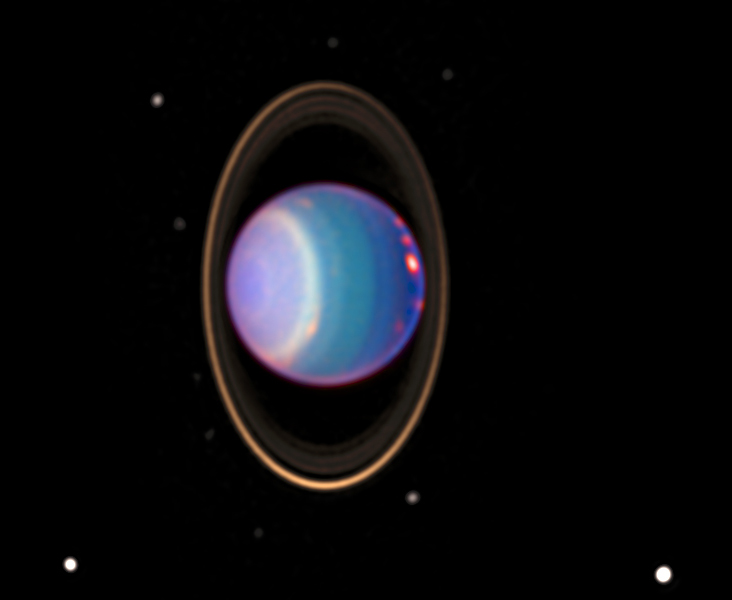
A false-color photograph of Uranus, its rings and 10 of its moons, taken by the Hubble Space Telescope's Near Infrared Camera and Multi-Object Spectrometer in near-infrared wavelengths. As seen in this photo, there's so much more to see on Uranus than meets the eye. This enigmatic world deserves a dedicated space mission to be launched there. Image Credit: Erich Karkoschka (University of Arizona) NASA
A false-color photograph of Uranus, its rings, and 10 of its moons, taken by the Hubble Space Telescope’s Near Infrared Camera and Multi-Object Spectrometer in near-infrared wavelengths. As seen in this photo, there’s so much more to see on Uranus than meets the eye. This enigmatic world deserves a dedicated space mission to be launched there. Image Credit: Erich Karkoschka (University of Arizona) NASA
Having been the object of neglect from space agencies on one hand, and hilarity from the general public on the other, Uranus still remains one of the most mysterious places in the Solar System.
There are currently 22 planetary spacecraft scattered throughout the Solar System, actively exploring almost every part of the Sun’s planetary family. Yet, one glaring omission from this long list of space exploration targets has been the planet Uranus, ever since NASA’s Voyager 2 spacecraft paid a brief visit there, 28 years ago this month, in January 1986.
Although it shares many similarities with neighboring Neptune, Uranus is an interesting peculiarity on its own. And even though Voyager 2’s fly-by has provided us with the bulk of our current knowledge of the planet, a greater series of even more intriguing questions about this enigmatic cyan-tinted ringed world remain unanswered to this day.
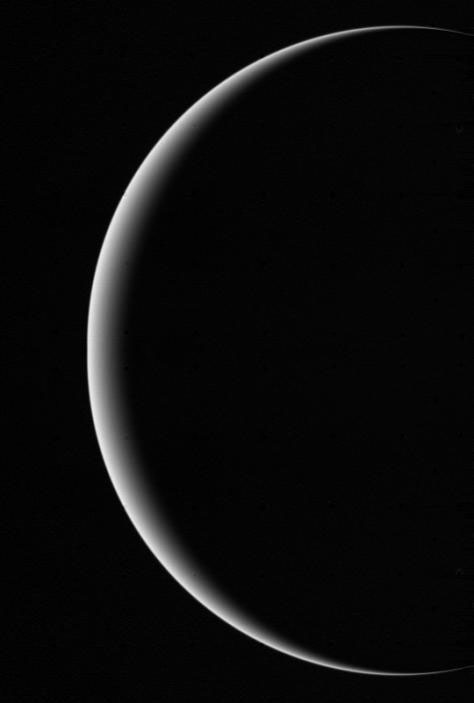
A crescent view of Uranus from a departing Voyager 2, following closest approach on 24 January 1986. Image Credit: JPL/NASA
For starters, Uranus is famous for being the only planet in the Solar System with a rotational axis that is almost parallel to the plane of the ecliptic. Where all of the other major planets rotate around an axis that is somewhat perpendicular or tilted no more than 30 degrees to the ecliptic plane, Uranus’ axial tilt of 97.7 degrees means that the planet is essentially “rolling” on its side, on its 84-year-old orbit around the Sun. This axial tilt gives Uranus the unique orientation of having each pole respectively facing the Sun for 42 years consecutively during summer, with the equatorial regions being lit by a Sun that is almost always low on the horizon, except from the time of the Uranian equinoxes, during spring and autumn.
Despite this axial tilt, the equatorial regions nevertheless exhibit warmer temperatures than the brightly lit poles. The reasons behind this phenomenon remain a mystery. Could it be that an atmospheric convection mechanism for heat transfer exists in Uranus’ atmosphere?
Another perplexing mystery is Uranus’ relative lack of internal heating, compared to the other giant planets and particularly Neptune. Although Uranus’ orbit lies approximately 18 Astronomical Units from the Sun, significantly closer than that of Neptune (30 AU), the temperatures that have been recorded on their respective tropospheres were almost the same, averaging 50 K (-223 °C) for both. Neptune has been found to radiate back into space as much as 2.6 times more energy than it receives from the Sun, which could help explain the more dynamic and readily visible changes in its atmosphere. Uranus’ internal heat in comparison is less than half that, something that could possibly account for the featureless disc that Uranus displayed to Voyager 2, when the spacecraft flew past the planet’s south pole in 1986. It was this absence of any visible atmospheric features that unjustly earned Uranus the definition of the “boring” planet.
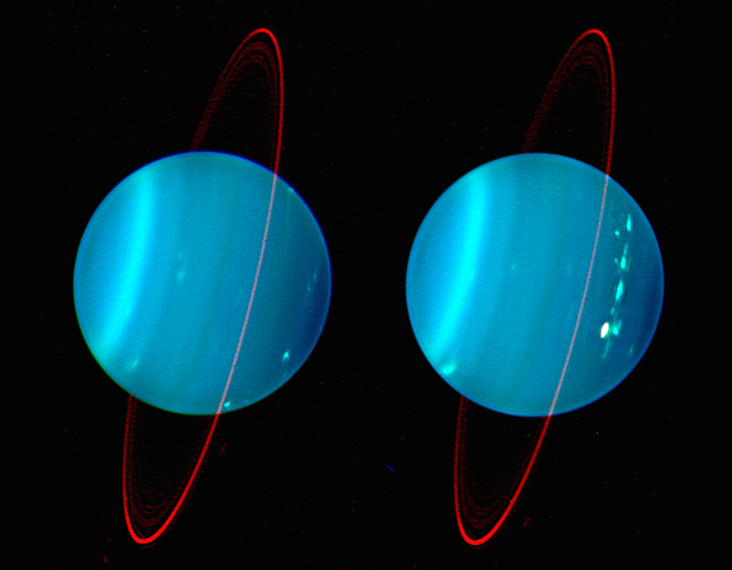
A composite photo of Uranus taken from the Keck Observatory at near-infrared wavelengths, in 2004. White bright spots are easily seen throughout the planet's face, showcasing a dynamic and ever-changing atmosphere. Image Credit: Lawrence Sromovsky, University of Wisconsin-Madison/ W. M. Keck Observatory
A composite photo of Uranus taken from the Keck Observatory at near-infrared wavelengths in 2004. White bright spots are easily seen throughout the planet’s face, showcasing a dynamic and ever-changing atmosphere. Image Credit: Lawrence Sromovsky, University of Wisconsin-Madison/ W. M. Keck Observatory

Earth's magnetic field

10:38 PM | BY ZeroDivide EDIT

Earth's magnetic field (also known as the geomagnetic field) is the magnetic field that extends from the Earth's inner core to where it meets the solar wind, a stream of energetic particles emanating from the Sun. Its magnitude at the Earth's surface ranges from 25 to 65 µT (0.25 to 0.65 G). It is approximately the field of a magnetic dipole tilted at an angle of 11 degrees with respect to the rotational axis—as if there were a bar magnet placed at that angle at the center of the Earth. However, unlike the field of a bar magnet, Earth's field changes over time because it is generated by the motion of molten iron alloys in the Earth's outer core (the geodynamo).

The North Magnetic Pole wanders, but does so slowly enough that a simple compass remains useful for navigation. However, at random intervals, which average about several hundred thousand years, the Earth's field reverses, which causes the north and South Magnetic Poles to change places with each other. These reversals of the geomagnetic poles leave a record in rocks that allow paleomagnetists to calculate past motions of continents and ocean floors as a result of plate tectonics.

The region above the ionosphere is called the magnetosphere, and extends several tens of thousands of kilometers into space. This region protects the Earth from cosmic rays that would otherwise strip away the upper atmosphere, including the ozone layer that protects the earth from harmful ultraviolet radiation.