re Donkeys Smarter Than Horses? Smart Ass or Not?

6:46 PM | BY ZeroDivide EDIT


Are Donkeys Smarter Than Horses? Smart Ass or Not?
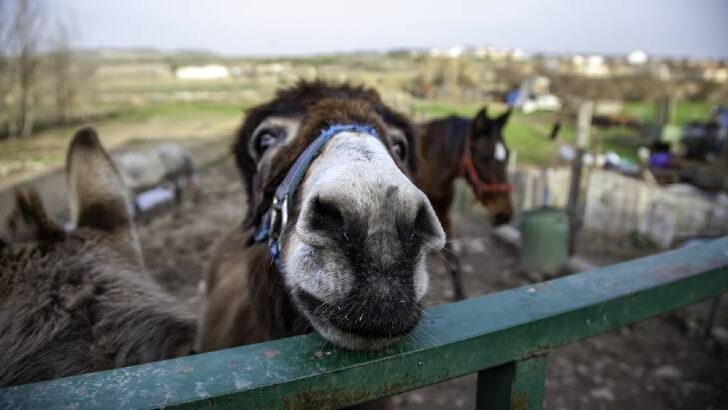
Are donkeys smarter than horses

Author:

Affiliate Disclaimer
As an Amazon Associate I earn from qualifying purchases. It helps me keep the website going. Thank you for your support.

Donkeys have an unenviable reputation for stubbornness, and being difficult to deal with.  As a result, they have long been relegated to the position of lower-class relatives in the equine family. However, those who know them well say they’re smarter than the average horse or pony and have been unjustly maligned for centuries! Are they right? Are donkeys smarter than horses?

As it turns out – yes, donkeys do perform better (some of the time) in some of the tests we use to measure ‘smartness’ and ‘intelligence’ in animals. But, those tests, or at least the results they produce, aren’t always reliable indicators of either donkey or horse intelligence because many other variables can influence results.
Are donkeys smarter than horses
Why not pin this article for later too?
Table of Contents  show 

Are Donkey And Horse Intelligence Tests Valid?

‘Smart’ is a subjective concept, particularly in relation to animals. It’s ambiguous, hard to define, and difficult to measure – for many reasons. A better question may well be – do the ways in which we try to measure smartness and intelligence in animals accurately answer the question ‘Are donkeys smarter than horses’? Do they tell us much about donkey vs horse intelligence? The answer to those questions unfortunately is that often they don’t!

Smartness Is As Smartness Does

In humans, ‘smart’ is defined as being able to creatively apply acquired skills and knowledge. ‘Intelligence’ is having the capacity to think, understand, reason, and communicate.

Do they mean the same thing in animals?

Fundamentally, yes. However, animals have something called goal-directed innovativeness i.e. they’ve evolved to be as smart as they need to be to survive. This is an important distinction between human and animal smartness and intelligence.

Animals can instinctively acquire information from their surroundings. They can retain it and then apply it in ways that allow them to survive. If they couldn’t, they wouldn’t exist. However, unlike humans, they don’t naturally take it much further than that, unless of course their environment ‘encourages’ them to indulge in more ‘opportunistic’ behaviors (source).
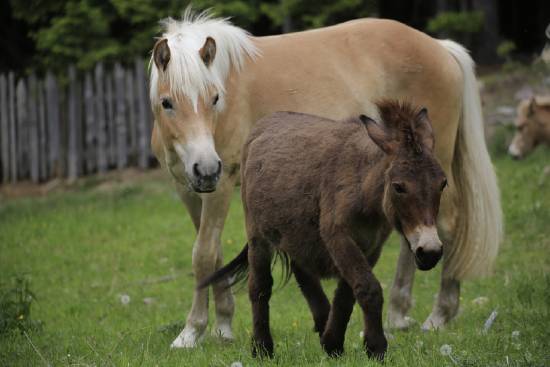
donkey and horse in field

Donkey vs Horse: Different ‘Smart’ Skills

Assessing animal smartness and intelligence requires a different approach and a different set of metrics and tests than those used to measure human smartness and intelligence.  Unfortunately, though they can fall short when comparing one species with another.

The fact is that donkeys and horses are 2 different species with totally different evolutionary histories. Donkeys eked out an existence in the arid African deserts, often traveling long distances to find food and water. They evolved a set of ‘smart’ skills designed to survive that existence.

Horses in contrast spent a large part of their evolutionary history living it up, relatively speaking, on the grassy plains of North America. Their major concern appears to have been a predatory meat-loving species called Homo sapiens… and no species has ever really evolved the smarts to successfully survive their dedicated onslaughts.

Consequently, horses have different attitudes and survival skills from donkeys. Take their primary defense mechanisms – horses run – very fast. Donkeys fight – very aggressively. Horses are highly reactive. Donkeys freeze. And so on…

How is Animal Intelligence Measured?

Researchers typically use the following types of metrics to assess animal smartness and intelligence:

  • Memory and retention
  • Trainability and learning abilities
  • Ability to solve problems
  • Curiosity

What Is Tested In Animal ‘Smartness’ Tests?

Exercises like conditioning tests assess an animal’s ability to learn and alter its behavior in response to negative or positive prompts. Spatial learning tasks such as negotiating mazes or locating moved openings in fences likewise test their ability to solve problems or remember solutions.  Likewise, curiosity is directly linked to learning and thus to smartness.

So – how does our favorite equine stack up against its long-eared relative across these metrics? Are donkeys smarter than horses in these tests?
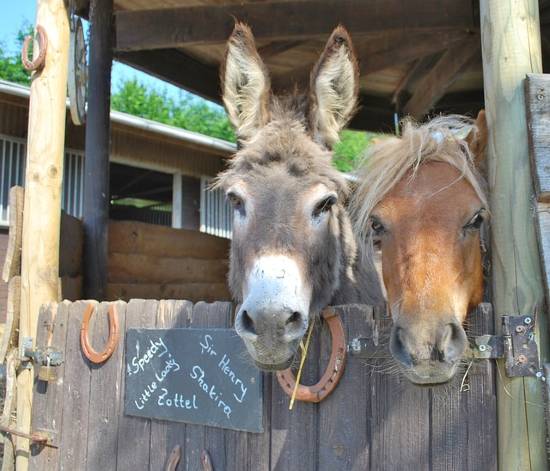
horse and donkey in stable together
Image by Hannelore Louis from Pixabay

1.   Memory And Retention Abilities – Donkey Vs Horse

Both donkeys and horses are highly adept at remembering and retaining information about places, like their home range or paddock (source). Importantly, they can locate food, water, and shelter and then remember where they are so they can return. They can also identify predators, recall faces, identify familiar herd members, remember routines, and repeat learned behaviors.

Whether either species is smarter at it though depends on what research you’re looking at. You’ll find results indicating that:

  • Donkeys are smarter than horses at remembering things.
  • Donkeys and horses are about the same at remembering things (source).
  • Horses are slightly faster at learning and remembering things than donkeys (source). 

Some studies have even found that groups of individuals within a species are better at observing and remembering than other groups within that same species. This in turn raises the point of how variables can affect performance in these tests (source). And determine how ‘smart’ individuals are subsequently assessed as being.

These variables include things like:

  • Living conditions,
  • Social interactions,
  • Level of domestication, and
  • Level of training

The following research project is a good example of this in action…

Study Shows Donkeys AND Ponies Outsmart Horses In Memory Tests

Researchers used puzzle tests to measure observation, working memory, retention, and spatial location memory in a group of donkeys and Esperia Ponies.

Both donkeys and ponies completed the tests successfully. They all remembered the object existed after it had been moved from view (memory retention) and where it had been hidden (spatial location memory), even after a delay of 10 seconds. So, the answer to ‘Are donkeys smarter than horses’ in these tests would be ‘No they’re not’, or at least not for these qualities.

However, when the tests were subsequently repeated with a group of Standardbreds, every single horse failed both tests! The researchers, therefore, concluded that the reason was likely their vastly different upbringing and living environment.

To explain:

Esperia Ponies are a semi-wild horse-like breed of large pony (with a reputation for being difficult to train like donkeys!). The ones used in this research had been living in an environment ‘rich in natural stimuli’. The Standardbreds on the other hand had spent their entire lives in human-controlled environments. Same species but totally different backgrounds… resulting in totally different test results!

More significantly – if these tests had only compared the Standardbreds and donkeys, the researchers would have concluded from the results that donkeys are smarter than horses (in these metrics at least).
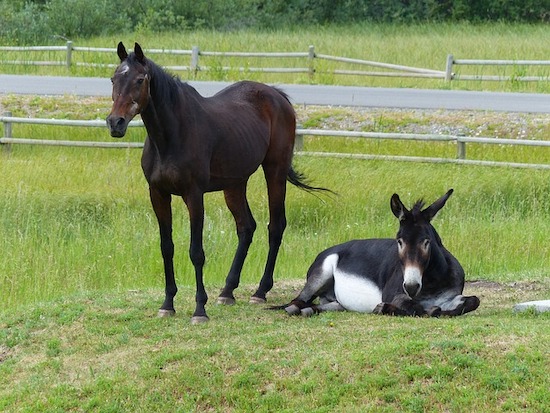
horse and donkey relaxing together
Image by Brigitte Werner from Pixabay

Long-Term Memory: Are Donkeys Smarter Than Horses Here?

Research by the National Institute for Agricultural Research (INRA) in Tours, France (source) found that horses and donkeys have comparable long-term memory retention. They got a group of horses and donkeys to repeat 2 tests they’d learned but last performed 2 years prior. Both donkeys and horses performed the tests perfectly.

Some Horses…! They’ll Do Anything For A Snack (Or A Puff)!

Interestingly though – when the positive (food) / negative (puff of air) incentives in the French experiment were removed, some of the horses stopped performing the activities. Notably – the less sensitive ones stopped backing up on command once the food reward was removed whilst the more sensitive ones refused to walk over the tarp when they realized the puff of air had vanished.

Researchers believe this may indicate that once incentives are removed from the equation, a horse’s natural temperament kicks in and begins to determine their behavior.

So at the end of all this, it’s probably fair to say that overall neither species is noticeably smarter than the other when it comes to powers of observation and memory.

 2.  Learning And Trainability: Are Donkeys Smarter Than Horses At This?

How well animals can learn and retain information affects how well they can adapt to new situations, problem-solve, and ultimately make survival decisions. Learning where a new water source is for example and then remembering its location would be an example of this.

From a human perspective, the more trainable an animal is, and the better its learning abilities are, the faster it can learn new things. This is key to determining how smart and intelligent we consider the animal to be.

How does this pan out with horses and donkeys?

Horses Take The Edge Over Donkeys In Learning Ability

According to this research, horses are faster and (marginally) better at learning than donkeys.  As it turns out, there’s probably a very good physiological reason for this…

collaborative 2020 study looked at the skull characteristics of Standardbred horses and donkeys and found that horses have larger olfactory lobes than donkeys. The olfactory lobes are the part of the brain that deals with smell.

Therefore, it’s likely that horses, with their larger olfactory lobes, can identify and process a wider range of smells than donkeys. Donkey olfactory lobes are also tilted more towards the center of the brain than those of horses, which may also affect their performance.

What does this have to do with learning abilities and training?

Well… we know from research that smell is closely linked with learning. Other research further suggests that smell may play an important role in visual memory performance as well (visual memory is ‘the ability to remember what you see’).

The inference is that if horses have larger olfactory lobes than donkeys and can probably identify and process more smells, that may be why they’re faster at learning things. And ostensibly at remembering what they see.

Horses Are Also More Trainable Than Donkeys

It doesn’t take research to know that horses are also more trainable than donkeys, who are renowned for their stubbornness. Side note – those who work with donkeys say that it isn’t so much that they’re stubborn but rather that they prefer to assess the situation first. Then, when they’re certain it’s safe to proceed, they’ll oblige. Donkeys also can’t be easily scared or intimidated into doing things!

So – when it comes to learning ability and trainability, horses definitely have an edge over donkeys.

donkey and horse in the wild
Image by Alessandro from Pixabay

3.   Horse Vs Donkey And Their Ability To Solve Problems

Now we come to the comparative problem-solving abilities of the 2 species. This ability is indicative of their ability to adapt to their surrounding and thus improve their chances of survival. When a water hole dries out, animals that can figure out they need to look for another one stand more chance of surviving than those who don’t.

Research indicates that although donkeys may be slow, they’re often more proficient at solving puzzles like ‘A not B detour tasks’. So they’d likely figure out they need to find a new water hole and start looking before horses would. That’s a tick in favor of donkeys for problem-solving abilities!

4.    Are Donkeys Or Horses More Curious And Does It Make Donkeys Smarter Than Horses?

Animals that are curious about things in their environment are more engaged with it, and more likely to learn and adapt to changes in it, which in turn aids their survival. However, the behavior requires a certain degree of mental flexibility and cognitive ability, which are attributes of intelligence and ‘smartness’. This is why it’s included in ‘smart’ metrics.

This is also another one of those attributes that depend on what you read as to which species is ‘smarter’ than the other. Some people believe horses are more curious because they are more social and tend to be more investigative as well. Conversely, there are also plenty of anecdotal stories about curious donkeys too.

One area where the 2 species may differ is that donkeys seem to spend longer checking out novel objects in their environment than horses do. Although with smaller olfactory lobes and presumably a lesser ability to identify and process smells, it may simply take donkeys longer to process and learn about unfamiliar objects.

So curiosity is probably about even between the 2 species.

Final Thoughts

Are donkeys smarter than horses? The real answer is that it’s a lot more complex than a simple yes/no. Smartness in animals is a complex trait that involves various cognitive abilities, and different species may excel in different areas.

While donkeys and horses are closely related and share many similarities, their cognitive abilities differ due to their evolutionary history, environmental circumstances, and individual differences. So overall – I don’t believe either species is necessarily ‘smarter’ than the other. They’re just ‘different’ but that’s why we love them both.

Fact or Fiction?: Elephants Never Forget

3:31 PM | BY ZeroDivide EDIT

Fact or Fiction?: Elephants Never Forget

Do elephants really have steel-trap memories?
elephant-matriarch


© Charles Foley

More In This Article

Elephants do not have the greatest eyesightin the animal kingdom, but they never forget a face. Carol Buckley at The Elephant Sanctuary in Hohenwald, Tenn., for instance, reports that in 1999 resident elephant Jenny became anxious and could hardly be contained when introduced to newcomer Shirley, an Asian elephant.

As the animals checked one another out with their trunks, Shirley, too, became animated and the two seemingly old friends had what appeared to be an emotional reunion. "There was this euphoria,"  sanctuary founder Buckley says. "Shirley started bellowing, and then Jenny did, too. Both trunks were checking out each other's scars. I've never experienced anything that intense without it being aggression."

Turns out the two elephants had briefly crossed paths years earlier. Buckley knew that Jenny had performed with the traveling Carson & Barnes Circus, before coming to the sanctuary in 1999, but she knew little about Shirley's background. She did a little digging, only to discover that Shirley had been in the circus with Jenny for a few months—23 years earlier.

Remarkable recall power, researchers believe, is a big part of how elephants survive. Matriarch elephants, in particular, hold a store of social knowledge that their families can scarcely do without, according to research conducted on elephants at Amboseli National Park in Kenya.

Researchers from the University of Sussex in England discovered that elephant groups with a 55-year-old matriarch (elephants live around 50 to 60 years) were more likely to huddle in a defensive posture than those with a matriarch aged 35 when confronted by an unfamiliar elephant. The reason: they were aware such strangers were likely to start conflicts with the group and possibly harm calves, Karen McComb, a psychologist and animal behaviorist at Sussex, and her colleagues reported in Science.

Other researchers, who studied three herds of elephants during a severe 1993 droughtat Tanzania's Tarangire National Park, found that they not only recognize one another but also recall routes to alternate food and water sources when their usual areas dry up.

The scientists from the Wildlife Conservation Society (WCS) in New York Cityreported in Biology Letters that pachyderm groups with matriarchs, ages 38 and 45, left the parched park, apparently in search of water and grub, but the ones with a younger matriarch, age 33, stayed put.

Cetacean intelligence

10:39 AM | BY ZeroDivide EDIT
Cetacean intelligence refers to the cognitive capabilities of the Cetacea order of mammals, which includes whalesporpoises, and dolphins.

Brain size[edit]

Brain size was previously considered a major indicator of the intelligence of an animal. However, many other factors also affect intelligence. Recent discoveries concerning bird intelligence have called into question the usefulness of brain size as an indicator.[1] Since most of the brain is used for maintaining bodily functions,[citation needed] greater ratios of brain to body mass may increase the amount of brain mass available for more complex cognitive tasks.[2][unreliable source?][3] Allometric analysis indicates that mammalian brain size scales at approximately the ⅔ or ¾ exponent of the body mass.[4] Comparison of a particular animal's brain size with the expected brain size based on such allometric analysis provides an encephalization quotient (EQ) that can be used as another indication of the animal's intelligence.
  • Sperm whales (Physeter macrocephalus) have the largest brain mass of any extant animal, averaging 7.8 kg in mature males.[5]
  • Bottlenose dolphins (Tursiops truncatus) have an absolute brain mass of 1500-1700 grams. This is slightly greater than that of humans (1300-1400 grams) and about four times that of chimpanzees(400 grams).[6]
  • The brain to body mass ratio (as distinct from encephalization quotient) in some members of the odontocete superfamily Delphinoidea (dolphins, porpoises, belugas, and narwhals) is second only to modern humans, and greater than all other mammals (there is debate whether that of the treeshrew might be second).[7][8] In some dolphins, it is less than half that of humans: 0.9% versus 2.1%.[citation needed] This comparison seems more favorable if the large amount of blubber (15-20% of mass) that dolphins require for insulation is omitted.
  • The encephalization quotient varies widely between species. The La Plata dolphin has an EQ of approximately 1.67; the Ganges River dolphin of 1.55; the orca of 2.57; the bottlenose dolphin of 4.14; and the tucuxi dolphin of 4.56;[9] In comparison to other animals, elephants have an EQ ranging from 1.13 to 2.36;[10]:151 chimpanzees of approximately 2.49; dogs of 1.17; cats of 1.00; and mice of 0.50.[11]
The discovery of spindle cells (neurons without extensive branching, known also as "von Economo neurons", or VENs) in the brains of the humpback whalefin whalesperm whalekiller whale,[15][16]bottlenose dolphinsRisso's dolphins, and beluga whales[17] is another unique discovery. Humans, the great apes, and elephants, species all well known for their high intelligence, are the only others known to have spindle cells[18](p242). Spindle neurons appear to play a central role in the development of intelligent behavior. Such a discovery may suggest a convergent evolution of these species.[19]

Brain structure[edit]

Elephant brains also show a similar complexity to dolphin brains, and are also more convoluted than that of humans,[20] and with a cortex "thicker than that of cetaceans".[21] However, in dolphins, "no patterns of cellular distribution, nuclear subdivision, or cellular morphology indicate specialization of the LC (coeruleus complex)" despite the large absolute brain size and unihemispheric sleep phenomenology of cetaceans.[22] Moreover, it is generally agreed that the growth of the neocortex, both absolutely and relative to the rest of the brain, during human evolution, has been responsible for the evolution of human intelligence, however defined. While a complex neocortex usually indicates high intelligence, there are exceptions to this. For example, the echidna has a highly developed brain, yet is not widely considered to be very intelligent.[23]
Although many cetaceans have a great number of cortical neurons, after Homo sapiens, the species with the greatest number of cortical neurons and synapses is the elephant.[21](p73) All sleeping mammals, including dolphins, experience a stage known as REM sleep.[24] Unlike terrestrial mammals, dolphin brains contain a paralimbic lobe, which may possibly be used for sensory processing. The dolphin is avoluntary breather, even during sleep, with the result that veterinary anaesthesia of dolphins is impossible, as it would result in asphyxiation.[citation needed] Ridgway reports that EEGs show alternating hemispheric asymmetry in slow waves during sleep, with occasional sleep-like waves from both hemispheres.[citation needed] This result has been interpreted to mean that dolphins sleep only one hemisphere of their brain at a time, possibly to control their voluntary respiration system or to be vigilant for predators. This is also given as explanation for the large size of their brains.[citation needed]
Dolphin brain stem transmission time is faster than that normally found in humans, and is approximately equivalent to the speed found in rats.[citation needed] As echo-location is the dolphin's primary means of sensing its environment – analogous to eyes in primates – and since sound travels four and a half times faster in water than in air, scientists[who?] speculate that the faster brain stem transmission time, and perhaps the paralimbic lobe as well, assist quicker processing of sound. (Though, if this is the case, it still does not explain the cause of the faster transmission time in the brain stem.)The dolphin's greater dependence on sound processing is evident in the structure of its brain: its neural area devoted to visual imaging is only about one-tenth that of the human brain, while the area devoted to acoustical imaging is about 10 times[citation needed] that of the human brain. (This is unsurprising: primate brains devote much more volume to visual processing than those of almost any other animal, and human brains more than other primates.) Sensory experiments suggest a great degree of cross-modal integration in the processing of shapes between echolocative and visual areas of the brain. Unlike the case of the human brain, the cetacean optic chiasm is completely crossed,[citation needed] and there is behavioral evidence for hemispheric dominance for vision.

Problem-solving ability[edit]

Some research shows that dolphins among other animals understand concepts such as numerical continuity (but not necessarily counting).[25] A recent research study found that dolphins may be able to discriminate between numbers.[26] However, the same researcher suggested that "It may involve mimicry", he said, "as dolphins are unsurpassed in imitative abilities among nonhuman animals".
Several researchers observing animals' ability to learn set formation tend to rank dolphins at about the level of elephants in "intelligence"[27] and show that dolphins do not have any unusual talent with problem solving compared with the other animals classed with very great intelligence.[28] Macphail in his "Brain and intelligence in vertebrates"[29] compared data from studies regarding learning "set formation" of animals. The results show that dolphins are skilled at performing this sort of standardized testing but not as adept as other animals in the study.

Elephant cognition

10:36 AM | BY ZeroDivide EDIT
Elephants are amongst the world's most intelligent species. With a mass of just over (11 lb), elephant brains have more mass than those of any other land animal, and although the largest whales have body masses twenty-fold those of a typical elephant, whale brains are barely twice the mass of an elephant's brain. In addition, elephants have a total of 257 billion neurons. [1] The elephant's brain is similar to that of humans in terms of structure and complexity—such as the elephant's cortex having as many neurons as a human brain,[2] suggesting convergent evolution.[3]
Elephants exhibit a wide variety of behaviors, including those associated with grief, learning, allomotheringmimicry, play, altruism, use of toolscompassioncooperation,[4][5] self-awarenessmemory, andlanguage.[6] Further, evidence suggests elephants may understand pointing: the ability to nonverbally communicate an object by extending a finger, or equivalent.[7] All indicate that elephants are highly intelligent; it is thought they are equal with cetaceans[8][9][10][11] and primates[9][12][13] in this regard. Due to the high intelligence and strong family ties of elephants, some researchers argue it is morally wrong for humans to cull them.[14] The Ancient Greek philosopherAristotle, once said that elephants were "the animal which surpasses all others in wit and mind."[15]

Intelligence and cognition

Main article: Elephant cognition
File:Insightful-Problem-Solving-in-an-Asian-Elephant-pone.0023251.s005.ogv
Elephant stacking blocks to allow it to reach food
Elephants exhibit mirror self-recognition, an indication of self-awareness and cognition that has also been demonstrated in some apes and dolphins.[131] One study of a captive female Asian elephant suggested the animal was capable of learning and distinguishing between several visual and some acoustic discrimination pairs. This individual was even able to score a high accuracy rating when re-tested with the same visual pairs a year later.[132] Elephants are among the species known to use tools. An Asian elephant has been observed modifying branches and using them as flyswatters.[133] Tool modification by these animals is not as advanced as that of chimpanzees. Elephants are popularly thought of as having an excellent memory. This could have a factual basis; they possibly havecognitive maps to allow them to remember large-scale spaces over long periods of time. Individuals appear to be able to keep track of the current location of their family members.[55]

Scientists debate the extent to which elephants feel emotion. They appear to show interest in the bones of their own kind, regardless of whether they are related.[134] As with chimps and dolphins, a dying or dead elephant may elicit attention and aid from others, including those from other groups. This has been interpreted as expressing "concern",[135] however, others would dispute such an interpretation as being anthropomorphic;[136][137] the Oxford Companion to Animal Behaviour (1987) advised that "one is well advised to study the behaviour rather than attempting to get at any underlying emotion".[138]