The Majestic Realm of a Forgotten World: The Alluring Mysteries of Uranus
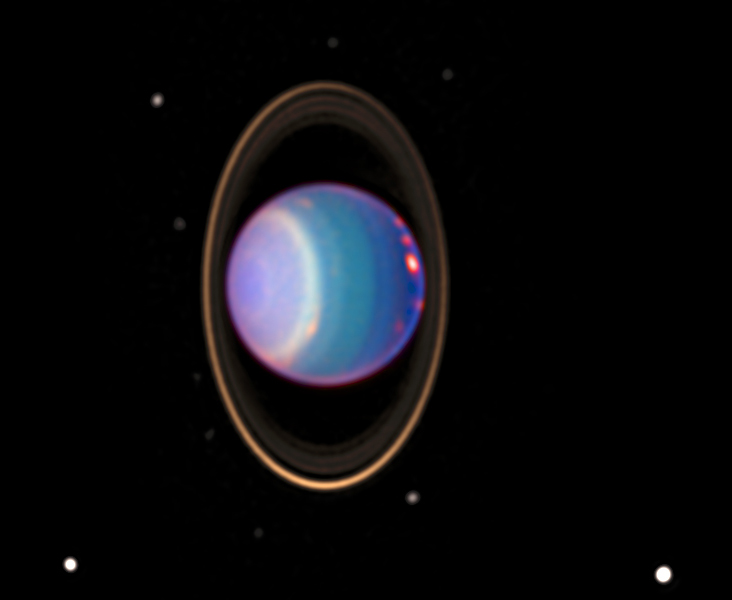
A
false-color photograph of Uranus, its rings, and 10 of its moons, taken
by the Hubble Space Telescope’s Near Infrared Camera and Multi-Object
Spectrometer in near-infrared wavelengths. As seen in this photo,
there’s so much more to see on Uranus than meets the eye. This enigmatic
world deserves a dedicated space mission to be launched there. Image
Credit: Erich Karkoschka (University of Arizona) NASA
Having been the object of neglect from space agencies on one hand, and hilarity from the general public on the other, Uranus still remains one of the most mysterious places in the Solar System.
There are currently 22 planetary spacecraft
scattered throughout the Solar System, actively exploring almost every
part of the Sun’s planetary family. Yet, one glaring omission from this
long list of space exploration targets has been the planet Uranus, ever
since NASA’s Voyager 2 spacecraft paid a brief visit there, 28 years ago
this month, in January 1986.

Although it shares many
similarities with neighboring Neptune, Uranus is an interesting
peculiarity on its own. And even though Voyager 2’s fly-by has provided
us with the bulk of our current knowledge of the planet, a greater
series of even more intriguing questions about this enigmatic
cyan-tinted ringed world remain unanswered to this day.
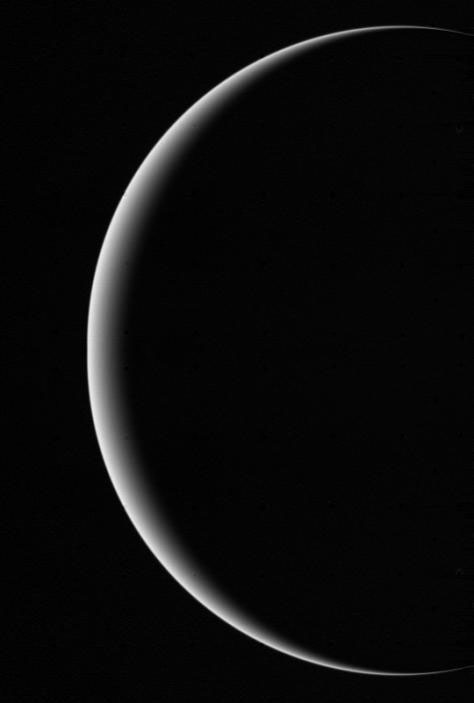
A crescent view of Uranus from a departing Voyager 2, following closest approach on 24 January 1986. Image Credit: JPL/NASA
For starters, Uranus is
famous for being the only planet in the Solar System with a rotational
axis that is almost parallel to the plane of the ecliptic. Where all of
the other major planets rotate around an axis that is somewhat
perpendicular or tilted no more than 30 degrees to the ecliptic plane,
Uranus’ axial tilt of 97.7 degrees means that the planet is essentially
“rolling” on its side, on its 84-year-old orbit around the Sun. This
axial tilt gives Uranus the unique orientation of having each pole
respectively facing the Sun for 42 years consecutively during summer,
with the equatorial regions being lit by a Sun that is almost always low
on the horizon, except from the time of the Uranian equinoxes, during
spring and autumn.
Despite this axial tilt, the
equatorial regions nevertheless exhibit warmer temperatures than the
brightly lit poles. The reasons behind this phenomenon remain a mystery.
Could it be that an atmospheric convection mechanism for heat transfer
exists in Uranus’ atmosphere?
Another perplexing mystery is Uranus’
relative lack of internal heating, compared to the other giant planets
and particularly Neptune. Although Uranus’ orbit lies approximately 18
Astronomical Units from the Sun, significantly closer than that of
Neptune (30 AU), the temperatures that have been recorded on their
respective tropospheres were almost the same, averaging 50 K (-223 °C)
for both. Neptune has been found to radiate back into space as much as
2.6 times more energy than it receives from the Sun, which could help
explain the more dynamic and readily visible changes in its atmosphere.
Uranus’ internal heat in comparison is less than half that, something
that could possibly account for the featureless disc that Uranus
displayed to Voyager 2, when the spacecraft flew past the planet’s south
pole in 1986. It was this absence of any visible atmospheric features
that unjustly earned Uranus the definition of the “boring” planet.
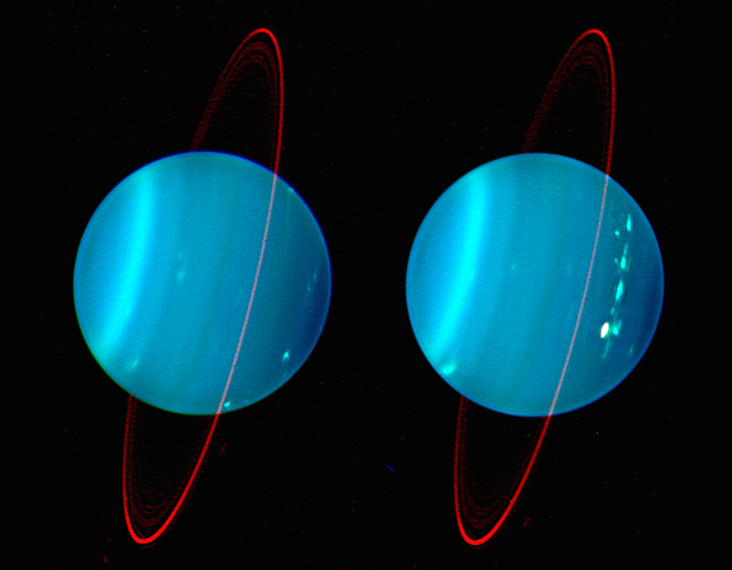
A
composite photo of Uranus taken from the Keck Observatory at
near-infrared wavelengths in 2004. White bright spots are easily seen
throughout the planet’s face, showcasing a dynamic and ever-changing
atmosphere. Image Credit: Lawrence Sromovsky, University of
Wisconsin-Madison/ W. M. Keck Observatory
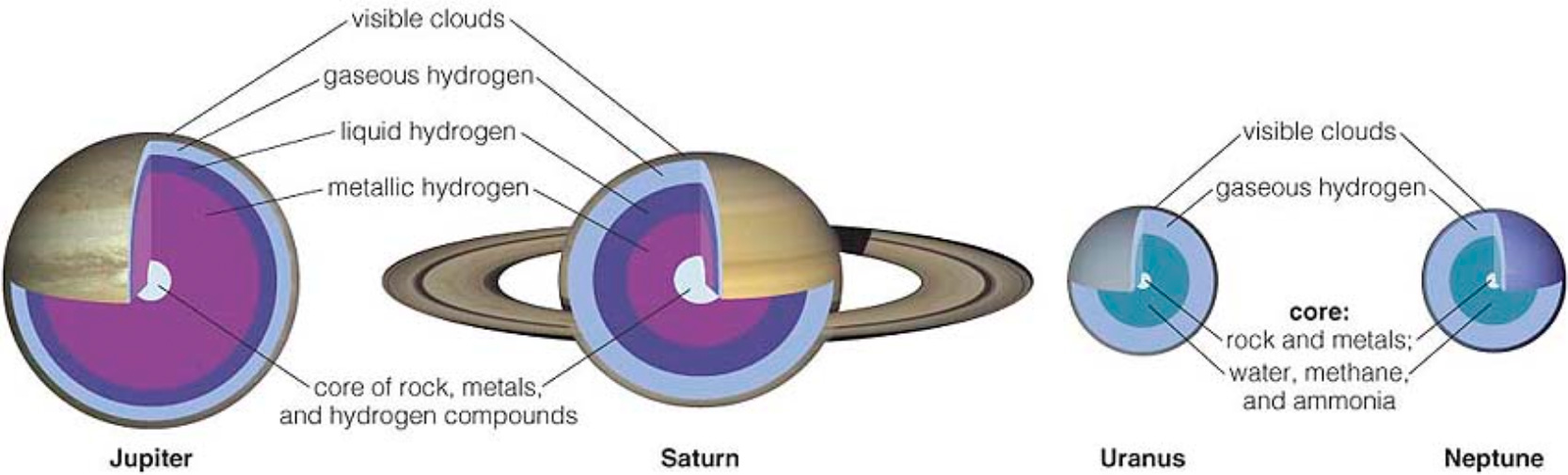
The
interiors of Jupiter and Saturn, compared to those of Uranus and
Neptune. Image Credit: Laboratory for Atmospheric and Space Physics,
University of Colorado Boulder
Besides these similar
atmospheric characteristics, the relation between Uranus and Neptune
runs deeper than that. Where the interiors of Jupiter and Saturn are
believed to consist of multiple layers of different states of hydrogen
on top of a rocky core, Uranus and Neptune, on the other hand, are
believed to harbor vast oceans of hot and dense liquid water, methane,
and ammonia on top of their rocky cores. It is because of this different
layered internal structure that they are considered to be a distinct
class of planets, with astronomers classifying them as “ice giants,”
contrary to the “gas giant” definition of Jupiter and Saturn.
This difference in internal
structure might also account for another of Uranus’ strange
characteristics: the orientation of its magnetic field axis relative to
the rotational axis. A similar orientation is observed in Neptune’s
magnetic field, further strengthening the case for “ice giants” being a
distinct sub-category of planets. Although the magnetic poles of Earth,
Jupiter, and Saturn lie close to those planets’ geographic poles, the
magnetic field of Uranus is severely displaced, with its axis being
offset by 59 degrees to the planet’s axis of rotation. The most
plausible explanation for this discrepancy is the different way in which
the magnetic field is generated on Uranus. The magnetic fields of
Earth, Jupiter, and Saturn are created by the motions of conducting
fluids on their molten cores. The Earth’s core is composed of molten
iron, and those of Jupiter and Saturn are made of metallic hydrogen. The
magnetic fields of Uranus and Neptune, on the other hand, are believed
to be generated by the motions of electric currents through the oceans
of ionised liquid water and ammonia that probably lie at the planets’
mantles.
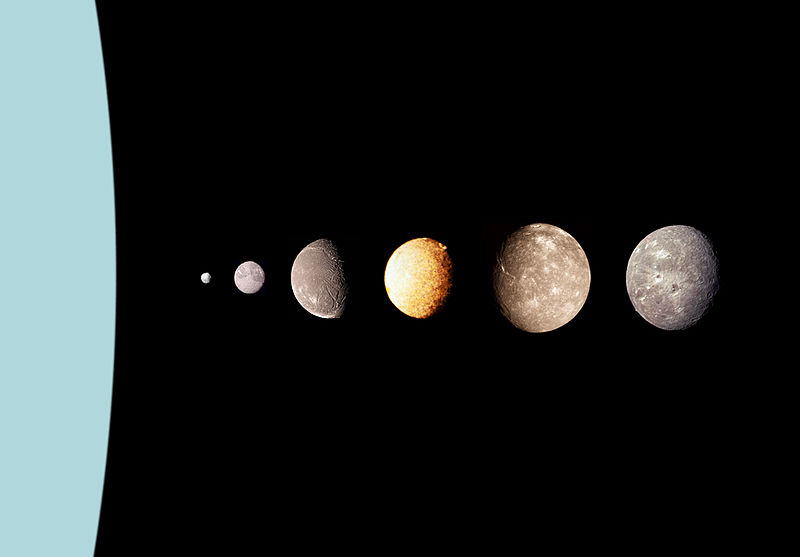
Uranus
(left) and six of its largest moons. Sizes and distances from the
planet are to scale. Moons from left to right: Puck, Miranda, Ariel,
Umbriel, Titania, and Oberon. Image Credit: Wikipedia
As intriguing as Uranus
itself may be, it also comes replete with a system of 27 moons, just as
interesting and inviting as the moons of Jupiter and Saturn. The five
bigger of these—Miranda, Ariel, Umbriel, Titania, and Oberon—are
primarily composed of rock and ice, with Titania and Oberon in
particular suspected to harbor underground oceans of liquid water, as in
the case of Jupiter’s moon Europa and Saturn’s moon Enceladus. The
evidence for the existence of underground water oceans on Solar System
objects that were previously thought of as frozen and dead has
revolutionised our concept and understanding of habitability beyond
Earth.
By better understanding
Uranus, scientists could gain a better understanding of the internal
structures and evolutions not only of the planets in our Solar System,
but of those beyond as well. During the recent 223rd meeting of the American Astronomical Society in Washington this January, scientists reported
on four years’ worth of data from NASA’s Kepler space telescope,
showing that the vast majority of exoplanets discovered so far are
planets whose sizes range from that of Earth to that of Neptune. If
those extrasolar, Neptune-sized worlds are anything like the ice giants
in our own Solar System, then what better way to study those distant
faraway planets than to study our neighboring ice giants, Uranus and
Neptune.
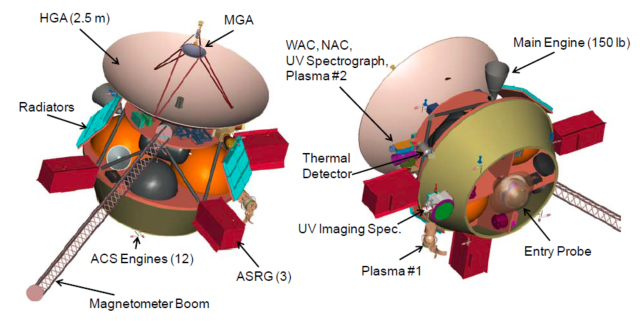
A dedicated Uranus orbiter/atmospheric entry probe mission concept. Image Credit: Ice Giants Mission Decadal Study Report/NASA
The importance of a dedicated Uranus
mission isn’t lost on the planetary science community. A Uranus orbiter
is listed as the third highest priority Flagship mission after Mars and
Europa, in the 2013-2022 U.S. Planetary Science Decadal Survey. Dr. Mark
Hofstadter, a planetary scientist at NASA’s Jet Propulsion Laboratory,
stressed that point during a presentation
of a Uranus Flagship mission concept at the January 2013 meeting of the
Outer Planets Assessment Group in Atlanta, Ga. “The Group is concerned
that no action was taken on its findings last year regarding a Uranus
mission study,” notes Hofstadter in the presentation, “and again urges
that NASA initiate such a study responsive to Decadal Survey science
goals for the ice giants.” Hofstadter also presented alternate Uranus
orbiter concepts that fall under NASA’s New Horizons and Discovery-class
cheaper mission profiles, but none of them have been selected by the
U.S. space agency to date, due to severe budget cuts to its planetary
science programs in recent years. A similar orbital mission concept
proposed to ESA, called “Uranus Pathfinder,” had received a very
positive assessment from the European space agency, but eventually
wasn’t selected for implementation either. “Being farther away makes it
more difficult (read more expensive) to get there than to, say, Jupiter
or Saturn,” says Hofstadter. “It’s for this reason that missions to the
inner gas giants have been preferred. But, in light of technological
advancements, the cost of sending a robotic mission to Uranus now is
more manageable.”
A dedicated mission to the
enigmatic and forgotten Uranus could be key as well for the
understanding of the Solar System as a whole. “To have a complete
understanding of our solar system we must study all of its components,”
says Chris Arridge, a research fellow at University College London’s
Mullard Space Science Laboratory. “It’s like having a huge jigsaw and
only having half the pieces – we need to get all those pieces to have a
chance of being able to see the big picture.”
Probably the most important
reason for such a mission isn’t to answer the long list of questions
that we’ve already made. As is always the case with space exploration,
the most important justification might be the list of things that we
didn’t expect to discover in the process, and the answers to the
questions that we haven’t thought to ask yet.