A Review of Authorities.
The student will quickly notice that while the Simon of the Acts and the Simon of the church fathers both share the traits of possessing magical power and clashing with Peter, the tone of their stories differs sharply.
In the Acts, the apostles naturally reject the magician’s offer of money with indignation, yet they show no personal hatred toward him.
In contrast, the fathers portray him as the most despicable of impostors and charlatans, holding him up for universal scorn.
The fathers admittedly draw the incident of Simon offering money to Peter from the Acts’ account, so their retelling adds no confirmation to the tale.
Thus, its truth hinges solely on the Acts’ author, since Justin, a Samaritan native, does not mention it.
As the Acts are not cited before the late second century, and their authorship is only traditionally tied to Luke, we can safely place ourselves in the realm of legend rather than history. The same holds true for all events in Simon’s career; they belong to the land of fable, likely born from later Patristic and Simonian disputes. Justin’s Simon gives us his birthplace as Gitta, and the other fathers follow with slight name variations.
Gitta, Gittha, Gittoi, Gitthoi, Gitto, Gitton, Gitteh—these are the differing forms.
This detail, however, is minor, and today the small town is said to be called Gitthoï. Justin’s claim of a statue to Simon in Rome, inscribed "To Simon, the Holy God," has been doubted by every scholar since a large marble fragment was found on the Tiber island in the late sixteenth century, bearing the inscription "To Semoni Sanco, the Faithful God," a Sabine deity.
Some argue Justin wouldn’t make such an obvious error writing to Romans, and if mistaken, Irenaeus wouldn’t have repeated it.
Yet the similarity is too striking to suggest anything but a clumsy attempt by some ignorant debater to give the tale a historical gloss, which Justin too readily accepted.
It’s also worth noting Justin says nearly all Samaritans were Simonians. Next comes Irenaeus’s Simon, which scholars believe mirrors Justin’s account—perhaps from his Apology, or a lost work on heresies Justin mentions there.
Alternatively, both might have drawn from a shared, now-lost source. Here, Helen’s story appears for the first time.
Whether Helen existed, we may never know.
Every Gnostic system, teaching the soul’s descent into matter, needed a "lost sheep"—be it Sophia, Acamôth, Prunîcus, Barbêlo, or the Magdalene glyph, from whom seven devils are expelled.
This figure’s meaning awaits understanding, and the mystery of the Christ and the seven aeons, churches, or assemblies within each person holds significance for every Theosophy student.
Such elements are standard in Gnostic aeonology. If Simon invented this aeonology, it’s surprising his and Helen’s names didn’t echo in later systems.
If instead he adapted existing ideas, excusing his questionable tie to Helen with the Sophia-mythos, it’s hard to see how such an obvious farce won over cultured followers like the Simonians.
Either way, the Gnostic tradition proves pre-Christian.
Every initiated Gnostic knew this mythos symbolized the World-Soul in the cosmos and the Soul in man. The accounts from the Acts, Justin, and Irenaeus are so muddled that some suggest two Simons.
If he claimed to be Jesus reincarnated, appearing in Jerusalem as the Son, he couldn’t have lived alongside the apostles.
Thus, either he made no such claim; or if he did, Justin and Irenaeus had such vague data they mixed him with the Acts’ Simon; or the two-Simon idea lacks footing, and he simply taught the esoteric view of one Christ principle’s varied descents. Tertullian’s Simon clearly stems from Irenaeus, as critics agree.
"Tertullian evidently knows only what he read in Irenaeus," one scholar notes. Only with the Philosophumena’s Simon do we stand on firmer ground.
Its early section is especially valuable for quoting The Great Revelation, a work unknown elsewhere.
The Philosophumena’s author, whoever he was, clearly had Simonian writings, offering real worth amid our rubble. Not until the mid-nineteenth century did Minoides Mynas bring a damaged fourteenth-century manuscript from Mount Athos to Paris, after a French government mission.
This manuscript, thought to be Hippolytus’s Philosophumena, arrived in poor shape.
Its authorship remains uncertain, as we’ll see with Epiphanius and Philaster’s Simon. The Philosophumena’s later Simon section is less vital, likely drawn from Irenaeus, Justin’s anti-heretical work, or their shared source.
Yet its account of Simon’s death shows the author wasn’t Hippolytus, whose lost work Lipsius proves Epiphanius and Philaster used. Origen’s Simon adds little new, save the Simonians’ small numbers.
But like other claims in his debates with the Gnostic Celsus, we can’t trust this, since Eusebius Pamphyli, writing a century later in the early fourth century, calls the Simonians still numerous. Epiphanius and Philaster’s Simon prompts mention of R.A. Lipsius’s remarkable scholarship, a divinity professor at Jena University.
From their accounts, he partly rebuilt a lost Hippolytus work against heresies, described by Photius.
This treatise built on Irenaeus’s discourses.
By comparing Philaster, Epiphanius, and Pseudo-Tertullian, he recovers Hippolytus; comparing that with Irenaeus, he deduces a common source—perhaps Justin Martyr’s lost work, or what Justin drew from. Theodoret’s Simon differs from prior accounts only in a few key aeonology details, suggesting to Matter that he mixed later Gnostic ideas or later Simonian teachings with Simon’s own. The legendary Simon lies wholly beyond historical critique.
Stories from the Homilies and Recognitions are clear fabrications—likely later doctrinal add-ons—and typical magic tales, unsupported by any scholar.
One reason may be their strong Ebionism, unpalatable to orthodox tastes.
Here’s an Ebionite emanation scheme for interest: GOD.
(The One Being, the source of all.)
SPIRIT.
MATTER.
The Four elements.
(This blend yields)
THE SON.
(Leader of the future cycle.)
THE DEVIL.
(Leader of this cycle.)
GREAT THINGS.
(Heaven, light, life, etc.)
LITTLE THINGS.
(Earth, fire, death, etc.)
ADAM.
(Truth.)
EVE.
(Error.)
MAN.
(Union of Spirit and Body, Truth and Error.)
INFERIOR MEN.
Ishmael.
Esau.
Aaron.
John the Baptist.
Antichrist.
SUPERIOR MEN.
Isaac.
Jacob.
Moses.
Jesus.
Christ.
GOD.
(Completion, rest.) We must note Bauer and the Tubingen school’s curious theory.
Recent theological critique confirms the Clementine writings came from Elkesaites, an Ebionite sect, written in Rome in the third century.
The Elkesaites based their creed on the Book of Elkesai, claiming angelic revelation, marked by hostility to Paul.
As the Recognitions show anti-Paulinism, Bauer’s school argued Simon Magus stands for Paul, the Acts and legends reflecting elder apostles’ jealousy and efforts to limit his apostolic rights.
Yet the latest scholarship rejects this, doubting such bitter anti-Paulinists would craft so odd a tale to vent spleen. To close this part, let’s broadly review our sources on Simon’s life and the immoral acts tied to his followers, with a brief nod to lost Simonian literature, saving his system’s explanation and magic for later. I’ve split the fathers’ Simon from the legendary one "by convention," not "by nature," as Simonians might say, for both rest on myth.
Rejecting the legendary Simon is logical for those dismissing the Ebionite Clementines.
Admit its tale’s truth, and incidents of John the Baptist and Peter must follow—but this won’t do, so Simon slips orthodox grasp here. Yet the fathers’ biographical snippets mirror the Clementines’ nature, their sources vague, unreliable, and far from the alleged events, warranting the same legendary label.
Whether we dismiss or accept, we must do so for both; accepting one and not the other is a partisan bias no fair enquirer can justly hold. The legends find some excuse in their era, when religious debate burned white-hot.
Orthodox Christians still smarted from countless vile accusations leveled at them.
Every known or imaginable crime had been charged; safely, they returned the favor when possible.
Though we regret such mudslinging in today’s tolerant times, the era’s fiery zeal offers some pardon—yet the quickest to accuse and twist others’ acts often unwittingly indict their own baser selves. Matter aptly notes this, writing: Eusebius says, "Nothing is so impure, nor can one imagine anything so criminal, that the Simonian sect doesn’t far exceed it."
Eusebius’s bolt is fierce—too fierce; nothing surpasses utter criminality’s excess.
Belonging to a community just free from punishments sparked by like grave charges, Eusebius perhaps shouldn’t have spoken so.
But man is thus; he hunts when no longer hunted. All groups with secret rites and public roles—like early Christians and Gnostics—faced such claims.
Whether Simonian and Christian communities were impure is now unprovable.
The key is that identical accusations and equal lack of proof demand both be judged alike; condemning one and sparing the other is biased and overturned by truth-seekers over prejudice. So keen were the fathers to smear Simon that they blatantly contradict themselves on major points.
One says Samaria took the apostles’ Word, forcing Simon to flee in despair; yet Justin, a Samaritan, claims a century later nearly all Samaritans were Simonians.
Simon’s death tales clash too; if he died so wretchedly in Rome, Romans wouldn’t likely honor him with a statue.
Critiquing such obvious fictions feels thankless; we know their inspiration’s source and the religious imagination’s fertility in disputes—enough to sift them from our pile. Now, a few words on Simonian literature, where only the Philosophumena’s quotes from The Great Revelation are surely genuine. That a Simonian scripture corpus existed is clear from passages in the Recognitions, Jerome, Pseudo-Dionysius, and the Arabic Preface to the Nicaean Council.
For a while, I hoped to gather fragments of these works, but they’ve sadly joined much else orthodoxy’s ignorance and fear torched.
We know of a book called The Four Quarters of the World, like the four orthodox gospels tied to the quarters’ signs in old manuscripts.
A collection of Simon’s sentences or debate replies also held sway among Simonians, irking their foes.
Matter and Amélineau mention a book by Simon’s disciples, On Saint Paul’s Preaching, but their hints and other sources yield no more.
Migne’s Theological Encyclopedia cites M. Miller’s Catalogue of Greek Manuscripts at the Escurial, noting a Greek text on Simon, but I can’t find this catalogue at the British Museum or elsewhere. At last, I thought I’d struck gold in Grabe’s Spicilegium, claiming fragments from first-to-third-century heretics, but its source is too late for much worth.
Grabe cites the vague references I’ve noted, quoting the Apostolic Constitutions’ unknown author—whom he calls the "collector" and oddly dates to the fourth century—to show these books’ nature: "Such were these ill-named folks’ deeds, slandering creation, marriage, providence, child-bearing, the Law, and Prophets; listing foreign Angel names—though they say so, truly Daemons answering from below." Only with Grabe’s mention of the Simonian Antirrhêtikoi Logoi, noted by Pseudo-Dionysius as "mad Simon’s Refutatory Sermons," do we get fresh insight. A tenth-century Syrian bishop, Moses Barcephas, claims to preserve some of Simon’s debate retorts, which pious Grabe italicizes to keep their "venom" from orthodox rebuttal.
Here’s the translation of those italicized bits: "God willed Adam not to eat from that tree; but he ate, so he didn’t stay as God willed: thus, Adam’s maker was weak."
"God willed Adam to stay in Paradise; but he fell disgracefully by his own act: thus, Adam’s maker was weak, unable to keep him there by his will."
"He forbade Adam the tree of knowledge of good and evil, tasting which he’d judge between them, shunning this, chasing that."
"But had Adam’s maker not barred him from that tree, he’d have faced no judgment or punishment; evil comes here, as he defied God’s order not to eat, and ate."
"Through envy, he barred Adam from the tree of life, ensuring he wouldn’t be immortal."
"For what earthly reason did God curse the serpent? If as the harm’s cause, why not stop it from seducing Adam? If as a benefit’s bringer, making Adam eat from that good tree, he was plainly unjust and envious; if neither, he’d still be blamed for ignorance and folly." Though these arguments could reflect Simon’s counter to literalists, the tenth century is too late for word-for-word trust without a surviving Syrian translation spared from ruin.
This sample of Simonian logic, though, is intriguing and feels relevant even today. Finally, one key point I’ve saved for this Part’s end, for readers to hold during the next: Every word we have on Simon comes from fierce foes—men merciless and intolerant of heretics.
To them, the heretic was damned by his heresy alone, a Satanic agent, God’s natural foe.
No hope, no mercy—he was eternally lost.
Our Simon has no ally, no defender; he’s chased through "history’s" backroads and tradition’s highways, his ruin a service to God.
One lone light shines from his Great Revelation fragment—one ray to brighten the twisted tales of his teachings, speaking clearly to today’s Theosophists, prompting each to say: I think his words hold much reason. If you weigh it rightly, Simon’s been greatly wronged.
The student will quickly notice that while the Simon of the Acts and the Simon of the church fathers both share the traits of possessing magical power and clashing with Peter, the tone of their stories differs sharply.
In the Acts, the apostles naturally reject the magician’s offer of money with indignation, yet they show no personal hatred toward him.
In contrast, the fathers portray him as the most despicable of impostors and charlatans, holding him up for universal scorn.
The fathers admittedly draw the incident of Simon offering money to Peter from the Acts’ account, so their retelling adds no confirmation to the tale.
Thus, its truth hinges solely on the Acts’ author, since Justin, a Samaritan native, does not mention it.
As the Acts are not cited before the late second century, and their authorship is only traditionally tied to Luke, we can safely place ourselves in the realm of legend rather than history.
In the Acts, the apostles naturally reject the magician’s offer of money with indignation, yet they show no personal hatred toward him.
In contrast, the fathers portray him as the most despicable of impostors and charlatans, holding him up for universal scorn.
The fathers admittedly draw the incident of Simon offering money to Peter from the Acts’ account, so their retelling adds no confirmation to the tale.
Thus, its truth hinges solely on the Acts’ author, since Justin, a Samaritan native, does not mention it.
As the Acts are not cited before the late second century, and their authorship is only traditionally tied to Luke, we can safely place ourselves in the realm of legend rather than history.
The same holds true for all events in Simon’s career; they belong to the land of fable, likely born from later Patristic and Simonian disputes.
Justin’s Simon gives us his birthplace as Gitta, and the other fathers follow with slight name variations.
Gitta, Gittha, Gittoi, Gitthoi, Gitto, Gitton, Gitteh—these are the differing forms.
This detail, however, is minor, and today the small town is said to be called Gitthoï.
Gitta, Gittha, Gittoi, Gitthoi, Gitto, Gitton, Gitteh—these are the differing forms.
This detail, however, is minor, and today the small town is said to be called Gitthoï.
Justin’s claim of a statue to Simon in Rome, inscribed "To Simon, the Holy God," has been doubted by every scholar since a large marble fragment was found on the Tiber island in the late sixteenth century, bearing the inscription "To Semoni Sanco, the Faithful God," a Sabine deity.
Some argue Justin wouldn’t make such an obvious error writing to Romans, and if mistaken, Irenaeus wouldn’t have repeated it.
Yet the similarity is too striking to suggest anything but a clumsy attempt by some ignorant debater to give the tale a historical gloss, which Justin too readily accepted.
It’s also worth noting Justin says nearly all Samaritans were Simonians.
Some argue Justin wouldn’t make such an obvious error writing to Romans, and if mistaken, Irenaeus wouldn’t have repeated it.
Yet the similarity is too striking to suggest anything but a clumsy attempt by some ignorant debater to give the tale a historical gloss, which Justin too readily accepted.
It’s also worth noting Justin says nearly all Samaritans were Simonians.
Next comes Irenaeus’s Simon, which scholars believe mirrors Justin’s account—perhaps from his Apology, or a lost work on heresies Justin mentions there.
Alternatively, both might have drawn from a shared, now-lost source.
Alternatively, both might have drawn from a shared, now-lost source.
Here, Helen’s story appears for the first time.
Whether Helen existed, we may never know.
Every Gnostic system, teaching the soul’s descent into matter, needed a "lost sheep"—be it Sophia, Acamôth, Prunîcus, Barbêlo, or the Magdalene glyph, from whom seven devils are expelled.
This figure’s meaning awaits understanding, and the mystery of the Christ and the seven aeons, churches, or assemblies within each person holds significance for every Theosophy student.
Such elements are standard in Gnostic aeonology.
Whether Helen existed, we may never know.
Every Gnostic system, teaching the soul’s descent into matter, needed a "lost sheep"—be it Sophia, Acamôth, Prunîcus, Barbêlo, or the Magdalene glyph, from whom seven devils are expelled.
This figure’s meaning awaits understanding, and the mystery of the Christ and the seven aeons, churches, or assemblies within each person holds significance for every Theosophy student.
Such elements are standard in Gnostic aeonology.
If Simon invented this aeonology, it’s surprising his and Helen’s names didn’t echo in later systems.
If instead he adapted existing ideas, excusing his questionable tie to Helen with the Sophia-mythos, it’s hard to see how such an obvious farce won over cultured followers like the Simonians.
Either way, the Gnostic tradition proves pre-Christian.
Every initiated Gnostic knew this mythos symbolized the World-Soul in the cosmos and the Soul in man.
If instead he adapted existing ideas, excusing his questionable tie to Helen with the Sophia-mythos, it’s hard to see how such an obvious farce won over cultured followers like the Simonians.
Either way, the Gnostic tradition proves pre-Christian.
Every initiated Gnostic knew this mythos symbolized the World-Soul in the cosmos and the Soul in man.
The accounts from the Acts, Justin, and Irenaeus are so muddled that some suggest two Simons.
If he claimed to be Jesus reincarnated, appearing in Jerusalem as the Son, he couldn’t have lived alongside the apostles.
Thus, either he made no such claim; or if he did, Justin and Irenaeus had such vague data they mixed him with the Acts’ Simon; or the two-Simon idea lacks footing, and he simply taught the esoteric view of one Christ principle’s varied descents.
If he claimed to be Jesus reincarnated, appearing in Jerusalem as the Son, he couldn’t have lived alongside the apostles.
Thus, either he made no such claim; or if he did, Justin and Irenaeus had such vague data they mixed him with the Acts’ Simon; or the two-Simon idea lacks footing, and he simply taught the esoteric view of one Christ principle’s varied descents.
Tertullian’s Simon clearly stems from Irenaeus, as critics agree.
"Tertullian evidently knows only what he read in Irenaeus," one scholar notes.
"Tertullian evidently knows only what he read in Irenaeus," one scholar notes.
Only with the Philosophumena’s Simon do we stand on firmer ground.
Its early section is especially valuable for quoting The Great Revelation, a work unknown elsewhere.
The Philosophumena’s author, whoever he was, clearly had Simonian writings, offering real worth amid our rubble.
Its early section is especially valuable for quoting The Great Revelation, a work unknown elsewhere.
The Philosophumena’s author, whoever he was, clearly had Simonian writings, offering real worth amid our rubble.
Not until the mid-nineteenth century did Minoides Mynas bring a damaged fourteenth-century manuscript from Mount Athos to Paris, after a French government mission.
This manuscript, thought to be Hippolytus’s Philosophumena, arrived in poor shape.
Its authorship remains uncertain, as we’ll see with Epiphanius and Philaster’s Simon.
This manuscript, thought to be Hippolytus’s Philosophumena, arrived in poor shape.
Its authorship remains uncertain, as we’ll see with Epiphanius and Philaster’s Simon.
The Philosophumena’s later Simon section is less vital, likely drawn from Irenaeus, Justin’s anti-heretical work, or their shared source.
Yet its account of Simon’s death shows the author wasn’t Hippolytus, whose lost work Lipsius proves Epiphanius and Philaster used.
Yet its account of Simon’s death shows the author wasn’t Hippolytus, whose lost work Lipsius proves Epiphanius and Philaster used.
Origen’s Simon adds little new, save the Simonians’ small numbers.
But like other claims in his debates with the Gnostic Celsus, we can’t trust this, since Eusebius Pamphyli, writing a century later in the early fourth century, calls the Simonians still numerous.
But like other claims in his debates with the Gnostic Celsus, we can’t trust this, since Eusebius Pamphyli, writing a century later in the early fourth century, calls the Simonians still numerous.
Epiphanius and Philaster’s Simon prompts mention of R.A. Lipsius’s remarkable scholarship, a divinity professor at Jena University.
From their accounts, he partly rebuilt a lost Hippolytus work against heresies, described by Photius.
This treatise built on Irenaeus’s discourses.
By comparing Philaster, Epiphanius, and Pseudo-Tertullian, he recovers Hippolytus; comparing that with Irenaeus, he deduces a common source—perhaps Justin Martyr’s lost work, or what Justin drew from.
From their accounts, he partly rebuilt a lost Hippolytus work against heresies, described by Photius.
This treatise built on Irenaeus’s discourses.
By comparing Philaster, Epiphanius, and Pseudo-Tertullian, he recovers Hippolytus; comparing that with Irenaeus, he deduces a common source—perhaps Justin Martyr’s lost work, or what Justin drew from.
Theodoret’s Simon differs from prior accounts only in a few key aeonology details, suggesting to Matter that he mixed later Gnostic ideas or later Simonian teachings with Simon’s own.
The legendary Simon lies wholly beyond historical critique.
Stories from the Homilies and Recognitions are clear fabrications—likely later doctrinal add-ons—and typical magic tales, unsupported by any scholar.
One reason may be their strong Ebionism, unpalatable to orthodox tastes.
Here’s an Ebionite emanation scheme for interest:
Stories from the Homilies and Recognitions are clear fabrications—likely later doctrinal add-ons—and typical magic tales, unsupported by any scholar.
One reason may be their strong Ebionism, unpalatable to orthodox tastes.
Here’s an Ebionite emanation scheme for interest:
GOD.
(The One Being, the source of all.)
SPIRIT.
MATTER.
The Four elements.
(This blend yields)
THE SON.
(Leader of the future cycle.)
THE DEVIL.
(Leader of this cycle.)
GREAT THINGS.
(Heaven, light, life, etc.)
LITTLE THINGS.
(Earth, fire, death, etc.)
ADAM.
(Truth.)
EVE.
(Error.)
MAN.
(Union of Spirit and Body, Truth and Error.)
INFERIOR MEN.
Ishmael.
Esau.
Aaron.
John the Baptist.
Antichrist.
SUPERIOR MEN.
Isaac.
Jacob.
Moses.
Jesus.
Christ.
GOD.
(Completion, rest.)
(The One Being, the source of all.)
SPIRIT.
MATTER.
The Four elements.
(This blend yields)
THE SON.
(Leader of the future cycle.)
THE DEVIL.
(Leader of this cycle.)
GREAT THINGS.
(Heaven, light, life, etc.)
LITTLE THINGS.
(Earth, fire, death, etc.)
ADAM.
(Truth.)
EVE.
(Error.)
MAN.
(Union of Spirit and Body, Truth and Error.)
INFERIOR MEN.
Ishmael.
Esau.
Aaron.
John the Baptist.
Antichrist.
SUPERIOR MEN.
Isaac.
Jacob.
Moses.
Jesus.
Christ.
GOD.
(Completion, rest.)
We must note Bauer and the Tubingen school’s curious theory.
Recent theological critique confirms the Clementine writings came from Elkesaites, an Ebionite sect, written in Rome in the third century.
The Elkesaites based their creed on the Book of Elkesai, claiming angelic revelation, marked by hostility to Paul.
As the Recognitions show anti-Paulinism, Bauer’s school argued Simon Magus stands for Paul, the Acts and legends reflecting elder apostles’ jealousy and efforts to limit his apostolic rights.
Yet the latest scholarship rejects this, doubting such bitter anti-Paulinists would craft so odd a tale to vent spleen.
Recent theological critique confirms the Clementine writings came from Elkesaites, an Ebionite sect, written in Rome in the third century.
The Elkesaites based their creed on the Book of Elkesai, claiming angelic revelation, marked by hostility to Paul.
As the Recognitions show anti-Paulinism, Bauer’s school argued Simon Magus stands for Paul, the Acts and legends reflecting elder apostles’ jealousy and efforts to limit his apostolic rights.
Yet the latest scholarship rejects this, doubting such bitter anti-Paulinists would craft so odd a tale to vent spleen.
To close this part, let’s broadly review our sources on Simon’s life and the immoral acts tied to his followers, with a brief nod to lost Simonian literature, saving his system’s explanation and magic for later.
I’ve split the fathers’ Simon from the legendary one "by convention," not "by nature," as Simonians might say, for both rest on myth.
Rejecting the legendary Simon is logical for those dismissing the Ebionite Clementines.
Admit its tale’s truth, and incidents of John the Baptist and Peter must follow—but this won’t do, so Simon slips orthodox grasp here.
Rejecting the legendary Simon is logical for those dismissing the Ebionite Clementines.
Admit its tale’s truth, and incidents of John the Baptist and Peter must follow—but this won’t do, so Simon slips orthodox grasp here.
Yet the fathers’ biographical snippets mirror the Clementines’ nature, their sources vague, unreliable, and far from the alleged events, warranting the same legendary label.
Whether we dismiss or accept, we must do so for both; accepting one and not the other is a partisan bias no fair enquirer can justly hold.
Whether we dismiss or accept, we must do so for both; accepting one and not the other is a partisan bias no fair enquirer can justly hold.
The legends find some excuse in their era, when religious debate burned white-hot.
Orthodox Christians still smarted from countless vile accusations leveled at them.
Every known or imaginable crime had been charged; safely, they returned the favor when possible.
Though we regret such mudslinging in today’s tolerant times, the era’s fiery zeal offers some pardon—yet the quickest to accuse and twist others’ acts often unwittingly indict their own baser selves.
Orthodox Christians still smarted from countless vile accusations leveled at them.
Every known or imaginable crime had been charged; safely, they returned the favor when possible.
Though we regret such mudslinging in today’s tolerant times, the era’s fiery zeal offers some pardon—yet the quickest to accuse and twist others’ acts often unwittingly indict their own baser selves.
Matter aptly notes this, writing:
Eusebius says, "Nothing is so impure, nor can one imagine anything so criminal, that the Simonian sect doesn’t far exceed it."
Eusebius’s bolt is fierce—too fierce; nothing surpasses utter criminality’s excess.
Belonging to a community just free from punishments sparked by like grave charges, Eusebius perhaps shouldn’t have spoken so.
But man is thus; he hunts when no longer hunted.
Eusebius’s bolt is fierce—too fierce; nothing surpasses utter criminality’s excess.
Belonging to a community just free from punishments sparked by like grave charges, Eusebius perhaps shouldn’t have spoken so.
But man is thus; he hunts when no longer hunted.
All groups with secret rites and public roles—like early Christians and Gnostics—faced such claims.
Whether Simonian and Christian communities were impure is now unprovable.
The key is that identical accusations and equal lack of proof demand both be judged alike; condemning one and sparing the other is biased and overturned by truth-seekers over prejudice.
Whether Simonian and Christian communities were impure is now unprovable.
The key is that identical accusations and equal lack of proof demand both be judged alike; condemning one and sparing the other is biased and overturned by truth-seekers over prejudice.
So keen were the fathers to smear Simon that they blatantly contradict themselves on major points.
One says Samaria took the apostles’ Word, forcing Simon to flee in despair; yet Justin, a Samaritan, claims a century later nearly all Samaritans were Simonians.
Simon’s death tales clash too; if he died so wretchedly in Rome, Romans wouldn’t likely honor him with a statue.
Critiquing such obvious fictions feels thankless; we know their inspiration’s source and the religious imagination’s fertility in disputes—enough to sift them from our pile.
One says Samaria took the apostles’ Word, forcing Simon to flee in despair; yet Justin, a Samaritan, claims a century later nearly all Samaritans were Simonians.
Simon’s death tales clash too; if he died so wretchedly in Rome, Romans wouldn’t likely honor him with a statue.
Critiquing such obvious fictions feels thankless; we know their inspiration’s source and the religious imagination’s fertility in disputes—enough to sift them from our pile.
Now, a few words on Simonian literature, where only the Philosophumena’s quotes from The Great Revelation are surely genuine.
That a Simonian scripture corpus existed is clear from passages in the Recognitions, Jerome, Pseudo-Dionysius, and the Arabic Preface to the Nicaean Council.
For a while, I hoped to gather fragments of these works, but they’ve sadly joined much else orthodoxy’s ignorance and fear torched.
We know of a book called The Four Quarters of the World, like the four orthodox gospels tied to the quarters’ signs in old manuscripts.
A collection of Simon’s sentences or debate replies also held sway among Simonians, irking their foes.
Matter and Amélineau mention a book by Simon’s disciples, On Saint Paul’s Preaching, but their hints and other sources yield no more.
Migne’s Theological Encyclopedia cites M. Miller’s Catalogue of Greek Manuscripts at the Escurial, noting a Greek text on Simon, but I can’t find this catalogue at the British Museum or elsewhere.
For a while, I hoped to gather fragments of these works, but they’ve sadly joined much else orthodoxy’s ignorance and fear torched.
We know of a book called The Four Quarters of the World, like the four orthodox gospels tied to the quarters’ signs in old manuscripts.
A collection of Simon’s sentences or debate replies also held sway among Simonians, irking their foes.
Matter and Amélineau mention a book by Simon’s disciples, On Saint Paul’s Preaching, but their hints and other sources yield no more.
Migne’s Theological Encyclopedia cites M. Miller’s Catalogue of Greek Manuscripts at the Escurial, noting a Greek text on Simon, but I can’t find this catalogue at the British Museum or elsewhere.
At last, I thought I’d struck gold in Grabe’s Spicilegium, claiming fragments from first-to-third-century heretics, but its source is too late for much worth.
Grabe cites the vague references I’ve noted, quoting the Apostolic Constitutions’ unknown author—whom he calls the "collector" and oddly dates to the fourth century—to show these books’ nature:
Grabe cites the vague references I’ve noted, quoting the Apostolic Constitutions’ unknown author—whom he calls the "collector" and oddly dates to the fourth century—to show these books’ nature:
"Such were these ill-named folks’ deeds, slandering creation, marriage, providence, child-bearing, the Law, and Prophets; listing foreign Angel names—though they say so, truly Daemons answering from below."
Only with Grabe’s mention of the Simonian Antirrhêtikoi Logoi, noted by Pseudo-Dionysius as "mad Simon’s Refutatory Sermons," do we get fresh insight.
A tenth-century Syrian bishop, Moses Barcephas, claims to preserve some of Simon’s debate retorts, which pious Grabe italicizes to keep their "venom" from orthodox rebuttal.
Here’s the translation of those italicized bits:
Here’s the translation of those italicized bits:
"God willed Adam not to eat from that tree; but he ate, so he didn’t stay as God willed: thus, Adam’s maker was weak."
"God willed Adam to stay in Paradise; but he fell disgracefully by his own act: thus, Adam’s maker was weak, unable to keep him there by his will."
"He forbade Adam the tree of knowledge of good and evil, tasting which he’d judge between them, shunning this, chasing that."
"But had Adam’s maker not barred him from that tree, he’d have faced no judgment or punishment; evil comes here, as he defied God’s order not to eat, and ate."
"Through envy, he barred Adam from the tree of life, ensuring he wouldn’t be immortal."
"For what earthly reason did God curse the serpent? If as the harm’s cause, why not stop it from seducing Adam? If as a benefit’s bringer, making Adam eat from that good tree, he was plainly unjust and envious; if neither, he’d still be blamed for ignorance and folly."
"God willed Adam to stay in Paradise; but he fell disgracefully by his own act: thus, Adam’s maker was weak, unable to keep him there by his will."
"He forbade Adam the tree of knowledge of good and evil, tasting which he’d judge between them, shunning this, chasing that."
"But had Adam’s maker not barred him from that tree, he’d have faced no judgment or punishment; evil comes here, as he defied God’s order not to eat, and ate."
"Through envy, he barred Adam from the tree of life, ensuring he wouldn’t be immortal."
"For what earthly reason did God curse the serpent? If as the harm’s cause, why not stop it from seducing Adam? If as a benefit’s bringer, making Adam eat from that good tree, he was plainly unjust and envious; if neither, he’d still be blamed for ignorance and folly."
Though these arguments could reflect Simon’s counter to literalists, the tenth century is too late for word-for-word trust without a surviving Syrian translation spared from ruin.
This sample of Simonian logic, though, is intriguing and feels relevant even today.
This sample of Simonian logic, though, is intriguing and feels relevant even today.
Finally, one key point I’ve saved for this Part’s end, for readers to hold during the next:
Every word we have on Simon comes from fierce foes—men merciless and intolerant of heretics.
To them, the heretic was damned by his heresy alone, a Satanic agent, God’s natural foe.
No hope, no mercy—he was eternally lost.
Our Simon has no ally, no defender; he’s chased through "history’s" backroads and tradition’s highways, his ruin a service to God.
One lone light shines from his Great Revelation fragment—one ray to brighten the twisted tales of his teachings, speaking clearly to today’s Theosophists, prompting each to say:
To them, the heretic was damned by his heresy alone, a Satanic agent, God’s natural foe.
No hope, no mercy—he was eternally lost.
Our Simon has no ally, no defender; he’s chased through "history’s" backroads and tradition’s highways, his ruin a service to God.
One lone light shines from his Great Revelation fragment—one ray to brighten the twisted tales of his teachings, speaking clearly to today’s Theosophists, prompting each to say:
I think his words hold much reason. If you weigh it rightly, Simon’s been greatly wronged.
The Theosophy of Simon
When exploring eschatology and the origin of things, the human mind constantly faces the same challenges. No matter how grand the intellect's effort to surpass itself, the finite always struggles to grasp the infinite. Even less can words capture what the entire phenomenal universe fails to express. The shift from the One to the Many defies description. How the All-Deity transforms into the primal Trinity remains an eternal enigma for humanity to unravel. No system of religion or philosophy has ever fully explained this unfathomable mystery, for it lies beyond the comprehension of the embodied Soul. Its vision and understanding are dimmed by the coarseness of its physical shell. Even the enlightened Soul, escaping its prison to bask in the light of the infinite, can only recall fleeting glimpses of that Glorious Vision upon returning to earth.
Simon echoes this idea when he declares:
I say there are many gods, yet one God above them all, incomprehensible and unknown to all—a Power of boundless and inexpressible Light, whose vastness is deemed beyond grasp, a Tower unrecognized by the world’s maker.
This forms a core belief of the Gnosis across all regions and eras. The demiurgic deity is not the All-Deity, for an infinite series of universes exists, each with its own deity—its Brahmâ, to use the Hindu term—but this Brahmâ is not THAT which is Para-Brahman, the essence beyond Brahmâ.
This perspective of the Simonian Gnosis finds a majestic precursor in the Rig Veda, beautifully translated by Colebrooke:
That, from which all this vast creation sprang,
Whether Its will created or stayed silent,
The Most High Seer in the highest Heaven,
He knows it—or perhaps even He does not.
Whether Its will created or stayed silent,
The Most High Seer in the highest Heaven,
He knows it—or perhaps even He does not.
When addressing emanation, evolution, creation, or any term for the process of manifestation, teachers focus solely on one specific universe. The Unmanifested Root and Universal Cause of all universes lie hidden behind, in potentiality, within Incomprehensible Silence. For on the "Tongue of the Ineffable" rest many "Words," each universe possessing its own Logos.
Thus, Simon speaks of this universe’s Logos, naming it Fire. This is the Universal Principle or Beginning, the Universal Rootage. Yet this Fire is not earthly flame; it is Divine Light, Life, and Mind—the Perfect Intellectual. It is the One Power, "generating itself, increasing itself, seeking itself, finding itself, its own mother, father, sister, spouse: the daughter, son, mother, and father of itself; One, the Universal Root." It is That, "which has neither beginning nor end, existing in oneness." "Producing itself by itself, it revealed its own Thought to itself."
True, this fire symbolism isn’t unique to Simon, but there’s no evidence he borrowed it from Heracleitus, especially since much of antiquity saw fire and the sun as the most fitting emblems of Deity. Among manifested elements, fire held the greatest potency, making it the most apt symbol in visible nature.
But what was the Fire of Heracleitus, dubbed the Obscure by Cicero and others for his challenging style? What was the Universal Principle of this "weeping philosopher," the pessimist who cared little for the crowd’s opinion? It was no ordinary "fire," no childish notion to dismiss with a mere label.
Heracleitus of Ephesus was a deeply religious man in the truest sense, a reformer opposing the degenerate polytheism and idolatry of his time. He emphasized the impermanence of the phenomenal universe, human affairs, beliefs, and opinions, proclaiming the One Eternal Reality. He taught that the Self of man was a fragment of Divine Intelligence. His quest was for Wisdom, and he chided his boastful countrymen in Diana’s city, saying: "Your knowledge of many things does not grant you wisdom."
In his natural philosophy, he declared the One Thing to be Fire, but a mystical Fire, "self-kindled and self-extinguished," the vital, animating force of the universe. It was the Universal Life, through which all things exist, and without which they are insubstantial and unreal. This is the "Tree of Life" Simon spoke of.
Within this Ocean of Fire or Life—in every point or atom—dwells an urge to manifest in diverse forms, sparking the ceaseless flux and change of the phenomenal world. This Divine Desire, this "love for all that lives and breathes," appears in many systems, notably in Vedic and Phoenician cosmogonies. In the Rig Veda, it is Kâma or Desire "which first arose in It (the Unknown Deity)," elsewhere linked to Agni or Fire. In Phoenician cosmogony fragments from Sanchuniathon, it is termed Pothos and Erôs.
In its pure state, Heracleitus’s Living and Rational Fire resides in the highest imaginable Heaven, descending step by step, losing speed and vitality, until it reaches the Earth-stage after passing through the "Water" stage. From there, it returns to its source.
In this eternal flux, peace came only through the harmony when a descending portion of Fire met an ascending one. All occurred under Law and Order. The Soul of man, a fragment of this pure Fire, an exile on Earth, found rest only by cultivating contentment—acquiescence to the Law—as the highest good.
The author of the Philosophumena claims to offer more on this philosopher who "bewailed all things, pitying mortal life and condemning the ignorance of all that lives and all men," but Heracleitus resists easy use for the patristic writer’s debates. He called the Universal Principle Intellectual Fire and said the sphere around us, up to the Moon, was filled with evil, while beyond it grew purer.
The sentences quoted from Heracleitus in Book IX are obscure, made murkier by the writer’s polemical lens. Heracleitus saw the ALL as embracing Being and Non-Being, all opposites—differentiation and non-differentiation, generable and ingenerable, mortal and immortal, Logos and Aeon, Father and Son—which he named the "Just God." This ALL mirrors the "Sadasat-Tatparam yat" of the Bhagavad Gîtâ, encompassing Being, Non-Being, and That which transcends both.
The Logos is central in the Ephesian sage’s system. He said those who heed the Logos—the Word or Supreme Reason—know "All is One." He called this insight "Reflex Harmony," akin to the Supernal Harmony, which he deemed Hidden or Occult, superior to Manifested Harmony. Men’s ignorance and misery stem from not acting in accord with this Harmony, meaning Divine Nature.
He also claimed the Aeon, the Emanative Deity, is like a child at play in creation—an idea found in Hindu and Hermetic texts. In Hindu lore, the Universe is Vishnu’s sport, one incarnation called Lîlâvatâra, descending to earth for pleasure, taking human form as pretense—a Docetic view—named Lîlâ-mânusha-vigraha. In Hermetic writings, a magic papyrus says Thoth created the world with "seven peals of laughter," symbolizing the Deity’s bliss in emanation or creation, driven by Divine Love and Compassion, the wellspring of the Universe’s Supreme Cause.
Plunging into the Mystery of Being, Heracleitus showed how a thing could be good or evil simultaneously—sea water sustains fish but destroys men. In his paradoxical style, graspable only by understanding man’s dual nature—the divine entity and its transient shell—he said:
The immortals are mortal, and mortals immortal, the former living the latter’s death, the latter dying the former’s life.
Thus, all externals are fleeting, for "no one steps twice into the same stream, as different waters ever flow," and chasing externals leads astray. Nothing holds power except through Harmony and its submission to the Divine Fire, the core principle of Life.
Such was Heracleitus’s Fire, akin to Simon’s Fire with its three primal aspects—Incorruptible Form, Universal Mind, and Great Thought—united as the Universal Logos, He who has stood, stands, and will stand.
Before delving into Simon’s aeonology, a brief pause to explore the ancients’ Initiated views on Mystic Fire proves worthwhile.
If Simon, a Samaritan versed in scripture’s esoteric reading, knew the Kabalah—perhaps even the lost Chaldæan Book of Numbers—he likely understood the Zohar, the "Book of Splendour." It speaks of the "Hidden Light," which Simon calls the Hidden Fire, and describes the "Mystery of the Three Parts of the Fire, which are One" thus:
Rabbi Sim-on began and said: Two verses declare, "That YHVH thy Elohim is a devouring fire, a zealous Ail (El)," and again, "But you who cleave unto YHVH your Elohim are alive, every one of you, this day." We told the companions about the verse, "That YHVH thy Elohim is a consuming fire," explaining it as a fire devouring fire, a fire that consumes itself, stronger than any flame, and so it stands confirmed. But come, see! Whoever seeks the wisdom of the Holy Unity should gaze at the flame rising from a burning coal or lit lamp. This flame emerges only when joined with something else. Come, see! In the rising flame are two lights: a bright white one and another united with a dark or blue hue. The white light rises above in a straight path, while below lies the dark or blue light, a throne for the white, which rests upon it. They unite as one. This dark or blue light below is the precious throne to the white—the mystery of the blue. This blue-dark throne joins another thing to spark light from below, awakening it to merge with the upper white light. Sometimes this blue or dark shifts its hue, but the white above remains ever white, never changing. The blue may turn to black or red, linking to two sides—above to the white light, below to the burning matter beneath. This burns and consumes endlessly from below. It devours all it touches underneath, for that is its nature—to consume all dead matter it contacts. Thus, it eats up everything linked below, while the white light above never consumes itself or alters its glow. Hence Moses said, "That YHVH thy Elohim is a consuming fire." Indeed, He consumes all beneath it. He said "thy Elohim," not "our Elohim," for Moses dwelt in that white light above, which neither devours nor consumes. Come, see! It’s not His Will to light that blue to join the white solely for Israel, for they connect beneath Him. And though that dark or blue light’s nature is to consume all below it, Israel clings to Him there and still exists, as it’s written: "You are all alive this day." Above the white light rests a Hidden Light, stronger still. Here lies the mystery of that flame, and within it is the Wisdom of the Above.
If Chaldæa sparked this vivid cosmic symbology, it’s no surprise the Chaldæan Oracles, tied to Zoroaster, claim "all things spring from One Fire." This Fire, in its first act, was intellectual; the initial "Creation" was of Mind, not Works:
For the Fire Beyond, the first, did not lock its power into Matter by Works, but by Mind, for the shaper of the Fiery Cosmos is the Mind of Mind.
This closely mirrors the Simonian system, reinforced by an Oracle saying:
Which first leaped from Mind, wrapping Fire with Fire, binding them to blend the mother-vortices, while keeping its own Fire’s flower.
This "flower" of Fire and the vorticle notion are clarified by another Oracle:
Thence a trailing whirlwind, the flower of shadowy Fire, leaping into worlds’ wombs. For from there all things begin to stretch their wondrous rays below.
Compare this to Simon’s teaching that the Tree’s "fruit" is stored, not cast into the Fire.
In his aeonology, Simon, like other Gnostic teachers, starts with the Word, the Logos, rising from the Depths of the Unknown—Invisible, Incomprehensible Silence. He doesn’t name the Great Power, He who has stood, stands, and will stand, but what emerges from Silence is Speech, the concept unchanged despite varying terms. Beyond Hermetic and later Gnostic teachings, the Chaldæan Oracles mention this Great Silence often. It’s called "God-nourished Silence," by whose divine will the Mind, active before all energies, rests in the Paternal Depth. Again:
This steadfast Deity, dubbed the Silent One by gods, consents with the Mind and is known to Souls only through Mind.
Elsewhere, the Oracles portray this Power, prior to the highest Heaven, as "Mystic Silence."
The Word from Silence begins as a Monad, then a Duad, a Triad, and a Hebdomad. Once differentiation starts, it moves from Oneness, and the Duadic and Triadic states arise together in the mind, which cannot settle on Duality but, by its nature, rests only on their joint emanation—the Trinity. The next natural step is the Hebdomad or Septenary, following the formula where the sum of things is taken one, two, three, up to the number at a time. With the Trinity manifest, the sum yields seven.
Thus, Simon has six Roots and the Seventh Power—seven total—as the archetype of the Aeons in the Plerôma, all born from the Fire. Similarly, the Cabeiric deities of Samothrace and Phoenicia, Fire-gods from the Fire, were sons of the mysterious Hephaestus (Vulcan), as Nonnus tells us, and seven in number, per Eusebius quoting Sanchuniathon. The Vedic Agni (Ignis), God of Fire, is also "Seven-tongued" and "Seven-flamed."
In the Hibbert Lectures, Prof. A.H. Sayce shares an ancient Babylonian Hymn to the Fire-god from cuneiform inscriptions:
The earth’s bed they took as their border, yet the god did not appear.
From the earth’s foundations, he emerged not to wage war.
To the lower heaven they stretched their path, climbing afar to the unseen heaven.
In Heaven’s stars their ministry lay not; their office was in Mazzaroth, the Zodiacal signs.
The Fire-god, firstborn supreme, they chased into heaven, knowing no father.
O Fire-god, supreme on high, firstborn, mighty, supreme commander of Anu’s will!
The Fire-god shares his throne with the friend he cherishes.
He unveils the enmity of those seven.
On his work he muses in his dwelling-place.
O Fire-god, how were those seven birthed, how nurtured?
Those seven were born in the mountain of sunset.
Those seven grew in the mountain of sunrise.
In earth’s hollows they dwell.
On earth’s heights their names resound.
For them, no home exists in heaven or earth; their name stays hidden.
Among knowing gods, they remain unknown.
Their name in heaven and earth is not.
Those seven gallop from the sunset mountain.
Those seven rest bound in the sunrise mountain.
In earth’s hollows they plant their feet.
On earth’s heights they lift their necks.
By nothing are they known; in heaven and earth, knowledge of them fades.
From the earth’s foundations, he emerged not to wage war.
To the lower heaven they stretched their path, climbing afar to the unseen heaven.
In Heaven’s stars their ministry lay not; their office was in Mazzaroth, the Zodiacal signs.
The Fire-god, firstborn supreme, they chased into heaven, knowing no father.
O Fire-god, supreme on high, firstborn, mighty, supreme commander of Anu’s will!
The Fire-god shares his throne with the friend he cherishes.
He unveils the enmity of those seven.
On his work he muses in his dwelling-place.
O Fire-god, how were those seven birthed, how nurtured?
Those seven were born in the mountain of sunset.
Those seven grew in the mountain of sunrise.
In earth’s hollows they dwell.
On earth’s heights their names resound.
For them, no home exists in heaven or earth; their name stays hidden.
Among knowing gods, they remain unknown.
Their name in heaven and earth is not.
Those seven gallop from the sunset mountain.
Those seven rest bound in the sunrise mountain.
In earth’s hollows they plant their feet.
On earth’s heights they lift their necks.
By nothing are they known; in heaven and earth, knowledge of them fades.
I don’t claim Simon drew directly from Vedic, Chaldæan, Babylonian, Zoroastrian, or Phoenician wells, but the shared ideas and near-certainty for students that antiquity’s Initiated tapped a common source suggest little originality in the Simonian system’s core.
This is backed by Epiphanius and the Apostolic Constitutions noting the Simonians used "barbarous" or foreign names for their Aeons—not Greek or Hebrew. The Fathers don’t list these, and the Greek terms from the Philosophumena and Theodoret likely mask esoteric names with exoteric stand-ins. Gems, monuments, and fragments show a mystery language among Gnostic and other schools, its nature still elusive to scholars, with deciphering efforts so far fruitless. The richest examples come from papyri Bruce brought from Abyssinia late last century.
Jamblichus says the Mysteries’ tongue was that of ancient Egypt and Assyria, "sacred nations," taught by gods:
You ask why we favor barbarous terms over our native tongues among symbolic words? There’s a mystic reason. The gods gave the sacred nations, like Egyptians and Assyrians, their full sacred dialect, so we should align our speech with that akin to the gods. Since antiquity’s first speech was so, and those who first named the gods wove them into their tongue—fitting and handing them to us—we keep this timeless tradition unchanged. For what suits the gods most is clearly the eternal and immutable.
This sacred tongue may explain Homer’s constant split between gods’ and men’s speech. Diodorus Siculus also notes the Samothracians used an ancient, unique dialect in rites.
These "barbarous names" held great power and sanctity, unchangeable by law. The Chaldæan Logia say:
Alter not the barbarous names, for all nations hold god-given names of unspeakable power in the Mysteries.
A scholiast adds they shouldn’t be Greek-translated.
Likely, Simon used one, three, five, and seven-syllabled or vowelled names, with Greek terms as veils hiding the esoteric from the uninitiated.
The Philosophumena lists the seven Aeons’ names: The Image from the Incorruptible Form, alone ordering all things, also called The Spirit moving on the Waters and The Seventh Power; Mind and Thought, also Heaven and Earth; Voice and Name, also Sun and Moon; Reason and Reflection, also Air and Water.
The first three are well-explained in Simon’s Great Revelation fragment in the Philosophumena, clear to a Kabalah student versed in the Sephirothal Tree’s emanations. Mind and Thought are plainly Chokmah and Binah, with the three and seven Sephiroth evident in the Simonian scheme to come.
For the two lower Syzygies, the Lower Quaternary of Aeons, the Fathers offer no details. We might infer meaning from their exoteric names—Voice and Name, Reason and Reflection—thus:
We should recall what’s been said of the Logos, Speech, and Divine Names. In the Septenary, the Quaternary marks the Manifested, the Triad the Concealed Side of the Fire. For Hindus and Buddhists, the manifested universe’s key traits are Name and Form. Simon says the Great Power wasn’t called Father until Thought, becoming Voice in manifestation, named him so. Reason and Reflection are clearly the divine Mind’s lowest aspects in man, part of the lower mind or Internal Organ, per Vedântin philosophers, termed Buddhi and Manas—mental faculties for certain judgment and doubtful enquiry.
This Quaternary, among much else, symbolizes the Universe’s four lower planes, elements, principles, or aspects, with Hierarchies of Angels, Archangels, and Rulers, each unified by a supreme Lord in his domain. Yet, as the physical plane’s vastness defies even the sharpest intellect, pondering cosmic forces’ interplay and the mysterious Spheres of Being beyond normal consciousness is futile. Only on the lowest, outermost plane does the Quaternary mark the four Cardinal Points. For the Initiated, the Kabalah’s Michael (Sun), Gabriel (Moon), Uriel (Venus), and Raphael (Mercury), the four Beasts, Ezekiel’s Wheels, were living, divine, intelligent Entities tied to man’s and the universe’s inner nature.
The Simonians likely had specific teachings here, hinted by their lost work’s title, The Book of the Four Angles and Points of the World. The Four Angles may link to the four ducts or Streams of the "River going forth from Eden to water the Garden," analogous on all planes—cosmically like the Âkâsha-Gangâ, the Ganges in Space’s Akâshic Ocean, and other Rivers in Hindu Paurânic texts.
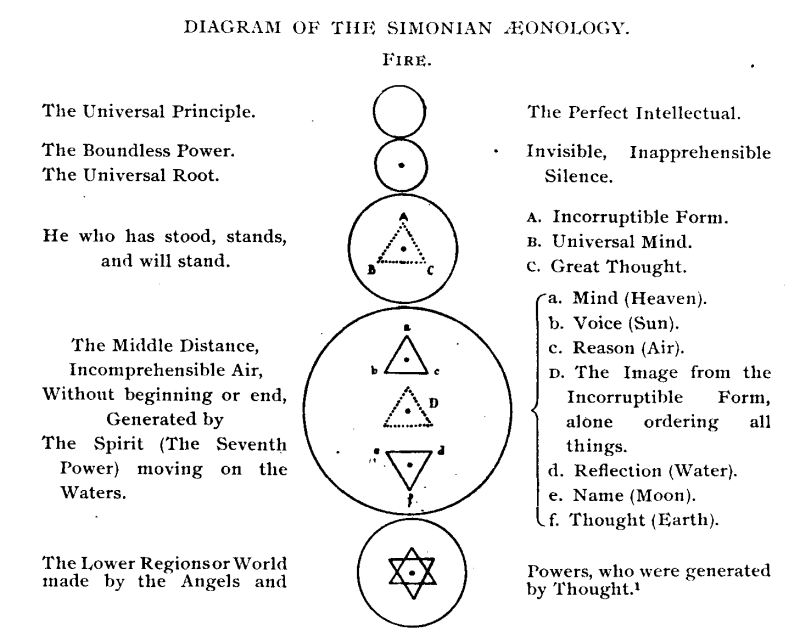
Before proceeding, a Diagram or Scheme of the Simonian Aeonology is apt, as Simon’s School likely had one, akin to the Ophites’ per Origen’s Contra Celsum.
Diagram of the Simonian Aeonology
A Diagram is just a symbolic mnemonic, offering merely a glimpse at one world-process facet. It’s a ladder’s step, useful for climbing, then set aside for the next. Euclid’s elements were but a prelude to grasping "Platonic Solids," themselves discarded when probing things’ essence, not appearance, however "typical" it seems.
Enough has been said of the Universal Principle, Universal Root, and Boundless Power—the Parabrahman (beyond Brahmâ), Mûla-Prakriti (Root-Nature), and Supreme Îshvara, the Unmanifested Eternal Logos of Vedântic thought. Next is the potential unmanifested Trinity, Three in One and One in Three—the Potentialities of Vishnu, Brahmâ, and Shiva, the Preservative, Emanative, and Regenerative Powers—the Supreme Logos, Universal Ideation, and Potential Wisdom, dubbed by Simon the Incorruptible Form, Universal Mind, and Great Thought. This Incorruptible Form is the Paradigm of all Forms, called Vishva Rûpam or All-Form and Param Rûpam or Supreme Form in the Bhagavad Gîtâ, also the Param Nidhânam or Supreme Treasure-house, which Simon terms the Treasure-house and Store-house—an idea widespread, most detailed in the Pistis-Sophia.
Between this Divine World, the Unmanifested Triple Aeon, and the Human World lies the Middle Distance—the Waters of Space, differentiated by the Triple Logos’s Image or Reflection brooding over them. With three Worlds—Divine, Middle, and Lower, aptly named Pneumatic (Spiritual), Psychic (Soul-World), and Hylic (Material) by Valentinians—the Middle Distance holds three or even seven planes. It spans the Invisible Spheres between the Physical and Divine Worlds. Spiritual Teachers across ages—the Initiated and Illuminati—have devoted much to explaining it. It’s both divine and infernal: its higher parts pure and spiritual, its lower corrupted and tainted. Analogy, imaging, and reflection govern all emanative nature. Though pure, spiritual ideas reach men from this Middle Distance, it also absorbs man’s impure thoughts and desires, making its lower realms fouler than the physical world, as secret passions outstrip deeds. Thus, it holds a Heaven and Hell, a Pneumatic and Hylic state.
This Middle World’s Lord is One in his Aeon, yet a reflection of the Unmanifested Logos’s triple radiance. This Manifested Logos is the Spirit moving on the Waters, its emanations or creations all triple. The triple Light above and triple Darkness below—force and matter, spirit and matter—owe their being and seeming opposition to the Mind, "alone ordering all things."
Mentally, the Diagram should place higher spheres within or interpenetrating the lower. The centre thus outweighs above or below. Outermost lies the Physical Universe, crafted by Hylic Angels—emanated by Thought, Epinoia, as Primeval Mother Earth or Matter’s Potencies, not our known Earth but the Adamic Earth of Philosophers, the Protyle modern Chemists seek as the One Mother Element, as Eugenius Philalethes swears no man has seen.
The Spirit of God moving on the Waters is a lovely image, detailed in Hindu scriptures. The Vishnu Purâna describes the Supreme Spirit’s emanation of this Universe at this Kalpa’s start, an infinity of Kalpas and Universes behind. Endowed with Goodness, the Pneumatic Potency, it creates. Nature’s three Qualities (Gunas) are Simon’s Waters’ Pneumatic, Psychic, and Hylic Potencies.
At the last (Pâdma) Kalpa’s end, divine Brahmâ, with goodness, awoke from sleep, seeing a void universe. He, supreme Nârâyana, incomprehensible, sovereign of all, took Brahmâ’s form—god without beginning, creator of all. Of his name Nârâyana, this verse repeats: "The waters are called Nârâ, offspring of Nara (supreme spirit); as his first progress (as Brahmâ) was in them, he’s named Nârâyana (he whose motion’s place was the waters)."
Sir Wm. Jones translates Manu’s famed verse:
The waters are called Nârâh, born of Nara, God’s spirit; as they were his first place of motion, he’s named Nârâyana, moving on the waters.
The Linga, Vâyu, and Mârkandeya Purânas echo this, the Bhâgavata elaborating:
Purusha (Spirit), splitting the egg (germ-universe), emerged, seeking a motion-place for himself, pure, creating pure waters.
In the Vishnu Purâna, Brahmâ tells Celestials:
I, Mahâdeva (Shiva), and you all are but Nârâyana.
The Divine Spirit moving and brooding over Space’s Primordial Waters—growing turbid with differentiation—is too vivid to need more explanation, hallowed by age and humanity’s assent, deserving our deepest awe.
Diagram discourse could stretch endlessly, but enough shows Simon’s ideas align with universal Theosophy.
Now, let’s explore Epinoia, Divine Thought, in the cosmic process, saving her human role for Simon’s soteriology. Here’s a take on the grand Sophia-mythus, vital in all Gnostic systems—both the mother-side of Divine Nature’s workings and the Divine Monad’s evolution through elemental spheres, lower kingdoms, to man.
Sophia-Epinoia’s mystery is vast, its origins unsolvable. How does the Divine descend and create Powers that bind their source? It’s the riddle of universe and man, soluble only by the Logos, whose self-sacrifice frees Sophia, the Soul, from her chains.
Epinoia bears many names: Mother, All-Mother, Mother of the Living, Shining Mother, Celestial Eve; Power Above; Holy Spirit—feminine in some systems, symbolically, especially the Mandaïtes’ Codex Nazaræus; She of the Left-hand, versus Christos, He of the Right-hand; Man-woman; Prouneikos; Matrix; Paradise; Eden; Achamôth; Virgin; Barbelo; Daughter of Light; Merciful Mother; Masculine One’s Consort; Revelant of Perfect Mysteries; Perfect Mercy; Revelant of All Magnitude’s Mysteries; Hidden Mother; Knower of the Elect’s Mysteries; Holy Dove, birthing two Twins; Ennoia—names varying by system, yet always the World-Soul in the Macrocosm and Soul in Man.
Epinoia is confined in every form, even the lowliest, for all within pulses with Life; each holds a Divine Fire spark, akin to the All. In the Roots and all things—built on their type—"the whole Boundless Power lies together in potentiality, not actuality."
Most systems say Sophia’s imprisonment stems from trying to create without her Syzygy, the Father or Nous, mimicking the Supreme’s self-generation alone. Through ignorance, she met suffering, freed by repentance and experience. What public explanation Simon offered we can’t know, as patristic accounts clash and confuse.
Irenæus says:
She was his Mind’s first Conception (Epinoia), the Mother of All, through whom he first conceived making Angels and Archangels. Leaping from him (Boundless Power) and knowing her Father’s will, she descended to Lower Regions, generating Angels and Powers, who he said made the world. After birthing them, envy detained her, as they shunned being seen as another’s offspring. He remained unknown to them; his Thought (Epinoia) was trapped by the Powers and Angels she birthed. She endured all indignities to block her return to her Father, even entering human bodies, shifting from one female form to another, like vessels.
Tertullian adds that "the Father’s design was thwarted," without saying how or why:
She was his first Suggestion, prompting the making of Angels and Archangels; sharing this, she sprang from the Father, leaping to Lower Regions. There, the Father’s design thwarted, she bore Angelic Powers ignorant of the Father, this world’s artificer (?); detained by them, not per his intent, lest her departure mark them as another’s progeny, etc.
The Philosophumena only note Epinoia "throws all World Powers into confusion with her unmatched Beauty."
Philaster muddies it further:
He dared say the World was made by Angels, birthed by heaven’s perceptive ones, who deceived humanity. He claimed another Thought (Intellectus) descended for man’s salvation.
Epiphanius complicates it:
This Power (Prunîcus and Holy Spirit), descending from Above, changed form. Through the Power Above, showing her beauty, she frenzied them, sent to despoil the World-making Rulers. Angels warred over her; she suffered nothing, while they slaughtered each other from desire she sparked.
Theodoret briefly tracks Irenæus.
These clashing tales blur Nous and Epinoia, Father and Thought, Spirit and Spiritual Soul. How did Lower Regions arise for Epinoia to descend? The Philosophumena’s fuller account shows self-emanation into matter by likeness, limiting "evil" to space and time, not an eternal principle. Naturally, "evil’s" origin isn’t fully solvable for man now, so whether it aligns or defies the Father’s design hinges on our viewpoint.
Law, Justice, and Compassion align for one spiritually steadfast; viewing evil as not inherent but born of ignorance suits the truly religious and philosophical mind. Evil isn’t fixed—it shifts with each person’s inner stance toward externals.
For example, killing isn’t evil for an animal or savage, lacking the higher law’s bright flame. Evil is only what displeases the Self. This may clarify Simon’s dogma of action by accident or institution, versus by nature—akin to Heracleitus’s call to act per nature, the Unmanifested Harmony heard by tuning to the still, small voice within, the Voice of the Silence, the Logos or Self. Simon likely nods to this with "the things which sound within," echoed by Psellus, citing a Logion:
When you see a holy, formless Fire shining and bounding through the Cosmos’s depths, heed the Voice of the Fire.
This leads to Simon’s teachings on the Lesser World, the Microcosm, Man, and his soteriology. He taught the ancient doctrine that Microcosmic Man mirrored and held the Cosmos’s potential, as noted earlier. What held for the Universe’s emanation held for Man; what was true of Macrocosmic Aeons was true of Man’s Microcosmic Aeons, potentially equal, growing into the Cosmos’s grandeur if given fit expression or vehicle. This explains why ancients said we perceive only what we already bear within. Thus, Empedocles taught:
By earth, earth we perceive; by water, water; by aether, aether; by fire, destructive fire; by friendship, friendship; strife by bitter strife.
If all’s potential dwelt in each, Q. Fabius Pictor’s saying rings true: "He who knows himself knows all in himself." Ancient moral and spiritual training thus hinged on Self-Knowledge—certainty of a divine nature in all, infinitely able to absorb universal Wisdom; in short, Man was one with Deity.
With Simon, as with Egypt’s Hermetic sages, all linked via correspondence, analogy, and likeness. "As above, so below," says Hermes’s Smaragdine Table. Thus, whatever befell the divine Epinoia, Supreme Mother, among Aeons, befell Man’s Spiritual Soul or Monadic Essence through all manifestation stages. This Soul is encased in all forms and bodies up to man’s stage.
Modern Science proves this from one angle, tracing external form’s evolution across kingdoms—now undisputed. Ancient evolution teachers, less precise in detail, were truer in positing a "something within" giving external evolution meaning. The formless Spiritual Soul—Life, Consciousness, Spirit, Intelligence—took new forms via metempsychosis, metasomatosis, metangismos, becoming reïncarnation in man, the Hindu Punarjanman.
Much has been written lately on metempsychosis and reïncarnation, so I won’t linger on this familiar idea. Broadly, all nature follows this existence mode; narrowly, it’s the Soul’s pilgrimage through Matter’s desert. In a philosophically settled concept—its "visible side" proven by Science’s evolution studies—rehashing superstitions like the Soul reverting to beasts wastes time. Such beliefs may stem from the lower Soul vestures shedding and merging with lesser creation in nature’s alchemy—the "Purgations" of the Soul—but once past lower kingdom bodies to man’s, the Soul can’t regress beyond that realm.
From the Diagram’s microcosmic view, man’s inner nature exceeds the simple Body, Soul, Spirit trichotomy. Each Being-plane, with its Soul Vesture, springs from an "indivisible point," a zero-point in modern Chemistry terms; six appear in the Diagram, bounding each plane like a Circle’s centre—everywhere, circumference nowhere.
On to Simon’s soteriology. Its general idea poses no hurdle for Eastern Religion students. Great teachers as Avatâras—Supreme Being incarnations aiding mankind—are simple to grasp, unobjectionable but for theological dogmas and myths often spun around them. Today, with past lessons in view, we needn’t clash over whether such a figure is fully divine, fully human, both, or neither.
Eastern philosophy, seeing the phenomenal world and all manifestation as ever-changing—not the one changeless Truth—shows why Gnostic Philosophers often held to Doceticism: the Saviour’s body wasn’t the Saviour, but an appearance. Polemical heat may have skewed both sides, but philosophically, the body as a mask of the real man, not his eternal own, isn’t distressing. Yet here, the body is real to us, as ours are alike, and appearances are real to appearances. Still, other bodies—vestures or consciousness vehicles—exist beyond the gross "coat of skin" for the spiritual man, each an "appearance" to the subtler one above.
In descending from the Divine World, the Soul transforms, weaving forms from its substance, akin to the Worlds’ Powers it traverses, each Soul bearing a unique consciousness vehicle per World or Plane.
The Soter or Saviour doctrine applies at the Christ-stage’s peak. Via rebirth, a spiritual life cycle threads earth-lives like beads, each purer and nobler as the Soul masters matter, the driver steering life’s chariot and steeds. As this cycle nears its end, an earthly vehicle emerges, fully showing the divine spirit possible in this evolution phase.
Viewed internally or externally, the Soul’s mystery unfolds as spirit’s involution into matter and matter’s evolution into spirit. Over-emphasizing one skews the process; neglecting either leaves the equation’s unknown unsolved. The Soul, a "lost sheep" in matter’s net, shifts bodies; the Spirit descends, transforming through spheres to free its Syzygy.
The Soul yearns for the Spirit, which cares for the Soul. The Simonians said:
The male (Heaven, Nous or Christ, Spiritual Soul) gazes from above, caring for its co-partner (Syzygy); the Earth (Epinoia or Jesus, Human Soul) below receives intellectual fruits from Heaven, akin to itself (essentially one with Nous).
Dramatized and personified, these Soul aspects become two figures—Simon and Helen, Krishna and Arjuna. In Canonical Gospels, John is the favored disciple, women sidelined. Gnostic Gospels elevate women, shedding light on the Magdalene’s tale that moves Christendom. In Pistis-Sophia, Mary Magdalene, most spiritual and intuitive, leads the disciples—a poignant nod to Christ’s love for her, "out of whom he cast seven devils."
This allegory, clear to comparative religion students, mirrors the seven Spiritual World Aeons or Soul aspects with seven earthly, impure reflections. As Buddhists have seven Cardinal Virtues, Prajnâ-Pâramitâs, so seven Cardinal Vices must be expelled by spiritual will before the repentant Mary, Human Soul, purifies.
This is Helen’s mystery, the "lost sheep," followed by the mystical marriage of the Lamb—the Human and Spiritual Soul’s union in man, oft-cited in Gospels and mystical texts.
The language is symbolic, unrelated to sex. Woe to those taking Soul allegories as literal tales, for sorrow follows such materialization. If Simon or his followers erred thus, they sealed their fate under the Great Law, as do all binding themselves in matter’s chains.
We shun condemnation; only the sinless may cast stones at Magdalenes, and the truly pure cleanse, not curse, with self-righteous stains. We, today’s ordinary folk, are all "lost sheep," struggling in ignorance. Shall we stone others for differing theology? Man’s hopes, fears, loves, hates, passions, and aspirations endure, despite expression’s form. What matters is our stance toward these forms. Today’s belief wears a scientific, not allegorical, garb, but are we closer to seeing it as mere dress, not the true man within?
Now, a brief look at the Symbolical Tree of Life, key in Simonian Gnosis, though not unique—many schools share it. In Pistis-Sophia, it expands into a Five Trees Aeonian Hierarchy, possibly a later twist. Turning to ancient Hindu Shâstras, the Ashvattha Tree, "of golden wings," offers the bird-souls wings to fly free, per the Sanatsujátîya. From the Bhagavad Gîtâ, a pre-Simon text, the fifteenth Adyâya begins:
They say the imperishable Ashvattha has roots above, branches below, its sacred hymns the leaves. Who knows this knows knowledge. Its branches stretch up and down, grown by potencies; sense-objects are its sprouts. Its roots stretch down too, binding to action in man’s world. Here, its form, end, beginning, or support isn’t grasped. Cutting this deep-rooted Ashvattha with detachment’s firm sword, one should seek the Supreme whence none return, thinking now he’s reached that primal Being, source of ancient evolution.
What is this "sword of detachment" but Simon’s "fiery sword," guarding the Tree of Life’s way? Our passions and desires block the golden-leaved Tree, whence wings lift us to the "Father in Heaven." Conquering Desire into spiritual Will, it becomes the "Sword of Knowledge," opening the Tree of Spiritual Life, where purified Life turns to the "Wings of the Great Bird," bearing us to its Nest of peace.
The Tree simile has many uses, like the heavenly "vine" of the reïncarnating Soul, each "life" a branch. This explains Simon’s use of Luke’s Logion:
Every tree not bearing good fruit is cut down and cast into the fire.
It also unveils an inner meaning in John’s Gospel:
I am the true vine, my Father the husbandman. Every branch in me not bearing fruit he takes away; every fruitful branch he purges to bear more.
Only each life’s spiritual fruit is stored in the Divine Soul’s "Store-house"; the rest sheds to purify in earthly existence’s "Fire."
We needn’t delve long into correspondences between Nature’s world-process and mortal woman’s womb. Simon likely taught many such links between Cosmic and Microcosmic Man, but details elude us. He may have erred in physiology by today’s standards, yet we must withhold judgment. We don’t know if patristic foes reported him accurately, and modern ignorance of foetal nourishment bars firm pronouncements. Simon’s view aligns more with Science than the early Fathers’ pious fancies. Whether ancients knew blood circulation and arterial roles is uncertain, their secrecy and missing texts urging caution.
Given the Tree’s role in Simon’s system, his school may have taught esoteric bodily correspondences for mystical ends, as India’s Yoga Science has long done. The human body holds at least two "Trees"—nervous and vascular systems. The former roots above in the cerebrum, the latter in the heart. "Nervous ether" and "life" currents flow along their trunks and branches, Yoga teaching their mystical use. Gnostics likely taught this too, as Neo-Platonists did. Simon may not have been as ignorant of blood circulation as supposed, and on embryo nourishment, he aligns with most modern views—that it’s via the umbilical cord.
The last key point before Simon’s magical practices is his allegorical use of Scripture. Details matter less than the concept. Ancients widely held that sacred writings’ mythic parts were allegorical. Beyond India, the Neo-Platonic School used analogetical interpretation, Porphyry allegorizing the Iliad. Lesser Mysteries staged allegorical shows, explained in the Greater, as Julian and Plutarch note.
Much evidence shows this was a common view among antiquity’s learned, though space limits full exploration. Simon claimed this method for his School, a vital factor we can’t ignore by taking allegories literally. The method may mislead and spawn superstition among the ignorant, but critiquing an allegory’s literal sense doesn’t touch its doctrine. Rationalistic critics of world bibles err thus, sidelining ancient teaching’s method, treating allegory as history. Perhaps as religion wanes and ignorance grows, the symbolic turns historical, spirit forgotten, letter deified—prompting rationalist reaction against materialism. Yet such critique doesn’t reach religion’s core truths or the soul’s convictions, any more than critiquing Roman letters or Arabic figures affects algebra’s truth. Rationalism may jolt literalism and dogma, but not the hidden doctrines.
Simon argued many scriptural tales were allegorical, opposing literalists. To comparative religion students, this seems praiseworthy, worthy of adoption today at century’s end. To grasp antiquity, we must follow its wise ones’ methods—allegory and parable, the great Masters’ way.
But if Scriptures hold inner meanings across all planes, who decides a just interpretation? Today, opposite readings of mystical tales emerge—an advance on physical literalism, yet disheartening to the philosophical mind.
If Deity favors no person, time, or nation, and no age lacks Divine witness, all pure religions may be one in essence, despite human error’s overgrowth. If Religion’s root is one, and the Soul’s nature and inner makeup are constant across climes and times in essence—whatever terms, allegories, or symbols describe it—and if these subjective realities are as potent in consciousness as any fact, proven by their unmatched sway over human hearts and history—then an interpretation fitting one system yet clashing with others isn’t universal, stemming more from the interpreter’s cleverness than a law of subjective nature. Only comparative religion offers interpretive certainty; refusing comparison undermines such enquiries’ reliability.
Simon sought inner meanings in scriptural tales and myths, drawing eclectically from known sacred literatures—a theosophical approach we can’t long dismiss even now.
The early church wasn’t as blind to symbology as most Christians today. The "Four Rivers" often graced primitive Christian art, the Rev. Professor Cheetham notes:
We see it repeated in catacomb frescoes, sarcophagi sculptures, and glass cup bottoms found there.
Early divines offered varied readings, usually fitting only Christianity, highlighting external differences. Few sought natural, objective, or subjective meanings in man. Simon tried broadening into a universal system for all, anytime—a spirit pure Christianity shares, often clouded by partisanship. True interpretation must endure religious aspiration, philosophical thought, and scientific scrutiny.
Nor should we lament Simon’s take on the Trojan Horse, crafted by Athena (Minerva-Epinoia), for George Stanley Faber labored to link it to the Ark. He merely recast myths into one, advancing little, but Simon outdid him theoretically by seeking a natural reading, calling it "ignorance." A full interpretation should span all consciousness and being planes, from human to cosmic. The Ark on Deluge Waters, Mundane Egg in Space’s Waters, and Mare with warriors all mirror a natural fact—scientifically the germ-cell’s growth, ethically the egg of ignorance, its germs our base passions.
In such allegories and embryological links, Simon speaks of the "cave," pivotal in religious tales. As a child births in a "cave," so the "new man" does; all Saviours’ birth legends note this. Antiquity’s Mysteries used caves or rock-cut temples. Epoptæ saw caverns as symbols of the physical world and Hades, the Unseen World encircling man. Cronus locked his children in such a cave mid-Ocean, called Petra or Rock, whence Mithras birthed, Porphyry says.
Faber ties this cave to the Ark, fair from one view, as nature’s and human wombs correspond.
In the Mysteries’ "new birth," Souls were bees born from an ox’s body, gathering wisdom’s honey from their dead lower natures. The cave had two doors—one for immortals, one for mortals—symbolizing the psychic womb around man, which Nicodemus misunderstands in the Gospels. It’s the microcosmic Middle Distance; the Lower Soul enters one, uniting with its immortal consort descending the other, becoming immortal.
An olive tree—the Tree of Life—overshadows the cavern, its branches hosting doves bearing leaves to the body’s ark and its captive.
Space bars deeper pursuit of this rich topic, needing its own treatise or volumes. Enough shows Simon’s interpretive method holds interest and value, and today’s tolerant spirit in Christendom’s best minds finds no cause for broad condemnation here.
Many other facets of Simon’s system fragments could be explored, but as an essay, not an exhaustive work, I’ll skip them now and turn to Magic, that strange, misunderstood subject.
What Magic, the ancients’ "Great Art," truly was is as hard to uncover as the true Religion beneath all great faiths. It was an art, a practice—the Supreme Art of the Sacred Science of God, Universe, and Man. In its highest sense, it is this still, its method akin to "creation." As Aeons mimicked the Boundless Power, emanating or creating, so man could mimic them, emanating or creating too. But "creation" isn’t generation—it’s a "mind" work in the loftiest sense. Through purification, aspiration, prayer, and fasting, man tuned his mind to the Universe’s Great Mind, crafting pure vehicles to carry consciousness everywhere. Such spiritual feats demanded utmost purity and piety—real, unmasked—for man faced himself and God, where no pretense held. Stern self-discipline bared the deepest motives and hidden desires.
Yet, like all here, Magic was dual. I’ve described its bright path, trod by World-Saviours, open only to hearts ablaze with love for all life, walking wisdom’s way to become that Path for humanity’s salvation. But there’s a dark side; knowledge serves good or ill, per the wielder’s selfishness. The sword of knowledge cuts both ways.
Corruptio optimi pessima—the best corrupted is the worst. Using wisdom for mankind’s good, like healing, is highest; wielding abnormal power for self is the vilest sin.
Nature holds odd parallels—the higher the spiritual, the lower the material counterpart—so magic’s vast history swings between extremes. Abuse of spiritual powers and vile physical acts—noxious, bizarre, pestilent—fill so-called magical texts, but these aren’t true Magic, any more than religious fanaticism’s horrors are true Mohammedanism or Christianity. They’re abuse, superstition, decay of the good and true, worse for touching denser matter planes. The highest pairing with the lowest in man is strange but true—the higher we climb, the lower we may fall.
Man’s nature persists across time. Though the Art shone pure with World-Teachers and their close followers—call it Magic or not—it always slid to abuse and decay due to man’s ingrained ignorance and selfishness. One nation’s Deity and Gods became another’s Devil and Demons; names changed, facts endured. Rejecting all as superstition sweeps away good with bad. If we cling to our Masters’ "miracles" and dismiss others as false, we falter. Nature knows no supernatural; man, midway between divine and infernal, demands we accept both nature’s poles if we accept one. Both rest on nature and science, under law and order.
Christendom’s great Master told disciples that with faith, they’d outdo his works. This is either false, or the followers failed him—no escape. Such "works" come by divine Magic alone—or whatever we name the great Science of Soul and Divine things.
For two centuries, deriding such matters was vogue, perhaps reacting to over-credulity fixated on law’s letter, not spirit. Today, ignoring this vital human facet is untenable; it demands scientific rigor like physical facts.
Hypnotism, Mesmerism, Spiritualism, and Psychical Research form a growing cloud forcing Magic’s facts on theological and scientific notice. Hypnotism and Psychical Research gain respect, drawing scientists and clergy. Spiritualism and Mesmerism, still shunned, await broader acceptance, already backed by pioneering scientists and professionals.
I speak of these arts’ facts, not their theories.
These linger in True Magic’s outermost court, if not beyond. Yet they suffice, urging the serious thinker to pause before crying "superstition" or "hallucination" too boldly, seeing now the need for clear definitions.
Lately, the shallowly learned chalk all to "suggestion" from hypnosis or "telepathy" from psychical research—ancient ideas—forgetting their stance matches their prior denial of both. To earnest students, these are public echoes of what always was, despite two centuries’ scoffing—not the whole, but spray from a psychism wave set to unbalance nations if they spurn past lessons for strength.
In the West, the Church’s ministers should wield these higher powers; then, we’d not see them in vulgar stage acts or paid mediumship.
Yet so it stands. Crying fraud, hallucination, or devil shirks duty. Only rational inquiry and high ideals aid humanity.
I won’t dissect Simon’s "wonders," denying them as hallucinations, blaming the devil, or waving them off with "suggestion." We don’t even know if Simon did or claimed these exact feats. We can only judge broadly: using abnormal power for self is ruinous, rebounding on the doer.
Amid patristic tales, a gem emerges—Simon denying a boy’s real soul could be exorcised, calling it a daemon, a sub-human elemental per Mediæval Kabalists. Simonians also expelled those worshipping Zeus or Athena statues as Simon and Helen, suggesting symbolic roles beyond usual reverence. In purity, the sect likely held teachings rationally interpreting religious practices, far from the Fathers’ wild diabolism charges.
Magic legends echo globally, fantastic to us now, likely bloated by tale-tellers’ imaginations, yet not all fancy. Sifting out most rubbish, the residue of main facts overwhelms, meriting every honest student’s study.
The task bristles with difficulty. Left to untrained thinkers—most current enthusiasts—it risks new credulity and superstition. This fault lies with religious, philosophical, and scientific leaders if they shirk their natural duty as popular mind’s guides, denying or merely condemning without explaining.
Facing Simon’s magical wonders in patristic tales, dismissing them as "superstition" won’t do. Ancients, Pagan and Christian, believed them real. Blank denial sweeps in Christianity’s and other faiths’ "miracles," negating a key religious thought factor. Denial may stem from ancients’ absurd explanations, but that doesn’t make rejecting such possibilities logical or scientific.
Simon’s wonders, though striking, pale beside the truly religious mind’s ideals. If he used them to prove his doctrine, he exploited public ignorance, betraying his better self.
Setting aside historical critique, if Simon, per Acts, thought to buy spiritual powers with money or that true possessors would sell, we grasp the apostles’ righteous anger, though not their cursing a fellow man. The Christian writer’s view here holds, but claiming all not in Christ’s name is evil struggles with those seeing humanity’s brotherhood and Deity as one, whatever the worship’s form.
To wrap up, we’ve cited and reviewed authorities, sifting good from the heap, leaving rubbish behind. Centuries past Christianity’s fierce rise, we can judge impartially, righting errors clear on orthodoxy’s and heterodoxy’s sides. We can’t escape the past, but clinging to its hates and strifes is regression. Instead, we should embrace its good, true, and beautiful, binding it into a sheaf—ground in common-sense and experience’s mills—to feed millions of all creeds, starving on dogmatism’s husks. No new revelation is needed, by any definition, but explaining old revelations and human experience’s undeniable facts is urgent. To cleanse today’s materialism clogging religion, philosophy, and science, only world-religions’ spiritual springs suffice, now buried under dogma and ignorance’s rocks. Explanation and investigation alone clear this, each worker—knowingly or not—joining the Hercules trailblazing humanity’s future.