by Ronald Regehr
The Alien Chaser
Don Ecker, Long Saga of Lunar Anomalies,
UFO magazine, Vol. 10, Nol 2 (March/April 1995), p. 23
from InformantNews Website
The moon is the Rosetta stone of the planets."—Robert JastrowFirst Chairman, NASA Lunar Exploration Committee
After hundreds of years of detailed observation and study, our closest companion in the vast universe, Earth’s moon, remains an enigma. Six moon landings and hundreds of experiments have resulted in more questions being asked than answered. Among them:
1. Moon’s Age: The moon is far older than previously expected. Maybe even older than the Earth or the Sun. The oldest age for the Earth is estimated to be 4.6 billion years old; moon rocks were dated at 5.3 billion years old, and the dust upon which they were resting was at least another billion years older.
2. Rock’s Origin: The chemical composition of the dust upon which the rocks sat differed remarkably from the rocks themselves, contrary to accepted theories that the dust resulted from weathering and breakup of the rocks themselves. The rocks had to have come from somewhere else.
3. Heavier Elements on Surface: Normal planetary composition results in heavier elements in the core and lighter materials at the surface; not so with the moon. According to Wilson,"The abundance of refractory elements like titanium in the surface areas is so pronounced that several geologists proposed the refractory compounds were brought to the moon’s surface in great quantity in some unknown way. They don’t know how, but that it was done cannot be questioned."4. Water Vapor: On March 7, 1971, lunar instruments placed by the astronauts recorded a vapor cloud of water passing across the surface of the moon. The cloud lasted 14 hours and covered an area of about 100 square miles.
5. Magnetic Rocks: Moon rocks were magnetized. This is odd because there is no magnetic field on the moon itself. This could not have originated from a "close call" with Earth—such an encounter would have ripped the moon apart.
6. No Volcanoes: Some of the moon’s craters originated internally, yet there is no indication that the moon was ever hot enough to produce volcanic eruptions.
7. Moon Mascons: Mascons, which are large, dense, circular masses lying twenty to forty miles beneath the centers of the moon’s maria,"are broad, disk-shaped objects that could be possibly some kind of artificial construction. For huge circular disks are not likely to be beneath each huge maria, centered like bull’s-eyes in the middle of each, by coincidence or accident."8. Seismic Activity: Hundreds of "moonquakes" are recorded each year that cannot be attributed to meteor strikes. In November, 1958, Soviet astronomer Nikolay A. Kozyrev of the Crimean Astrophysical Observatory photographed a gaseous eruption of the moon near the crater Alphonsus. He also detected a reddish glow that lasted for about an hour. In 1963, astronomers at the Lowell Observatory also saw reddish glows on the crests of ridges in the Aristarchus region. These observations have proved to be precisely identical and periodical, repeating themselves as the moon moves closer to the Earth. These are probably not natural phenomena.
9. Hollow Moon: The moon’s mean density is 3.34 gm/cm3 (3.34 times an equal volume of water) whereas the Earth’s is 5.5. What does this mean? In 1962, NASA scientistDr. Gordon MacDonald stated,"If the astronomical data are reduced, it is found that the data require that the interior of the moon is more like a hollow than a homogeneous sphere."Nobel chemist Dr. Harold Urey suggested the moon’s reduced density is because of large areas inside the moon where is "simply a cavity."MIT’s Dr. Sean C. Solomon wrote,"the Lunar Orbiter experiments vastly improved our knowledge of the moon’s gravitational field... indicating the frightening possibility that the moon might be hollow."In Carl Sagan’s treatise, Intelligent Life in the Universe, the famous astronomer stated, "A natural satellite cannot be a hollow object."
10. Moon Echoes: On November 20, 1969, the Apollo 12 crew jettisoned the lunar module ascent stage causing it to crash onto the moon. The LM’s impact (about 40 miles from the Apollo 12 landing site) created an artificial moonquake with startling characteristics—the moon reverberated like a bell for more than an hour.This phenomenon was repeated with Apollo 13 (intentionally commanding the third stage to impact the moon), with even more startling results. Seismic instruments recorded that the reverberations lasted for three hours and twenty minutes and traveled to a depth of twenty-five miles, leading to the conclusion that the moon has an unusually light—or even no—core.
11. Unusual Metals: The moon’s crust is much harder than presumed. Remember the extreme difficulty the astronauts encountered when they tried to drill into the maria? Surprise! The maria is composed primarily illeminite, a mineral containing large amounts of titanium, the same metal used to fabricate the hulls of deep-diving submarines and the skin of the SR-71 "Blackbird". Uranium 236 and neptunium 237 (elements not found in nature on Earth) were discovered in lunar rocks, as were rustproof iron particles.
12. Moon’s Origin: Before the astronauts’ moon rocks conclusively disproved the theory, the moon was believed to have originated when a chunk of Earth broke off eons ago (who knows from where?). Another theory was that the moon was created from leftover "space dust" remaining after the Earth was created. Analysis of the composition of moon rocks disproved this theory also.Another popular theory is that the moon was somehow "captured" by the Earth’s gravitational attraction. But no evidence exists to support this theory. Isaac Asimov, stated,"It’s too big to have been captured by the Earth. The chances of such a capture having been effected and the moon then having taken up nearly circular orbit around our Earth are too small to make such an eventuality credible."13. Weird Orbit: Our moon is the only moon in the solar system that has a stationary, near-perfect circular orbit. Stranger still, the moon’s center of mass is about 6000 feet closer to the Earth than its geometric center (which should cause wobbling), but the moon’s bulge is on the far side of the moon, away from the Earth. "Something" had to put the moon in orbit with its precise altitude, course, and speed.
14. Moon Diameter: How does one explain the "coincidence" that the moon is just the right distance, coupled with just the right diameter, to completely cover the sun during an eclipse? Again, Isaac Asimov responds,"There is no astronomical reason why the moon and the sun should fit so well. It is the sheerest of coincidences, and only the Earth among all the planets is blessed in this fashion."15. Spaceship Moon: As outrageous as the Moon-Is-a-Spaceship Theory is, all of the above items are resolved if one assumes that the moon is a gigantic extraterrestrial craft, brought here eons ago by intelligent beings. This is the only theory that is supported by all of the data, and there are no data that contradict this theory.
Greek authors Aristotle and Plutarch, and Roman authors Apolllonius Rhodius and Ovid all wrote of a group of people called the Proselenes who lived in the central mountainous area of Greece called Arcadia. The Proselenes claimed title to this area because their forebears were there "before there was a moon in the heavens."
1. Ages of Flashes: Aristarchus, Plato, Eratosthenes, Biela, Rabbi Levi, and Posidonius all reported anomalous lights on the moon. NASA, one year before the first lunar landing, reported 570+ lights and flashes were observed on the moon from 1540 to 1967.
2. Operation Moon Blink: NASA’s Operation Moon Blink detected 28 lunar events in a relatively short period of time.
3. Lunar Bridge: On July 29, 1953, John J. O’Neill observed a 12-mile-long bridge straddling the crater Mare Crisium. In August, British astronomer Dr. H.P. Wilkens verified its presence,"It looks artificial. It’s almost incredible that such a thing could have been formed in the first instance, or if it was formed, could have lasted during the ages in which the moon has been in existence."4. The Shard: The Shard, an obelisk-shaped object that towers 1½ miles from the Ukert area of the moon’s surface, was discovered by Orbiter 3 in 1968. Dr. Bruce Cornet, who studied the amazing photographs, stated,"No known natural process can explain such a structure."5. The Tower: One of the most curious features ever photographed on the Lunar surface (Lunar Orbiter photograph III-84M) is an amazing spire that rises more than 5 milesfrom the Sinus Medii region of the lunar surface.
6. The Obelisks: Lunar Orbiter II took several photographs in November 1966 that showed several obelisks, one of which was more than 150 feet tall.". . . the spires were arranged in precisely the same was as the apices of the three great pyramids."
by Rick-AngelOfThyNight
from ParanormalGhostSociety Website
Our Moon roughly 239,000 miles away and roughly the size of the USA around 2000 miles in diameter and is still one of the biggest mysteries of all time.
Anybody can view it in there telescope and anybody can occasionally spot anomalies of unknown origin. Nobody knows what's on the dark side of the moon but if the lighter side of the moon has buildings, cities, structures then its quite probable that the dark side contains the same thing.
What got me into the moon as a kid is how large and yellow it looked one time popping over some railroad tracks then later when I was about 19 I found a photo with a structure that looked like a ship on the moon or barge.
There is a lot of speculation that the moon landings were faked because it was a way to end the cold war between the countries of course there are many sites that explain that out there but mainly what I want to cover is the moon itself.
First of all some say the moon came from earth it was a part of it and broke off I find this hard to believe since the Moon is spherical shaped not like an asteroid space rock.
I mean we all know that planets have moons some are almost like worlds of their own.
My theory is though that our moon was not always near earth unlike other moons. I believe our moon may have been bombarded somewhere else in our galaxy and so it traveled slowly and millions of years later it got caught in the earths gravitational field. The other theory I may have is that the moon is a base of some kind that is a disguise. Can you imagine what this could serve for a species of aliens?
Millions of them could live underground or on the surface or possibly did at one time. But see here is the scenario earth is close to the moon, earth is close to Mars both seem to have structures on it?
Why? simple we are being watched or civilizations that started off on the moon possibly started life on earth. Lets say the moon had water and an atmosphere lets say it was bombarded by a huge asteroid storm then its possible that the civilization on the moon fled to earth. If you refer to my Cydonia and Ancient mystery pages it will help you better understand our past and some extraterrestrial origins etc.
The moon plays a big part for this planet it changes the tides, lights up the night sky's and even is said to change our moods. Another possibility for its many craters is that since it already has no atmosphere nothing can burn up when it hits the moon. As far as the structures on the moon they look like buildings, ships, cities, canals things of that sort. Some of them exist in the craters themselves which means that they had to be built after the moons fate because any asteroid would pretty much obliviate anything it hits.
In theory I think aliens are on the moon, I think there was a civilization connected to mankind somehow on the moon and I think alot more remains to be seen. Ask yourself this why do we never go back to our moon if we already been there? Why do we not collect more data, check out the dark side, get more rocks, explore some of the moons caves, dig in the moons ground etc after all out moon is very large. I believe half of the mystery of this planet at least one half of it exist on the moon.
Therefore it remains a mystery.
The Spaceship Moon Theory
In July 1970, two Russian scientists offered a bizarre theory of the origins of the moon. Michael Vasin and Alexander Scherbakov published an article in the Soviet journal Sputnik entitled "Is the moon a creation of alien intelligence?"
The Soviet scientists put forward the belief that the moon is not a completely natural world but a planetoid, hollowed out eons ago in the far reaches of space. Huge machines were used to melt rock and form large cavities within the moon, spewing the molten refuse onto the surface. Protected by a hull-like inner shell plus a reconstructed outer shell of metallic rocky junk, this gigantic craft was steered through the cosmos and finally parked in orbit around our earth.
The theory was re-vitalized in 1975 with the publication of Our Mysterious Spaceship Moon by Don Wilson. He stated that,
"Too many pieces of evidence seem to fit to reject the theory without investigation."
There is even tantalizing evidence that in the dim recesses of human memory there have been recollections of a time before the arrival of the moon. Aristotle told of a people who lived in Arcadia, a mountainous region in Central Greece, long before the coming of the Greeks. The Greek term Proscelene means before the moon. In Tibetan texts there are stories of a people on a lost continent called Gondwana, said to be civilized before the moon shone in the night sky.
Bolivian symbols have been interpreted by Dr. P. Allen as records that a satellite came into orbit around the Earth about 11,500 to 13,000 years ago.
Where did the moon come from?
As there is very little similarity between the moon and earth, the old theory that the moon broke off our planet and ended up in its orbit can be discounted.
It is well accepted that the moon originated in other parts of the universe before moving into the earths orbit. Author and science expert, Isaac Asimov believed that the moon was too large to have been captured by our orbit. The orbit of the moon itself is also enigmatic. It is a perfect circle and stationary, with only one side being exposed to earth. As far as we know, the moon is the only natural satellite with such an orbit.
Author and expert on the ancient Sumerian civilization, Zecharia Sitchin also had an interest in the moon. Our mysterious satellite has caused much argument among scientists with respect to its age and origin (Go to our moon mysteries page for more information).
Sitchin wrote in his book Genesis Revisited (1990), some answers are provided if we go back to the Sumerian cosmology. The assertion here is that the moon originated not as a satellite of Earth but the much larger planet, Tiamat, which is placed beyond Mars.
The Sumerian cosmology describes an unstable solar system caused by emerging gravitational forces disturbing planetary balance and causing moons to grow disproportionately. According to the Sumerians, one of the eleven moons of Tiamat grew to an unusual size. and proved to be increasingly disruptive to the other planets. It was named 'Kingu'.
In an ensuing celestial battle, Tiamat was split in two; one half was shattered; the other half, accompanied by Kingu, was thrust into a new orbit to become the Earth and its moon.
The mystery of the lunar eclipse?
Why is it that the moon is just the right distance from the earth to completely cover the sun during an eclipse?
While the diameter of the moon is a mere 2,160 miles against the sun's gigantic 864,000 miles, it is never the less in just the proper position to block out the suns corona when it moves between the sun and earth. Isaac Asimov explains, "there is no reason why the moon and the sun should fit so well.
It is the sheerest of coincidences, and only the Earth is among all the planets blessed in this fashion.
The moon older than the earth and sun?
It is believed that the moon could possibly be older than the earth and sun. Scientists have dated some moon rocks as billions of years old. Some have been dated back as far as 4.5 billion years.
Scientists nowadays accept the moon to be 4.6 billion years old.
Harvard's respected astronomy journal, Sky and Telescope, reported that at a lunar conference in 1973 dated a lunar rock as 5.3 billion years old which would make it almost a billion years older than our planet.
Harvard's respected astronomy journal, Sky and Telescope, reported that at a lunar conference in 1973 dated a lunar rock as 5.3 billion years old which would make it almost a billion years older than our planet.
Titanium and rust proof rocks!
Scientists found that the crushed up rocks on the moon is of another world.
Analysis has shown that the moon rocks are of a completely different composition to the soil around them. Some of the rocks gathered by a Soviet mission in 1970 were resistant to rusting. This is not a feature of any metal known to man and years ahead of our technology.
The moon has three distinct layers of rocks. Contrary to the idea heavier rocks sink, the heavier rocks are found on the surface.
The moon has three distinct layers of rocks. Contrary to the idea heavier rocks sink, the heavier rocks are found on the surface.
Stated Don Wilson,
"The abundance of titanium and other refractory elements in the surface areas is so pronounced that several geo-chemists proposed that refractory compounds were bought to the moon's surface in great quantity in some unknown way. That this was done cannot be questioned. These materials which are usually concentrated towards the interior of a world are now on the outside."
Earl Ubel, who was a former science director for CBS Television added to the mystery by stating that,
"The first layer (20 miles deep), consists of lava-like material similar to lava flows on Earth. The second, extending down to 50 miles, is made up of somewhat denser rock. The third, continuing to a depth of at least 80 miles and probably below, appears to be of a heavier metal, similar to the Earth's mantle."
Many of the rock samples discovered on the moon have also been found to be magnetized. It has been suggested that this is due to their exposure to the magnetism present on earth.
Others have rebutted this claim by arguing that if such an influence was placed on the moon, the earths magnetism would have caused the destruction of the moon and its orbit many millions of years ago.
Huge disk shaped objects located beneath the moons lava seas!
The moon has large seas of smooth molten rock. Known as 'maria', four fifths of these are on the Earth-side hemisphere. In the centre of these maria, huge disk-shaped objects have been detected lying 20 to 40 miles below the surface.
The objects are referred to as 'mascons' and they are said to be located like a bulls-eye at the centre of the marias. The mascons were first discovered because their density distorted the orbits of objects flying over or near them.
Some scientists have theorized that the mascons are heavy iron ore meteorites that plunged into the moon when it was in a soft and formable state.
Volcanic activity on the moon?
In 1963 astronomers at the Lowell Observatory saw a reddish glow on the crests of the ridges in the Aristarchus region.
This was after a similar glow and gaseous explosions were photographed by Russian astronomer Nikolay A. Kozyrev in 1958. Other observatories also reported red glow. Although the moon is deemed to be volcanically dead it seems that there is certainly something creaking in its interior.
Seismographic equipment left at six separate sites on the moon by the Apollo missions picked up a great deal of activity until it ceased operating in 1977.
Operation Moonblink
In the early nineteenth century, Sir John Herschel in England saw unidentified lights on the moon during an eclipse and noted that some of the lights appeared to be moving above the moon.
Other astronomers of the period also reported seeing a geometrical pattern of lights that resembled city streets. In the mid 1960's NASA established the operation to investigate many strange flashes of light over the moon. The space association had received reports of many extraordinary lunar events.
In 1959 a dark object had been observed hovering over the moon for two hours. On July 29, John O'Neill observed a nineteen kilometer long bridge strabbling the crater Mare Crisium. One month later famous British astronomer Dr H. Wilkins verified the sighting.
In the twelve months to September 1966, Operation Moonblink had detected 28 unusual lunar events.
In 1968 an obelisk shaped object was discovered. This became known as the 'Shard'. The object rose nearly two and a half kilometers above the Urkert area of the moon's surface, which rises more than eight kilometers from the Sinus Medii region.
In 1959 a dark object had been observed hovering over the moon for two hours. On July 29, John O'Neill observed a nineteen kilometer long bridge strabbling the crater Mare Crisium. One month later famous British astronomer Dr H. Wilkins verified the sighting.
In the twelve months to September 1966, Operation Moonblink had detected 28 unusual lunar events.
In 1968 an obelisk shaped object was discovered. This became known as the 'Shard'. The object rose nearly two and a half kilometers above the Urkert area of the moon's surface, which rises more than eight kilometers from the Sinus Medii region.
No known natural process can explain the structure.
Is the moon hollow?
There are many indications that the moon is hollow.
The moon's mean density- about 3.34 grams per cubic centimeter is significantly less than the 5.5 gram density of the earth's mantle. This density indicates that the moon may not have a core.
The most starling evidence came on November 20 1969, when the Apollo 12 crew, after returning to their command ship, sent the lunar module ascent stage crashing down back on to the moon, creating an artificial earthquake. The crash site was 40 miles from where the astronauts had left their seismic devices. The ultra sensitive equipment recorded the moon ringing like a bell for more almost forty minutes. The vibration took almost eight minutes to reach a peak and then diminished in intensity.
This ringing was repeated when the Apollo 13's third stage fell to the lunar surface, striking with the equivalent of eleven tons of TNT. According to NASA, this time the moon reacted like a gong.
The most starling evidence came on November 20 1969, when the Apollo 12 crew, after returning to their command ship, sent the lunar module ascent stage crashing down back on to the moon, creating an artificial earthquake. The crash site was 40 miles from where the astronauts had left their seismic devices. The ultra sensitive equipment recorded the moon ringing like a bell for more almost forty minutes. The vibration took almost eight minutes to reach a peak and then diminished in intensity.
This ringing was repeated when the Apollo 13's third stage fell to the lunar surface, striking with the equivalent of eleven tons of TNT. According to NASA, this time the moon reacted like a gong.
Although seismic equipment was 108 miles from the crash site, recordings showed reverberations lasted for three hours and twenty minutes and traveled to a depth of twenty-two to twenty-five miles. Subsequent studies of man-made crashes yielded similar results. After one impact the moon reverberated for four hours.
On March 13, 1972, a large meteorite struck the moon with the equivalent off 200 ton of TNT. After sending shockwaves deep into the interior of the moon, scientists were baffled to find that none returned, concerning there is something unusual about the moon's core.
It seems the moon has a tough outer shell but a light, or non-existent interior.
On March 13, 1972, a large meteorite struck the moon with the equivalent off 200 ton of TNT. After sending shockwaves deep into the interior of the moon, scientists were baffled to find that none returned, concerning there is something unusual about the moon's core.
It seems the moon has a tough outer shell but a light, or non-existent interior.
Lunar Life or Transient Phenomena?
The Moon is far from being an inert and lifeless world.
Many centuries of observation have noted occurencies on the lunar surface which take the form of glows, mists, flashes and similar illuminations. They have become more popularly described as Lunar Transient Phenomena (LTP), thanks to noted astronomer Patrick Moore who coined the phrase. It largely encompasses all such recorded signs of activity now generally thought to be volcanic in nature.
Ancient peoples throughout the world held the moon and its periodic eclipses in awe and for many it was a source of worship. From this sprang numerous intriguing myths and legends, including the notion firmly held by many Greeks that this small neighbor of Earth's was inhabited also. Lucian of Samosata, although Syrian, was a widely regarded Greek satirist and lyracist.
He first wrote of his travels to that "great country in the air" in a published work entitled: 'True History'.
Although more fiction that fact, it told the tale of a voyage in a sailing ship carried aloft by a whirlwind to the moon and a subsequent meeting with its inhabitants; claimed to be much like those of Earth.
In 1516 Lodovico Ariosto wrote an epic poem in which the theme was a lunar trip by way of "firie chariet". The astronomer Johannes Kepler, who published his famous 'Laws of Planetary Motion' between 1609 and 1618, also wrote 'Dream'; a book full of fantasies and visions based on the science of the day that included the idea of moon-dwellers. It was in the same year, 1634, that Lucian of Samosata's original work was first published in England.
Now the idea of life on other worlds was beginning to form in earnest and Bishop Francis Godwin pursued this theme four years later when he wrote: 'The Man in the Moon'. It recorded the adventures of a fictitious Spaniard, Domingo Gonzales, who trained large birds for an eventful trip that was to take him eleven days. So popular was this and other stories that moon voyages appeared in over 200 published accounts during the 17th century.
Moon-men were an emerging breed and their strange world was to become the object of increasing interest and speculation. It led to respected astronomers such as Sir William Herschel devoting much of their time to observing the lunar surface.
In 1516 Lodovico Ariosto wrote an epic poem in which the theme was a lunar trip by way of "firie chariet". The astronomer Johannes Kepler, who published his famous 'Laws of Planetary Motion' between 1609 and 1618, also wrote 'Dream'; a book full of fantasies and visions based on the science of the day that included the idea of moon-dwellers. It was in the same year, 1634, that Lucian of Samosata's original work was first published in England.
Now the idea of life on other worlds was beginning to form in earnest and Bishop Francis Godwin pursued this theme four years later when he wrote: 'The Man in the Moon'. It recorded the adventures of a fictitious Spaniard, Domingo Gonzales, who trained large birds for an eventful trip that was to take him eleven days. So popular was this and other stories that moon voyages appeared in over 200 published accounts during the 17th century.
Moon-men were an emerging breed and their strange world was to become the object of increasing interest and speculation. It led to respected astronomers such as Sir William Herschel devoting much of their time to observing the lunar surface.
He himself recorded on two consecutive nights in April, 1787 three bright white spots on the earth-lit side of the moon which he concluded could only have been volcanoes. In 1822 German astronomer Franz von Paula Gruithuisen announced he had discovered a "lunar city" possessing "dark gigantic ramparts". These were to be identified later as consisting of nothing more than haphazard surface ridges.
It was shrewd American news reporter Richard Lock who became the first person to recognize an opportunity for personal fame and fortune, when in 1835 he successfully duped the New York Sun and its readership. In August that year the newspaper was to publish the first of his amazing accounts alleging that Sir John Herschel, son of William, was using a revolutionary new lunar telescope at a site in Southern Africa and through it had observed goat-like creatures ambling about on the moon's surface.
It was shrewd American news reporter Richard Lock who became the first person to recognize an opportunity for personal fame and fortune, when in 1835 he successfully duped the New York Sun and its readership. In August that year the newspaper was to publish the first of his amazing accounts alleging that Sir John Herschel, son of William, was using a revolutionary new lunar telescope at a site in Southern Africa and through it had observed goat-like creatures ambling about on the moon's surface.
The tale gradually unfolded during the next week as successive editions of the Sun carried ever-more colorful descriptions of flora and fauna, also islands, rivers, birds and beasts. Meanwhile, poor Herschel remained oblivious to these events.
Lock possessed a nifty turn-of-phrase and capitalized on the limitations imposed on communications in the early 19th century. He milked it for all he was worth while the hoax continued, first ensnaring rival newspapers and then even eminent scientists on both sides of the Atlantic.
Lock possessed a nifty turn-of-phrase and capitalized on the limitations imposed on communications in the early 19th century. He milked it for all he was worth while the hoax continued, first ensnaring rival newspapers and then even eminent scientists on both sides of the Atlantic.
Readers avidly absorbed every word and were captivated by flowery descriptions of great works supposedly wrought on the lunar surface, such as this:
"A lofty chain of obelisk-shaped or very slender pyramids standing in irregular groups, each composed of about thirty or forty spires, every one of which was perfectly square."
Lock crowned his literary achievement one week later by introducing into the narrative a colorful report of the lunar inhabitants.
These hairy winged creatures were said to be four feet in height and "covered, except on the face, with short and glossy copper-colored hair, lying snugly on their backs. The face, which was of a yellowish flesh-color, was a slight improvement upon that of an orang-outang."
A rival newspaper subsequently exposed the whole things as being a hoax, although it took until mid-September before the Sun newspaper, who became willing partners in the deception, grudgingly owned up to it. Herschel for his part was to learn of this duplicity some time later and continued his observations at the Cape apparently somewhat amused at the claims and following furor in both America and Europe.
Lunar observers such as W.H.Pickering spent many years at the turn of this century mapping what he himself often described as "canals" present on the moon's seemingly ever-changing landscape. These maze of lines were observed to intersect mysterious dark spots, much in the manner of those more famous Martian canals which had been recoded by Shiaparelli and announced to the world in 1877.
A rival newspaper subsequently exposed the whole things as being a hoax, although it took until mid-September before the Sun newspaper, who became willing partners in the deception, grudgingly owned up to it. Herschel for his part was to learn of this duplicity some time later and continued his observations at the Cape apparently somewhat amused at the claims and following furor in both America and Europe.
Lunar observers such as W.H.Pickering spent many years at the turn of this century mapping what he himself often described as "canals" present on the moon's seemingly ever-changing landscape. These maze of lines were observed to intersect mysterious dark spots, much in the manner of those more famous Martian canals which had been recoded by Shiaparelli and announced to the world in 1877.
Pickering went on to claim that he had identified vegetation, along with "river-beds" and active volcanoes, or geysers. From his vantage point in the hills of Jamaica during 1919-24 the astronomer believed he was witness to the migratory passage of small insects or animals, in their leisurely traversing of the area around the moon's Eratosthenes crater.
Throughout the last 200 years many lunar observers have reported witnessing the brief appearance of inexplicable mists, cloud-like shapes, glows and flashes on a seemingly lifeless gray world. Walter H.Haas, who wrote in 1942 that Sir William Herschel's white spots on the moon might have been the impact flare of a large meteorite, himself observed a "milky luminosity" present on the wall of the crater Tycho.
Throughout the last 200 years many lunar observers have reported witnessing the brief appearance of inexplicable mists, cloud-like shapes, glows and flashes on a seemingly lifeless gray world. Walter H.Haas, who wrote in 1942 that Sir William Herschel's white spots on the moon might have been the impact flare of a large meteorite, himself observed a "milky luminosity" present on the wall of the crater Tycho.
Astronomer F.H.Thornton reported seeing "a puff of whitish vapour obscuring details for some miles," one February night in 1949.
That same year, Spanish engineer Sixto Campo seriously promoted the theory that a technologically advanced civilization had once waged nuclear war against itself on the lunar surface. Annihilation followed swiftly for all he claimed and the resulting craters remain as testament to the holocaust on a now dead world. However, red glows continue to be observed in the region of the moon's north pole and blue misty glows have been periodically noted near craters at the south pole.
Russian astronomer N.A.Kozyrev, has recorded via spectrograms numerous incidents of red transient lunar phenomena, particularly in the 80-mile wide crater known as Alphonsus. It was at this location in 1965 that the final Ranger probe 9 crash-landed.
That same year, Spanish engineer Sixto Campo seriously promoted the theory that a technologically advanced civilization had once waged nuclear war against itself on the lunar surface. Annihilation followed swiftly for all he claimed and the resulting craters remain as testament to the holocaust on a now dead world. However, red glows continue to be observed in the region of the moon's north pole and blue misty glows have been periodically noted near craters at the south pole.
Russian astronomer N.A.Kozyrev, has recorded via spectrograms numerous incidents of red transient lunar phenomena, particularly in the 80-mile wide crater known as Alphonsus. It was at this location in 1965 that the final Ranger probe 9 crash-landed.
Aristarchus is not only one of the brightest formations on the moon, it is responsible for more than half the number of reported TLP and has been a proven source for gaseous emissions.
Strange Lunar ShadowsBy JJ
The first of the two mysterious incidents I’ve chosen happened on the night of 3 July 1882. For 45 minutes the residents of Lebanon, Connecticut, were treated to a bizarre lunar display:
“Two pyramidal luminous protuberances appeared on the moon’s upper limb. They were not large, but gave the moon a look strikingly like that of a horned owl... . These points were a little darker than the rest of the moon’s face. They slowly faded away a few moments after their appearance, the one on the right...disappearing first.About three minutes after their disappearance two black triangular notches were seen on the...lower half of the moon. These points gradually moved toward each other along the moon’s edge, and seemed to be...obliterating nearly a quarter of its surface, until they finally met, when the moon’s face assumed its normal appearance.”
The “pyramidal luminous protuberances” bring to mind the “strange pyramid of light” seen in 1519.
I also noted similarities in the Sunday Telegraph’s report [30 July 2000] that, on 18 June,
“two large triangular objects were seen flying over Charlesville-Mézières and Villers-Semeuse in eastern France. They made a loud, strange engine noise and swooped down to roof height.They had metallic bars beneath the engines, with lights at either end. Half an hour earlier and about 200 miles...south-west, Thierry Garnier was... on the outskirts of Gasny when he saw a strong white luminous flash approaching from the east.”
Were these two events connected? Were they the triangular UFOs I wrote about in Into the Triangle and Beyond...?
I can’t believe, though, that the military would’ve risked flying aircraft so low over urban areas. But would aliens have had such a fit of bravado either? Do the three incidents from different centuries [especially the flashes and fading - think of the Back To The Future films] suggest time travel or a ‘time warp’?
It’s been said that, what passes for years or even centuries in Earth time, in alien terms may only be a matter of days, weeks or months. This would explain sightings of certain UFO types, such as these triangles, the Flying Wheels, ‘cigars’, etc, from ancient times onwards. Maybe they’re even the same craft and navigators!
The second occurrence took place on 27 January 1912, and was witnessed by Dr. F.B. Harris:
It’s been said that, what passes for years or even centuries in Earth time, in alien terms may only be a matter of days, weeks or months. This would explain sightings of certain UFO types, such as these triangles, the Flying Wheels, ‘cigars’, etc, from ancient times onwards. Maybe they’re even the same craft and navigators!
The second occurrence took place on 27 January 1912, and was witnessed by Dr. F.B. Harris:
“At 10:30 Eastern time I was surprised to see the left cusp showing the presence of an intensely black body about 250 miles long and 50 wide, allowing 2000 miles from cusp to cusp,...in shape like a crow poised.Of course dark places are here and there on the lunar surface, but not like this... . I will say every effort was made to eliminate any error of vision or other mistake... The moon is very tricky... I cannot but think that a very interesting and curious phenomenon has happened.”
But what was it?
Well... apparently there exists a high quality photo [1950s or 1960s, I think] of a vast starship flying over the Moon, snapped by an astronomer.
It is said to be an intergalactic craft, several miles long, and capable of carrying thousands at a time! If anyone has any further info, please let me know. An image would be great!!
Some Astounding Lunar Anomaly Images
Below you will find some of the lunar anomalies. These are collected from NASA, Clementine, Hoagland and some other famous sourced. Some of these photos were taken from the Apollo missions from space, others taken from Satellite.
I want you to put things into perspective and think about these images after viewing them.
Consider this other most of the anomalies are glass since they give off reflections.
Most of the anomalies are HUGE. The bridge is said to be 12 miles, the shard tower is said to be 1.5 miles high and there is said to be cities near mountain ranges the size of LA. These are not camera tricks we are viewing here. There is said to be over 400 unexplained anomalies found on the moon that's enough to show me something is or once existed there.
A photograph of astronaut Alan Bean shows the photographer, Pete Conrad, reflected in Bean's helmet visor. Also reflected in the visor is a "geometric object" hanging several feet above the lunar surface. Also visible is the shadow created by this object.
A photograph of astronaut Alan Bean shows the photographer, Pete Conrad, reflected in Bean's helmet visor. Also reflected in the visor is a "geometric object" hanging several feet above the lunar surface. Also visible is the shadow created by this object.
The object seems to be suspended in a "grid" of surrounding glass-like structure!
The Castle
This strange object, photographed during an Apollo mission, has been named "the castle" by Hoagland.
It seems to have a definite structure, like the remnant wall of some ancient building. The bottom looks as if it has rows of support columns, above which is a high spire. Whatever it is, it's much brighter than the surrounding landscape.

place mouse on image

This unusual donut-shaped crater is found in orbit 150 Notice the symmetrical objects that flank the opening on the left side of the crater, and the bullseye-like inner crater, which contains two bright objects in the lower part.
April 20, 1972Lunar SurfaceNASA Apollo 16 photo
An elongated, glowing white, cigar shaped craft hovering over a crater - or simply a reflection?This photo was taken by Apollo-16 just before the April 20, 1972 landing on the Moon. Down left you see the metallic foot of the Lunar Lander. This was taken by Neil Armstrong some say its a shadow but it does show something very solid and long.NASA photo AS16-120-19238

The next is possibly the Castle Again but this time in the reflection of the helmet.
The object is casting a shadow and is above the ground so either its off in the distance or its something hovering. The castle is said to be a 7 mile large structure. Click below image, a thesis of the artifact and better photo.

Below images show the UFO's one was caught when Apollo was approaching the moon the other was a strange glowing ball of light when Armstrong was walking on the moon.
Moonlights are not uncommon but clearly one of these UFO's does show a disc or saucer like object near the moon to the left.


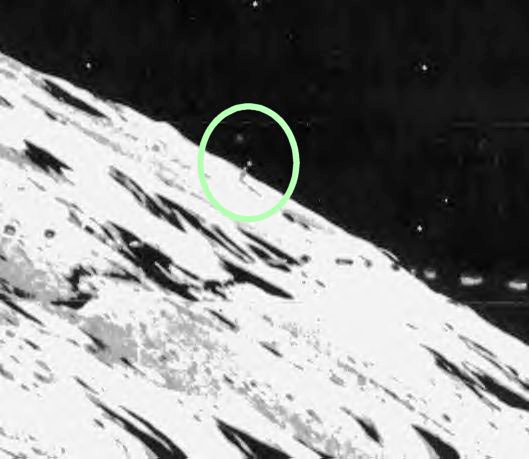
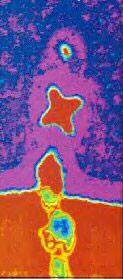
The thumbnails below are the shard one of the most compelling of all photos I think. It shows a tower like object rising high above the surface. The shard was taken at many angles and still the same results.
The shard is said to be made of glass and about 1.5 miles high. Its also said to contain a symmetrical cubical structure. What's it for we may never know it could be a building, a communications tower but this thing is huge based on how far away the photo was taken from.



Below is a supposed moon base its unknown do not know where this came from but it seems authentic.

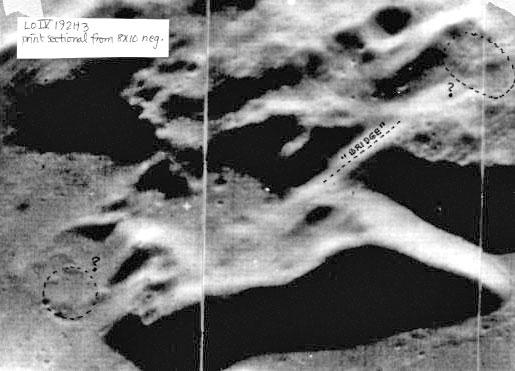
Below is the bridge said to be 12 miles in length but as you can see now this is clear this spans over a bridge. This is not a natural phenomena this bridge was purposely made.


Domes such as these (below images) are found all over the moon said to be made of glass. Notice how much lighter they are in color these are not natural structures one of them has a flat roof.


This obviously is an unusual object to the lower left very round and bright. (below image)

  |
The above photo to the left shows buildings or machines notice how they are all lined up in two's from left to right. The photo to the right is a close up can you say unbelievable? Well this is bigger than even you and me.
This below image shows a building which has a road behind it. There obviously may be a mining operation going on in this crater. The building seems to be just one solid block you may have to save it and zoom in larger but this picture is really interesting.
This below image shows a building which has a road behind it. There obviously may be a mining operation going on in this crater. The building seems to be just one solid block you may have to save it and zoom in larger but this picture is really interesting.


Above is the Ukert Crater notice the triangular shape to it.
On the moon there were a few craters that were shaped in triangles, pentagons, hexgons etc almost like there is some sort of craft sitting in them.
The image below scares me. I get vibrations off this one more then any other photo. Its a face very human to but looks to be that of an older lady. The thing about it that makes me believe its real is there is a nose, eyes, chin, many strong features which is far to great to be some natural formation.
The image below scares me. I get vibrations off this one more then any other photo. Its a face very human to but looks to be that of an older lady. The thing about it that makes me believe its real is there is a nose, eyes, chin, many strong features which is far to great to be some natural formation.
Why would the astronaut take a photo of these rocks if this did not have some symbolic meaning?

The photos below show the hexagonal craters side by side. They also show rectangular ruins and a grid like patter for a city similar like LA when its viewed from high above.
These once again are not natural formations.
The moon is full of craters yet you got these rectangular like structures interesting indeed.


Cities Found on the Moon!by LaRay
Reasonable activity of an alien civilization showed up unexpectedly close to us.
However, we were not psychologically ready for it. We still come across publications trying to find an answer to the following question: Are we alone in the universe?
At the same time, the presence of reasoning beings has been detected close to our home, on the Moon. However, this discovery was immediately classified as secret, as it is so incredible that it even might shake the already existing social principles, reports Russia's newspaper Vecherny Volgograd.
Here is an extract from the official press-release:
Here is an extract from the official press-release:
"NASA scientists and engineers participating in exploration of Mars and the Moon reported the results of their discoveries at a briefing at the Washington National Press Club on March 21, 1996. It was announced for the first time that man-made structures and objects have been discovered on the Moon."
The scientists spoke rather cautiously and evasively about these objects, with the exception of a UFO. They always mentioned that the man-made objects are possible, and stated the information was still under study and official results will be published later.
It was mentioned at the briefing as well that the Soviet Union used to own some photo materials proving the presence of such activity on the Moon. And, although it wasn't identified what kind of activity it was, thousands of photo- and video materials from the Apollo's and the Clementine space station showed many parts on the lunar surface where this activity and its traces were perfectly evident.
It was mentioned at the briefing as well that the Soviet Union used to own some photo materials proving the presence of such activity on the Moon. And, although it wasn't identified what kind of activity it was, thousands of photo- and video materials from the Apollo's and the Clementine space station showed many parts on the lunar surface where this activity and its traces were perfectly evident.
The video films and photos made by US astronauts during the Apollo program were demonstrated at the briefing. People were extremely surprised why the materials hadn't been presented to the public earlier.
NASA specialists answered:
"It was difficult to forecast the reaction of people to information that some creatures had been or still are on the Moon. In addition, there were some other reasons to it, which were beyond the control of NASA."
Specialist for lunar studies Richard Hoagland says that NASA is still trying to alter photo materials before they are published in public catalogues and files.
They do some retouching or are partially refocusing them while copying. Some investigators, Hoagland is among them, suppose that an extraterrestrial race had used the Moon as a terminal station during their activity on the Earth. These suggestions are confirmed by the legends and myths of different nations of our planet.
The ruins of lunar cities stretch for many kilometers. Huge domes on massive basements, numerous tunnels, and other constructions cause scientists to reconsider their opinions concerning the Moon. How the Moon appeared and principles of its revolving around the Earth still pose a great problem for scientists.
Some partially destroyed objects on the lunar surface can't be placed among natural geological formations, as they are of complex organization and geometrical structure. In the upper part of Rimahadley, not far from the place where the Apollo-15 had landed, a construction surrounded by a tall D-shaped wall was discovered.
The ruins of lunar cities stretch for many kilometers. Huge domes on massive basements, numerous tunnels, and other constructions cause scientists to reconsider their opinions concerning the Moon. How the Moon appeared and principles of its revolving around the Earth still pose a great problem for scientists.
Some partially destroyed objects on the lunar surface can't be placed among natural geological formations, as they are of complex organization and geometrical structure. In the upper part of Rimahadley, not far from the place where the Apollo-15 had landed, a construction surrounded by a tall D-shaped wall was discovered.
As of now, different artifacts have been discovered in 44 regions. The NASA Goddard Space Flight Center and the Houston Planetary Institute are investigating the regions. Mysterious terrace-shaped excavations of rock have been discovered near the Tiho crater.
The concentric hexahedral excavations and the tunnel entry on the terrace side can't be the results of natural geological processes; instead, they look very much like open cast mines. A transparent dome raised above the crater edge was discovered near the crater Copernicus. The dome is unusual, as it is glows white and blue from the inside. A rather unusual object, which is unusual indeed even for the Moon, was discovered in the upper part of the Factory area.
A disk of about 50 meters in diameter stands on a square basement surrounded with walls. In the picture, close to the rhomb, we can also see a dark, round embrasure in the round, which resembles an entry to an underground caponier. There is a rectangular area between factory and the crater Copernicus, which is 300 meters wide 400 meters long.
Apollo-10 astronauts took a photo (AS10-32-4822) of a one-mile long object called "Castle," which is at the height of 14 kilometers and casts a distinct shadow on the lunar surface.
Apollo-10 astronauts took a photo (AS10-32-4822) of a one-mile long object called "Castle," which is at the height of 14 kilometers and casts a distinct shadow on the lunar surface.
The object seems to consist of several cylindrical units and a large conjunctive unit. The internal porous structure of the Castle is clearly seen in one of the pictures, which gives the impression that some parts of the object are transparent.
As it turned out at the briefing where many NASA scientists were present, when Richard Hoagland had requested originals of the Castle pictures for the second time, no pictures were found at all. They disappeared even from the list of pictures made by the Apollo-10 crew. Only intermediate pictures of the object were found in the archives, which unfortunately don't depict the internal structure of the object.
When the Apollo-12 crew landed on the lunar surface, they saw that the landing was observed by a half-transparent, pyramidal object. It was hovering just several meters above the lunar surface and shimmered with all the colors of the rainbow against the black sky.
In 1969, when the film about astronauts travelling to the Sea of Storms was demonstrated (the astronauts saw the strange objects once again, which were later called "striped glasses"), NASA finally understood what consequences such kind of control could bring.
As it turned out at the briefing where many NASA scientists were present, when Richard Hoagland had requested originals of the Castle pictures for the second time, no pictures were found at all. They disappeared even from the list of pictures made by the Apollo-10 crew. Only intermediate pictures of the object were found in the archives, which unfortunately don't depict the internal structure of the object.
When the Apollo-12 crew landed on the lunar surface, they saw that the landing was observed by a half-transparent, pyramidal object. It was hovering just several meters above the lunar surface and shimmered with all the colors of the rainbow against the black sky.
In 1969, when the film about astronauts travelling to the Sea of Storms was demonstrated (the astronauts saw the strange objects once again, which were later called "striped glasses"), NASA finally understood what consequences such kind of control could bring.
Astronaut Mitchell answered the question about his feelings after his successful return:
"My neck still aches as I had to constantly turn my head around, because we felt we were not alone there. We had no choice but to pray."
Johnston, who worked at the Houston Space Center and studied photos and video materials made during the Apollo program, discussed the artifacts with Richard Hoagland and said that theNASA leadership was awfully annoyed with the great number of anomalous, to put it mildly, objects on the Moon.
It was even said that piloted flights to the Moon might be banned.
Investigators are especially interested in ancient structures resembling partially destroyed cities. Photos reveal an astonishingly regular geometry of square and rectangular constructions. They resemble our cities seen from the height of 5-8 kilometers.
Investigators are especially interested in ancient structures resembling partially destroyed cities. Photos reveal an astonishingly regular geometry of square and rectangular constructions. They resemble our cities seen from the height of 5-8 kilometers.
A mission control specialist commented on the pictures:
"Our guys observed ruins of the Lunar cities, transparent pyramids, domes, and God knows what else, which are currently hidden deep inside the NASA safes, and felt like Robinson Crusoe when he suddenly came across prints of bare feet on the sand of the desert island."
What do geologists and scientists say after studying the pictures of lunar cities and other anomalous objects? They say that such objects can't be natural formations.
"We should admit they are artificial, especially the domes and pyramids."
Reasonable activity of an alien civilization showed up unexpectedly close to us. We were not ready for it psychologically, and some people hardly believe they are true even now.
from CollectSpace Website
Because of all the processing, "these" images should not be used for research purposes. They should only be used to select and identify images for use in a research project.
Because of all the processing, "these" images should not be used for research purposes. They should only be used to select and identify images for use in a research project.
Higher resolution products should be obtained for use in any scientific investigation.

Magazine R AS 11-37-5438
Apollo 11

Magazine T AS 12-54-8118
Apollo 12

Magazine D AS 12-49-7319
Apollo 12

compare to image AS 12-49-7318 above
Apollo 12


Magazine R AS 12-51-7552
Apollo 12

Magazine L AS 13-60-8622
Apollo 13
and that's not the Earth - its too bright for one thing.
by Jim Marrs
2004
from RumorMillNews Website
Before the Apollo missions, lunar scientists longed for the time when humans could walk on the moon's surface.
By studying the make-up of our satellite, they hoped to resolve some of the mysteries of how our planet and solar system came into existence. Six moon landings later, the public perception was that we had learned all we needed to about the moon. However, those same lunar scientists were no closer to agreement on how to answer even the most basic questions - such as how the moon was created.
Despite the return of some 842 pounds of rocks and soil samples, photos and videotape and the placement of five nuclear-powered scientific stations on the lunar surface, there are still no clear cut solutions to the moon's mysteries.
Despite the return of some 842 pounds of rocks and soil samples, photos and videotape and the placement of five nuclear-powered scientific stations on the lunar surface, there are still no clear cut solutions to the moon's mysteries.
Quite the reverse, what we have learned about the moon in the wake of the Apollo missions has only raised more questions.
Science writer Earl Ubell declared,
"...the lunar Rosetta Stone remains a mystery. The moon is more complicated than anyone expected; it is not simply a kind of billiard ball frozen in space and time, as many scientists had believed. Few of the fundamental questions have been answered, but the Apollo rocks and recordings have spawned a score of mysteries, a few truly breath-stopping.
Consider some of these "breath-stopping" mysteries or anomalies as scientists prefer to call them: The moon is far older than previously imagined, perhaps even much older than the Earth and sun. By examining tracks burned into moon rocks by cosmic rays, scientists have dated them as billions of years old.Some have been dated back 4.5 billion years, far older than the Earth and nearly as old as the solar system. The oldest rocks ever found on Earth only date back 3.5 billion years. It is accepted by scientists today that the Earth is about 4.6 billion years old.
Harvard's respected astronomy journal Sky and Telescope reported that at the Lunar Conference of 1973, it was revealed that one moon rock was dated at 5.3 billion years old which would make it almost a billion years older than our planet.
This puzzle was compounded by the fact that lunar dust in which the rocks were found proved to be a billion years older than the rocks themselves. Chemical analysis showed that the moon rocks were of a completely different composition from the soil around them. Since dusty soil is usually produced by the weathering and breakup of surrounding rocks, the lunar rocks must have come from someplace other than where they were found. But where?
The moon has at least three distinct layers of rocks. Contrary to the idea that heavier objects sink, the heavier rocks are found on the surface. These rich materials that are usually concentrated in the interior of a world are on the outside of moon.
This puzzle was compounded by the fact that lunar dust in which the rocks were found proved to be a billion years older than the rocks themselves. Chemical analysis showed that the moon rocks were of a completely different composition from the soil around them. Since dusty soil is usually produced by the weathering and breakup of surrounding rocks, the lunar rocks must have come from someplace other than where they were found. But where?
The moon has at least three distinct layers of rocks. Contrary to the idea that heavier objects sink, the heavier rocks are found on the surface. These rich materials that are usually concentrated in the interior of a world are on the outside of moon.
Earl Ubell, a former science editor for CBS television, acknowledged this mystery, saying,
"The first (layer), 20 miles deep, consists of lava like material similar to lava flows on Earth. The second, extending down to 50 miles, is made up of somewhat denser rock. The third, continuing to a depth of at least 80 miles and probably below, appears to be of a heavy material similar to the Earth's mantle..."Ubell asked, "If the Earth and moon were created at the same time, near each other, why has one got all the iron and the other (the moon) not much? The differences suggest that Earth and moon came into being far from each other, an idea that stumbles over the inability of astrophysicists to explain how exactly the moon became a satellite of Earth."
The moon is extremely dry and does not appear to have ever had water in any substantial amounts.
None of the moon rocks, regardless of location found, contained free water or even water molecules bound into the minerals. Yet instruments left behind by Apollo missions sent a signal to Earth on March 7, 1971, indicating a "wind" of water had crossed the moon's surface. Since any water on the airless moon surface vaporizes and behaves like the wind on Earth, the question became where did this water originate? The vapor cloud eruptions lasted 14 hours and covered an area of some 100 square miles.
Some scientists claimed the water vapor came from deep inside the moon, apparently released during a moonquake. NASA officials offered a more mundane, and questionable, explanation. They speculated that two tanks on Apollo descent stages containing between 60 and 100 pounds of water became stressed and ruptured, releasing their contents.
Scientists declined to accept this explanation, pointing out that the two tanks - from Apollo 12 and 14 - were some 180 kilometers apart yet the water vapor was detected with the same flux at both sites although the instruments faced in opposite directions. Skeptics also have understandably questioned the odds of two separate tanks breaking simultaneously and how such a small quantity of water could produce 100 square miles of vapor.
Additionally, Apollo 16 astronauts found moon rocks which contained bits of rusted iron. Since oxidation requires oxygen and free hydrogen, this rust indicates there must be water somewhere on the moon. Moon rocks were found to be magnetized - not strong enough to pick up a paper clip, but magnetic nevertheless. What makes this so odd is that there is no magnetic field on the moon itself.
Additionally, Apollo 16 astronauts found moon rocks which contained bits of rusted iron. Since oxidation requires oxygen and free hydrogen, this rust indicates there must be water somewhere on the moon. Moon rocks were found to be magnetized - not strong enough to pick up a paper clip, but magnetic nevertheless. What makes this so odd is that there is no magnetic field on the moon itself.
So where did the magnetism come from? The argument that perhaps the moon picked up its magnetism from close contact with the Earth collapses when one considers that if the moon got close enough to pick up a magnetic field, it was close enough to be ripped apart by the Earth's gravitational pull.
The presence of maria, or large seas of smooth solidified molten rock, on the moon indicates nothing less than a vast outpouring of lava at some distant time. It has now been confirmed that some of the moon's craters are of internal origin.
The presence of maria, or large seas of smooth solidified molten rock, on the moon indicates nothing less than a vast outpouring of lava at some distant time. It has now been confirmed that some of the moon's craters are of internal origin.
Yet there is no indication that the moon has ever been hot enough to produce volcanic eruptions.
"The relative cool of the lunar interior (about 1,800 degree Fahrenheit as compared with the Earth's interior temperature of between 3,600 and 9,000 degrees) suggests that the moon was pretty cool to begin with and that the interior contains less radioactivity than the Earth or the surface of the moon," stated Ubell.
Others tried to explain this conundrum by stating that the moon was volcanically active some billions of years ago but, being a small world, rapidly lost its heat.
Another puzzle is that almost all - four-fifths - of the maria are located on the moon's Earthside hemisphere. Few maria mark the far side of the moon, often erroneously referred to as the "dark side". Yet the far side contains many more craters and mountainous areas. In comparison to the rest of the moon, the maria are relatively free of craters suggesting that craters were covered by lava flow.
Another puzzle is that almost all - four-fifths - of the maria are located on the moon's Earthside hemisphere. Few maria mark the far side of the moon, often erroneously referred to as the "dark side". Yet the far side contains many more craters and mountainous areas. In comparison to the rest of the moon, the maria are relatively free of craters suggesting that craters were covered by lava flow.
Adding to this mystery are the mascons - large dense circular masses lying 20 to 40 miles below the center of the moon's maria. The mascons were discovered because their denseness distorted the orbits of our spacecraft flying over or near them. One scientist proposed that the mascons are heavy iron meteorites which plunged deep into the moon while it was in a soft, formiable stage.
This theory has been discounted since meteorites strike with such high velocities, they would vaporize on contact. Another mundane explanation is that the mascons are nothing more than lava-filled caverns, but skeptics say there isn't enough lava present to accomplish this.
This theory has been discounted since meteorites strike with such high velocities, they would vaporize on contact. Another mundane explanation is that the mascons are nothing more than lava-filled caverns, but skeptics say there isn't enough lava present to accomplish this.
Since the maria appear to have been formed by hot lava, why did not these heavy mascons sink to the bottom?
"What they are is a major moon mystery," wrote Don Wilson, author of Our Mysterious Spaceship Moon."It now appears that the mascons are broad disk-shaped objects that could be possibly some kind of artificial construction. For huge circular disks are not likely to be beneath each huge maria, centered like bull-eyes in the middle of each, by coincidence or accident."
During the Apollo missions seismographic equipment was placed at six separate sites on the moon.
Between 1969 and 1977, when this equipment ceased operating, up to 3,000 "moonquakes" were detected during each year of operation. Most of the vibrations were quite small and were caused by meteorite strikes or falling booster rockets. But many other quakes were detected deep inside the moon. This internal creaking is believed to be caused by the gravitational pull of our planet as most moonquakes occur when the moon is closest to the Earth.
However, an event occurred in 1958 in the moon's Alphonsus crater which shook the idea that all internal moonquake activity was simply settling rocks.
In November of that year, Soviet astronomer Nikolay A. Kozyrev of the Crimean Astrophysical Observatory set the scientific world on its ear by photographing the first recorded gaseous eruption on the moon near the crater's peak. Kozyrev attributed this to escaping fluorescent gases. He also detected a reddish glow characteristic of carbon compounds which "seemed to move and disappeared after an hour".
Some scientists refused to accept Kozyrev's findings. However, astronomers at the Lowell Observatory also saw reddish glows on the crests of ridges in the Aristarchus region in 1963. Apollo Astronauts Neil Armstrong and Edwin "Buzz" Aldrin sighted eerie lights inside a crater near the point on the moon where their lunar lander was due to touch down in July, 1969.
On their first sweep around the moon, Armstrong described a mysterious bright light on the inner wall of the crater Aristarchus, located north of their flight path.
On their first sweep around the moon, Armstrong described a mysterious bright light on the inner wall of the crater Aristarchus, located north of their flight path.
"It seems to have a slight amount of fluorescence to it. The area in the crater is quite bright," he reported."That area is definitely brighter than anything else I can see. There doesn't appear to be any color involved in it. It looks like an eerie sight," confirmed Aldrin.
Something is going on inside the volcanically dead moon.
And whatever it is, it occurs the same way at the same time. As the moon moves closer to the Earth, seismic signals from different stations on the lunar surface detect identical vibrations. Could internal shifting inside the moon always occur the exact same way? Hardly likely.
New York Times writer Walter Sullivan wrote,
"It is as though the ups and downs of the stock market repeated themselves precisely for each period of fluctuation."
The question of identical vibrations made it hard to understand how this could be a natural phenomenon.
However, something artificially constructed could produce the same identical seismic result, which could occur over and over. For example, a broken hull plate could shift exactly the same way each time the moon passed near the Earth.
There are many indications that the moon may be hollow. The moon's mean density - about 3.34 grams per cubic centimeter or 3.34 times as much as an equal volume of water - is significantly different from the 5.5 gram density of the Earth's mantle. Studies of moon rocks indicate that the moon's interior differs from the Earth's mantle in ways suggesting a very small, or even no core.
There are many indications that the moon may be hollow. The moon's mean density - about 3.34 grams per cubic centimeter or 3.34 times as much as an equal volume of water - is significantly different from the 5.5 gram density of the Earth's mantle. Studies of moon rocks indicate that the moon's interior differs from the Earth's mantle in ways suggesting a very small, or even no core.
As far back as 1962, NASA scientist Dr. Gordon MacDonald stated,
"If the astronomical data are reduced, it is found that the data require that the interior of the moon be less dense than the outer parts. Indeed, it would seem that the moon is more like a hollow than a homogeneous sphere."
Unwilling to believe the moon hollow, MacDonald believed his data may have been faulty.
However, other studies tended to confirm his findings. M.I.T.'s Dr. Sean C. Solomon wrote,
"The Lunar Orbiter experiments vastly improved our knowledge of the moon's gravitational field... indicating the frightening possibility that the moon might be hollow."
Why frightening?
The significance was stated by astronomer Carl Sagan way back in his 1966 work Intelligent Life in the Universe, "A natural satellite cannot be a hollow object." The most startling evidence that the moon could be hollow came on November 20, 1969, when the Apollo 12 crew, after returning to their command ship, sent the lunar module (LM) ascent stage crashing back onto the moon creating an artificial moonquake.
The LM struck the surface about 40 miles from the Apollo 12 landing site where ultra-sensitive seismic equipment recorded something both unexpected and astounding - the moon reverberated like a bell for more than an hour. The vibration wave took almost t eight minutes to reach a peak, then decreased in intensity.
At a news conference that day, one of the co-directors of the seismic experiment, Maurice Ewing, told reporters scientists were at a loss to explain the ringing.
At a news conference that day, one of the co-directors of the seismic experiment, Maurice Ewing, told reporters scientists were at a loss to explain the ringing.
"As for the meaning of it, I'd rather not make an interpretation right now. But it is as though someone had struck a bell, say, in the belfry of a church a single blow and found that the reverberation from it continued for 30 minutes."
Dr. Frank Press of M.I.T. added,
"...none of us have seen anything like this on Earth. In all our experience, it is quite an extraordinary event. That this rather small impact... produced a signal which lasted 30 minutes is quite beyond the range of our experience."
The phenomenon was repeated when the Apollo 13's third stage was sent crashing onto the moon by radio command, striking with the equivalent of 11 tons of TNT.
According to NASA, this time the moon "reacted like a gong". Although seismic equipment was more than 108 miles from the crash site, recordings showed reverberations lasted for three hours and 20 minutes and traveled to a depth of 22 to 25 miles.
Subsequent studies of man-made crashes on the moon yielded similar results. After one impact the moon reverberated for four hours. This ringing coupled with the density problem on the moon led some to conclude the moon may have an unusually light - or even no - core.
They hoped to record the impact of a meteor large enough to send shock waves to the moon's core and back and settle the issue. That opportunity came on May 13, 1972, when a large meteor stuck the moon with the equivalent force of 200 tons of TNT.
After sending shock waves deep into the interior of the moon, scientists were baffled to find that none returned, confirming that there is something unusual about the moon's core. According to author Wilson, one NASA scientist has admitted that the U.S. Government has conducted experiments "which were not publicly announced" to determine if the moon is hollow or contains large cavities.
After sending shock waves deep into the interior of the moon, scientists were baffled to find that none returned, confirming that there is something unusual about the moon's core. According to author Wilson, one NASA scientist has admitted that the U.S. Government has conducted experiments "which were not publicly announced" to determine if the moon is hollow or contains large cavities.
Dr. Farouk El Baz was quoted as saying,
"There are many undiscovered caverns suspected to exist beneath the surface of the moon. Several experiments have been flown to the moon to see if there actually were such caverns."
The results of these experiments have not been made public.
It seems apparent that the moon has a tough, hard outer shell and a light or nonexistent interior. The moon's shell contains dark minerals such as titanium, used on Earth in the construction of aircraft and space vehicles. Many people still recall watching our astronauts on TV as they vainly tried to drill through the crust of a moon maria. Their specially designed drills could only penetrate a few inches.
The puzzle of the moon's hard surface was compounded by the discovery of what appeared to be processed metals. Experts were surprised to find lunar rocks bearing brass, mica andamphibole in addition to the near-pure titanium. They conclude it is the large amount of titanium in the black mineral illeminite which gives the dark tone to the lunar seas . Uranium 236 andneptunium 237 - elements not previously found in nature - were discovered in moon rocks, according to the Argone National Laboratory.
While still trying to explain the presence of these materials, scientists were further startled to learn of rust-proof iron particles in a soil sample from the Sea of Crisis. In 1976, the Associated Press reported that the Soviets had announced the discovery of iron particles that "do not rust" in samples brought back by an unmanned moon mission in 1970. Iron which does not rust is unknown in nature and well beyond present Earth technology.
Undoubtedly the greatest mystery concerning our moon is how it came to be there in the first place. Prior to the Apollo missions, one serious theory as to the moon's origin was that it broke off of the Earth eons ago, although no one could positively locate where on Earth it originated. This idea was discarded when it was found that there is little similarity between the composition of our world and the moon.
The puzzle of the moon's hard surface was compounded by the discovery of what appeared to be processed metals. Experts were surprised to find lunar rocks bearing brass, mica andamphibole in addition to the near-pure titanium. They conclude it is the large amount of titanium in the black mineral illeminite which gives the dark tone to the lunar seas . Uranium 236 andneptunium 237 - elements not previously found in nature - were discovered in moon rocks, according to the Argone National Laboratory.
While still trying to explain the presence of these materials, scientists were further startled to learn of rust-proof iron particles in a soil sample from the Sea of Crisis. In 1976, the Associated Press reported that the Soviets had announced the discovery of iron particles that "do not rust" in samples brought back by an unmanned moon mission in 1970. Iron which does not rust is unknown in nature and well beyond present Earth technology.
Undoubtedly the greatest mystery concerning our moon is how it came to be there in the first place. Prior to the Apollo missions, one serious theory as to the moon's origin was that it broke off of the Earth eons ago, although no one could positively locate where on Earth it originated. This idea was discarded when it was found that there is little similarity between the composition of our world and the moon.
A more recent theory had the moon created out of space debris left over from the creation of the Earth. This concept proved untenable in light of current gravitational theory which indicates that one large object will accumulate all loose material, leaving none for the formation of another large body.
It is now generally accepted that the moon originated elsewhere and entered the Earth's gravitational field at some point in the distant past. Here theories diverge - one stating that the moon was originally a planet which collided with the Earth creating debris which combined forming the moon while another states the moon, while wandering through our solar system, was captured and pulled into orbit by Earth's gravity.
It is now generally accepted that the moon originated elsewhere and entered the Earth's gravitational field at some point in the distant past. Here theories diverge - one stating that the moon was originally a planet which collided with the Earth creating debris which combined forming the moon while another states the moon, while wandering through our solar system, was captured and pulled into orbit by Earth's gravity.
Neither of these theories are especially compelling because of the lack of evidence that either the Earth or the moon has been physically disrupted by a past close encounter.
There is no debris in space indicating a past collision and it does not appear that the Earth and the moon developed during the same time period.
A current encyclopedia stated,
"...there seems to be a record of lunar magmatic (molten rock) processes in operation long before any processes that can be deduced directly by terrestrial geological studies."
As for the "capture" theory, even scientist Isaac Asimov, so well known for his works of fiction, has written,
"It's too big to have been captured by the Earth. The chances of such a capture having been effected and the moon then having taken up nearly circular orbit around our Earth are too small to make such an eventuality credible."
Asimov was right to consider the moon's orbit - it is not only nearly a perfect circle but stationary, one side always facing the Earth with only the slightest variation.
As far as we know, it's the only natural satellite with such an orbit. This circular orbit is especially odd considering that the moon's center of mass lies more than a mile closer to the Earth than its geometric center. This fact alone should produce an unstable, wobbly orbit, much as a ball with its mass off center will not roll in a straight line. Additionally, almost all of the other satellites in our solar system orbit in the plane of their planet's equator.
Not so the moon, whose orbit lies strangely nearer the Earth's orbit around the sun or inclined to the Earth's ecliptic by more than five degrees. Add to this the fact that the moon's bulge - located on the side facing away from Earth - thus negating the idea that it was caused by the Earth's gravitational pull - makes for an off-balanced world. It seems impossible that such an oddity could naturally fall into such a precise and circular orbit.
It is a fascinating conundrum as articulated by science writer William Roy Shelton, who wrote,
"It is important to remember that something had to put the moon at or near its present circular pattern around the Earth. Just as an Apollo spacecraft circling the Earth every 90 minutes while 100 miles high has to have a velocity of roughly 18,000 miles per hour to stay in orbit, so something had to give the moon the precisely required velocity for its weight and latitude....The point - and it is one seldom noted in considering the origin of the moon - is that it is extremely unlikely that any object would just stumble into that orbit. 'Something' had to put the moon at its altitude, on its course and at its speed. The question is: what was that 'something'?"
If the precise and stationary orbit of the moon is seen as sheer coincidence, is it also coincidence that the moon is at just the right distance from the Earth to completely cover the sun during an eclipse?
While the diameter of the moon is a mere 2,160 miles against the sun's gigantic 864,000 miles, it is nevertheless in just the proper position to blockout all but the sun's flaming corona when it moves between the sun and the Earth.
Asimov explains,
"There is no astronomical reason why the moon and the sun should fit so well. It is the sheerest of coincidences, and only the Earth among all the planets is blessed in this fashion."
How does one explain these and many other moon mysteries?
Scientists are a conservative lot who all too often tend to ignore any data not pertaining to their own particular area of expertise. They are as lost at explaining our nearest satellite as they are at explaining tektites - small glassy extraterrestrial blobs found only at a few sites on Earth.
For years scientists believed tektites were blown to Earth by meteorite strikes on the moon. However, this theory was overturned when the Apollo missions failed to find anything comparable on the moon. In July, 1970, two Russian scientists offered a bizarre theory of the origin of the moon - but one which provided an answer to all the mysteries.
Little notice was taken when Michael Vasin and Alexander Shcherbakov published an article in the Soviet journal Sputnik entitled "Is the Moon the Creation of Alien Intelligence?" After all, who could take seriously such an outrageous concept?
They advanced the theory that the moon is not a completely natural world, but a planetoid which was hollowed out eons ago in the far reaches of space by intelligence beings possessing a technology far superior to ours.
They advanced the theory that the moon is not a completely natural world, but a planetoid which was hollowed out eons ago in the far reaches of space by intelligence beings possessing a technology far superior to ours.
Huge machines were used to melt rock and form large cavities within the moon, spewing the molten refuse onto the surface. Protected by a hull-like inner shell plus a reconstructed outer shell of metallic rocky junk, this gigantic craft was steered through the cosmos and finally parked in orbit around the Earth.
Absurd? Perhaps, but it answers the many questions raised by the moon better than the constantly revised theories of science
Absurd? Perhaps, but it answers the many questions raised by the moon better than the constantly revised theories of science