What Did Ham Do to Noah?
by Neil Godfrey
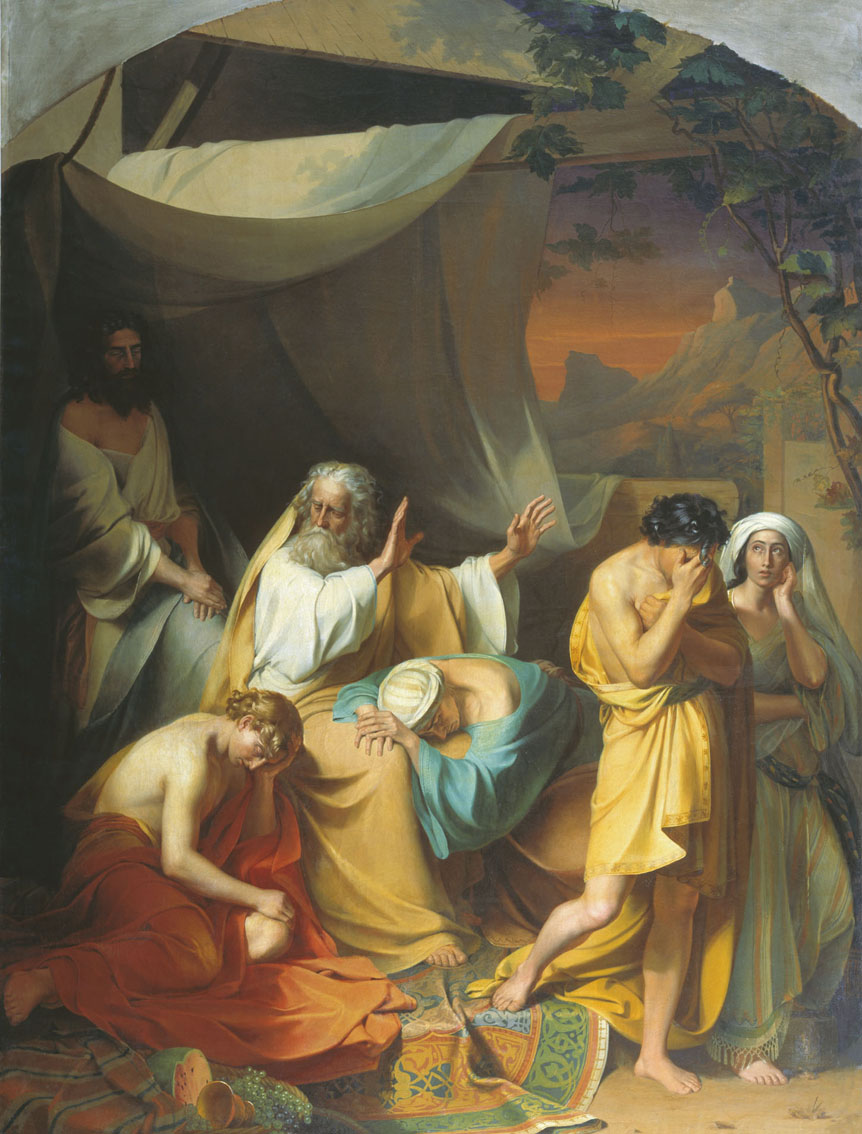 Now for something light. It comes from a book by two professors at the Hebrew University of Jerusalem, Avigdor Shinan and Yair Zakovitch, titled From Gods to God: How the Hebrew Bible Debunked, Suppressed, or Changed Ancient Myths & Legends, published 2004 by the Jewish Publication Society. Chapter 14 explores the curious episode that led a hungover Noah to curse Canaan, the fourth son of Ham.
We know the story in all its vagueness. After the flood Noah became the first in the new world order to plant a vineyard, to make wine, and to get blind drunk. We read that while drunk the good saint
So we are being told that there is something so terrible about seeing one’s father naked that it needs to be recorded in the Bible for all posterity to read.
But look at the punishment that follows:
I added and crossed out Ham there to draw attention to the bizarre detail that it was not Ham, Noah’s younger son who saw him naked, who is cursed, but Ham’s son. And not just any son, but his fourth son:
The mystery thickens.
Now many of us savvy sophisticates know that when the Bible speaks of “seeing the nakedness” of someone it is euphemism for having sex. Leviticus 20:17 leaves no doubt:
So this makes a bit more sense than Ham merely peeping at his naked father. Noah did, after all, know what Ham had “done unto him”. That’s a bit stronger than having a peek.
But that still doesn’t explain everything. Why did Noah curse Canaan, Ham’s fourth son?
As we read the following books in the Bible we see that the Canaanites were notorious for their sexual license and so were the Egyptians who were also descended from Ham. So perhaps here is an indication that Ham’s sin involved a sex act? Not entirely a satisfactory explanation, is it.
Stepping Back for a Closer Look
Here’s where Avigdor Shinan and Yair Zakovitch take a literary step back and view this episode in its broader structural context.
Before the flood recall that one of the sins that upset God so much was the fallen angels lusting after and procreating with human females. Then not long after the flood Ham does something relating to illicit sex to his father. Sin is ever the human condition. God just has to learn to be patient if he wants humans to populate the earth. But consider another subsequent tale of annihilation — Sodom and Gomorrah. In that case, it is the humans who lust after and want to have sex with the angels who are visiting Lot. Not that they know they are angels, of course, but we do see a curious chiastic or sandwich structure here either side of the Noah-Ham filling.
It gets more interesting as we zoom in for a closer look. Here’s a little diagram produced by the authors to help explain the way it works:
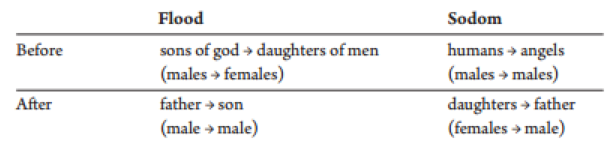 Before the flood the fallen angels “went unto” the daughters of men. Before the destruction of Sodom the wicked men wanted “to have” the male angels sheltering with Lot.
After the flood a son “sees the nakedness” of his father (I think the diagram is a bit askew there); after the destruction of Sodom the daughters have sex with their father Lot.
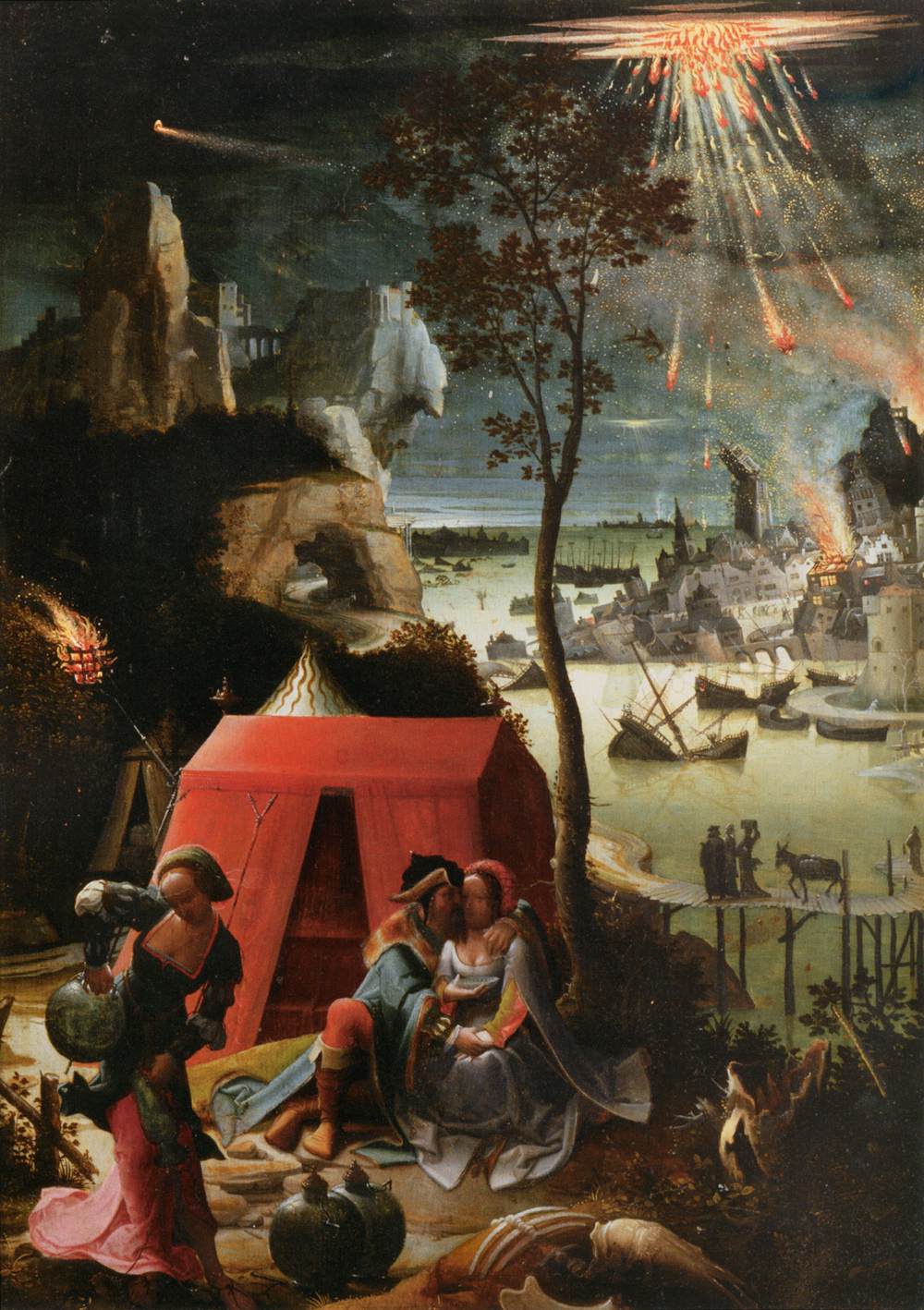 Before the flood there is illicit male-female sex and after Sodom there is illicit male-female sex.
After the flood there appears to be illicit male-male sex and before Sodom’s demise there is an attempt to have illicit male-male sex.
Moreover, getting blind drunk is an essential part of each story. Both Noah and Lot become so drunk that they don’t know what is happening to them.
Noah knows what has happened when he recovers, however. So he curses Ham’s fourth son. We’re coming to that.
Lot does not know what has happened and does not curse anyone. The children are later cursed in the biblical narrative, though (Deut 23:4). Later rabbinic readings, however, did find a way to interpret the Genesis account to mean that though Lot did not know when one of his daughters came to lie with him he did register her getting up and leaving. This appears to have been an attempt to connect the stories of Noah and Lot more closely. Was this interpretation known in Second Temple times? (Genesis — and I’m departing from the Shinan and Zakovitch’s book here — is considered by some scholars to have been of very late composition, even as late as the second century BCE.)
So despite the vagueness and ostensibly virtual innocence of Ham’s “sin” (peeking at his naked father) in the Genesis account, the rabbis recognized that there was something more sinister just below the surface (the Midrash Genesis Rabbah 51:8).
The Unspeakable is Spoken
They (the rabbis) went further. B. Sanhedrin 70a says the following:
Castration? Where did that come from?
The neighbouring Phoenicians, Hurrites and Greeks all had myths of intergenerational conflict in which a son castrated his father or ruler. Philo of Byblos tells us the Phoenician god Kronos castrated his father Uranus with his own knife; the Hurrite god Kumarbi rebelled against the sky god Anu and replaced him as the ruler of the heavens, even biting his knee and swallowing his genitals. We know of the Greek myth of Kronos castrating his father Uranus, god of the sky.
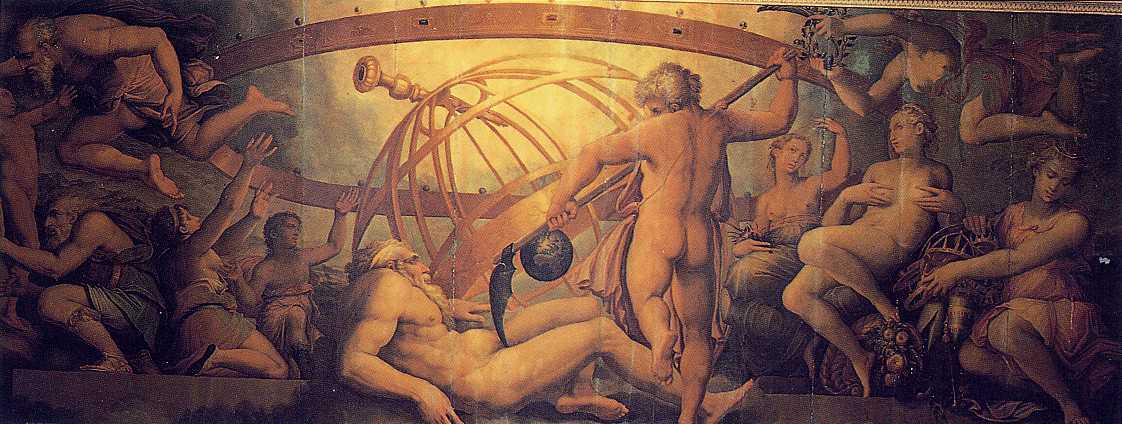
Shinan and Zakovitch inform us that
It follows then, Shinan and Zakovitch explain, that the story of Ham and Noah developed in three stages:
First stage:
The mythic tradition of a son castrating his father in order to prevent his father from having more sons and “dilute the older son’s inheritance.” So the Midrash ha-Gadol to Genesis 9:25 says:
Rashi in the commentary says that the castration was performed “for inheriting the world.”
Now as Shinan and Zakovitch point out, an act of castration would leave some fairly obvious evidence for the sobered-up Noah to notice. It would also explain why Noah cursed Ham’s fourth son. If Noah could no longer have a fourth son then Ham’s fourth son was to be cursed.
Genesis Rabbah 36:7 explains
Second stage:
The Pentateuch stepped back from documenting a castration upon a man who was elsewhere called “righteous” (Genesis 6:9). So Noah’s emasculation was replaced with a lesser evil, being raped by his son.
The “see nakedness” expression and the correlations with the Sodom narrative make this interpretation fairly clear.
Third stage:
Censorship finally sanitized the whole episode to infer that Ham was guilty of “seeing” his father naked and instead of covering his shame rushing to tell his brothers.
Interestingly the Bible retains an ambiguity here — as it does in many other narratives. The reader is not quite sure what the author intended. Alternative possibilities are always on the table.
Why Did God Want It In the Bible At All?
But why should such a tale enter Holy Writ at all? S and Z answer:
S and Z also suggest a morality tale to warn against drunkenness.
I often wonder of such intriguing explanations how much of their account really is “true” and how much is owed to the wisdom of hindsight. Either way, it’s a plausible and interesting tale. It also underscores the point of Hector Avalos that the Bible is, or should be, an irrelevant book for any sort of moral guidance this day and age.