| Quick Facts |
| Type | Logophonetic |
| Genealogy | Unrelated |
| Location | South Asia |
| Time | 2600 BCE to 1900 BCE |
| Direction | Variable |
|  |
|

Stamp seal with unicorn and ritual offering stand, ca. 2000-1900 B.C.; Harappan. Indus Valley, Harappa, 8796-01. Indus inscription. Steatite; L. 5.2 cm (2 in.); W. 5.2 cm (2 in.). Harappa Museum, Harappa H99-4064. Courtesy of the Department of Archaeology and Museums, Ministry of Minorities, Culture, Sports, Tourism, and Youth Affairs, Government of Pakistan.
Photograph © www.metmuseum.org |
The Indus Valley Civilization was the first major urban culture of South Asia. It reached its peak from 2600 BC to 1900 BC roughly, a period called by some archaeologists "Mature Harappan" as distinguished from the earlier Neolithic "Early Harappan" regional cultures. Spatially, it is huge, comprising of about 1000 settlements of varying sizes, and geographically includes almost all of modern Pakistan, parts of India as far east as Delhi and as far south as Bombay, and parts of Afghanistan.
The main corpus of writing dated from the Indus Civilization is in the form of some two thousand inscribed seals in good, legible conditions. (In case you don't know what seals are, they are used to make impressions on malleable material like clay.)
Although these seals and samples of Indus writing have been floating around the scholastic world for close to 70 years, little progress has been made on deciphering this elegant script. However, we should not blame scholars for their lack of progress, for there are some major impediments to decipherment:
- Very short and brief texts. The average number of symbols on the seals is 5, and the longest is only 26.
- The language underneath is unknown.
- Lack of bilingual texts.
For instance, consider Champollion, who deciphered Egyptian hieroglyphs with all of these 3 important clues: there were very long Egyptian texts; he knew Coptic, a descendant of Egyptian; and the Rosetta Stone, a bilingual text between Greek and two written forms of Egyptian.
But the script isn't as bad as undecipherable. For one, even though scholars don't have long texts and bilingual texts, they can still theorize about the language underneath the writing system. There are several competing theories about the language that the Indus script represent:
- The language is completely unrelated to anything else, meaning an isolate. Well, this doesn't get us anywhere.
- The language is "Aryan" (some form of Indian-Iranian Indo-European). The historical languages spoken in Northern India and Pakistan all belong to the Indic branch of Indo-European, including Sanskrit, Hindi, Punjabi, etc., so maybe the people of the Indus valley spoke a very old Indo-European language?
The major problem with this model is the fact that horses played a very important role in all Indo-European cultures, being a people constantly on the move. "There is no escape from the fact that the horse played a central role in the Vedic and Iranian cultures..." (Parpola, 1986) Sidenote: "Vedic" means from the time of the Vedas, the earliest text in India, and the Vedic culture is from around 1500 to 500 BC. However, no depiction of horses on seals nor any remains of horses have been found so far before 2000 BC. They only appear after 2000 BC. Very likely there were no Aryan speakers present before 2000 BC in the Indus Valley.
- The language belongs to the Munda family of languages. The Munda family is spoken largely in eastern India, and related to some Southeast Asian languages. Like Aryan, the reconstructed vocabulary of early Munda does not reflect the Harappan culture. So its candidacy for being the language of the Indus Civilization is dim.
- The language is Dravidian. The Dravidian family of languages is spoken in Southern Indian, but Brahui is spoken in modern Pakistan. So far this is the most promising model, as in the following points:
- There are many Dravidian influences visible in the Vedic texts. If the Aryan language gradually replaced the Dravidian, features from Dravidian would form a "substratum" in Aryan. One of these features is the appearance of retroflex consonants in Indian languages, both Indo-European and Dravidian. In contrast, retroflex consonants do not appear in any other Indo-European language, not even Iranian ones which are closest to Indic. (For more information on retroflex consonants please visit my Phonetics page).
- Another possible indication of Dravidian in the Indus texts is from structural analysis of the texts which suggests that the language underneath is possibly agglutinative, from the fact that sign groups often have the same initial signs but different final signs. The number of these final signs range between 1 to 3. The final signs possibly represent grammatical suffixes that modify the word (represented by the initial signs). Each suffix would represent one specific modification, and the entire cluster of suffixes would therefore put the word through a series of modifications. This suffix system can be found in Dravidian, but not Indo-European. Indo-European tongues tend to change the final sounds to modify the meaning of a word (a process called inflection), but repeated addition of sounds to the end of word is extremely rare. Often many suffixes in an agglutinative language correspond to a single inflectional ending in an inflectional language.
The Dravidian model isn't just an unapplicable theory...But first we have to know what kind of writing system is the Indus script.
A count of the number of signs reveal a lot about the type of system being used. Alphabetic systems rarely have more than 40 symbols. Syllabic systems like Linear B or Cherokee typically have 40 to 100 or so symbols. The third ranges from logophonetic to logographic, running upwards of hundreds of signs (like 500 signs in Hieroglyphic Luwian, and 5000 symbols in modern Chinese).
It appears that the maximum number of Indus script symbols is 400, although there are 200 basic signs (ie signs that are not combined from others). This means that the Indus script is probably logophonetic, in that it has both signs used for their meanings, and signs used for their phonetic values.
Many signs start off as pictorial representation of a physical object, often misleadingly called pictograms. They really are should be called logograms because they represent words in the language. However, it's next to impossible to write out a word with abstract meaning pictorially. What all early writers figured out was to use a logogram not for the object or idea it was originally supposed to stand for, but for all words sounding similar to the original word for that object or idea. For example, in English to write "leave" we can use a picture of a "leaf". This is called rebus writing, and is a tremendously common pattern in all early writing systems. We could also then use the same "leaf" symbol to stand for the sound in "relief", adding another symbol in front of the "leaf" symbol in order to indicate the "re" sound. So the logogram gained a phonetic value as well.
Testing the theory
How can we take the theoretical framework so far and apply it to archaeological data?
Numerals seem to represented by vertical lines (represented by number of lines in the glyph), but they only go up to 7. Analysis reveal 4 more signs that appear in the same context as these numerals, and so they likely represent numbers higher than 7.
The fact that no vertical-line numeral sign denotes 8 very likely means the Harappan language is based 8. (For example, the Arabic numerals that we use has symbols from 0 to 9, and to write "ten" we have to combined the symbols 1 and 0, which identify our number system as based ten.)
Base 8 languages are rare in the world, but it does appear that early Dravidian is base 8, but later changed to base 10 (possibly under Indo-European influence). When translated, the count from 1 to 7 is familiar to us: "one", "two", "three", "four", "five", "six", "seven". However, above seven, the number's etymologies become non-numerical: 8 is "number", 9 is "many minus one", and 10 is "many". (Fairservis 1983)
But can we actually read (not interpret) any symbol on the seals? We should start with "pictograms", as this one:
Many scholars (Knorozov, Parpola, Mahadevan, etc) see this sign as a fish. Fish in reconstructed Proto-Dravidian is *mîn. Coincidentally, *mîn is also the word for star. On many pots from Mohenjo Daro, an Indus site, there are drawings of fish and stars together, and so affirming this linguistic association.
Going further, often the numeral six appears before the fish. Either it means 6 fish, or 6 stars[Plaeid?). Old Tamil (a Dravidian language still spoken today) texts from just around the 1st century AD recorded the name of the Pleiades, a star cluster visible during autumn and winter just above Orion, as "Six-Stars", or aru-mîn. Throughout the world, titles with celestial connotations are very common, and the clause Six Stars forming part or whole of a Harappan title is not unreasonable. (Parpola, 1986)
Sometimes symbols are added to the basic sign to make new signs. Of these, the one that looks like a circumflex accent placed on top of the fish is quite interesting. It is theorized to mean "roof", and in Proto-Dravidian it is *vêy/mêy. This is phonetically similar to Proto-Dravidian word for "black", *may. Together with fish, it spells out mai-m-mîn, or "black star", which in Old Tamil means the planet Saturn. In Sanskrit texts, Saturn is associate the color black. The god of death, Yama, is the presiding of this planet, and is usually depicted as riding on a dark buffalo.
But the "fish" reading isn't accepted by all scholars. William Fairservis saw it as a combination of a loom twist and a human sign, and form a honorific title pertaining to rulership (Fairservis, 1983). I, however, am more inclined to accept the fish identification.
This is a quick overview of the current process in the decipherment of the Indus script. For more information you can either go to the following links, or go to a good library for books and articles (check out my references).
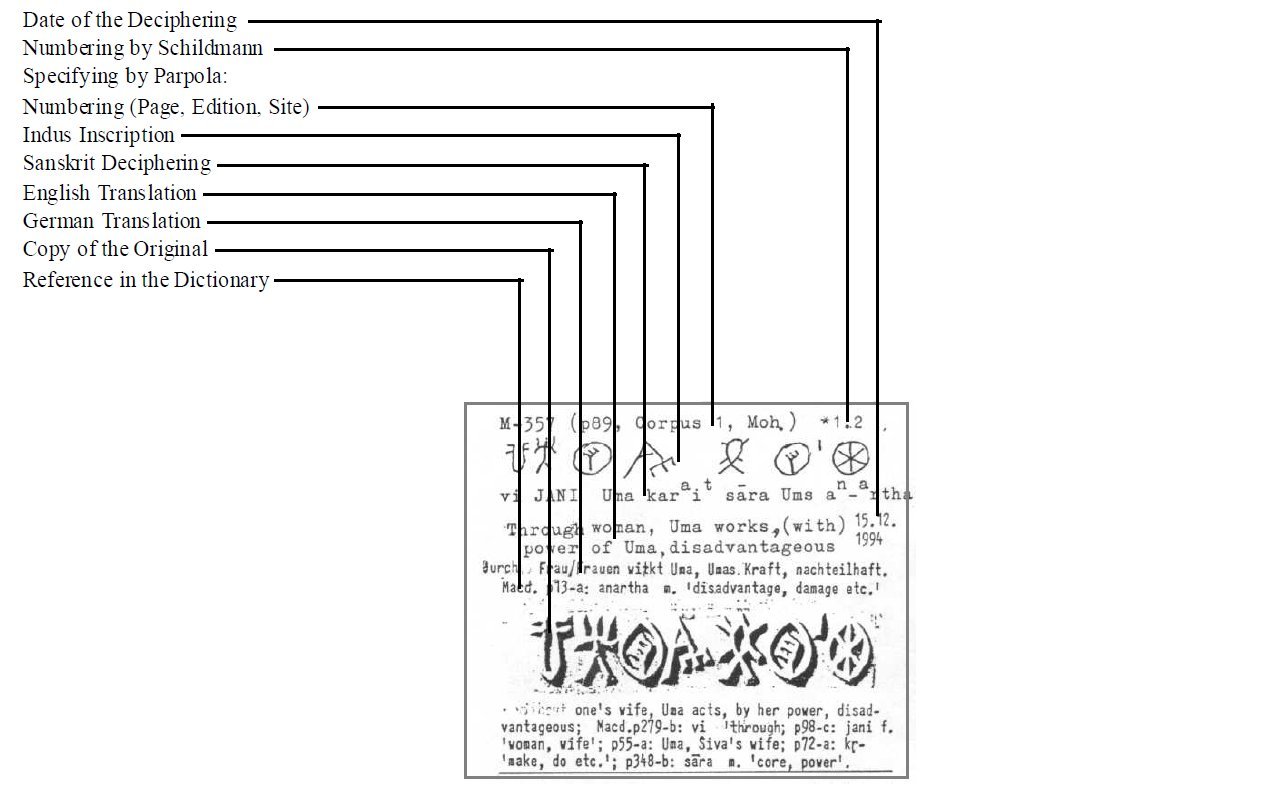
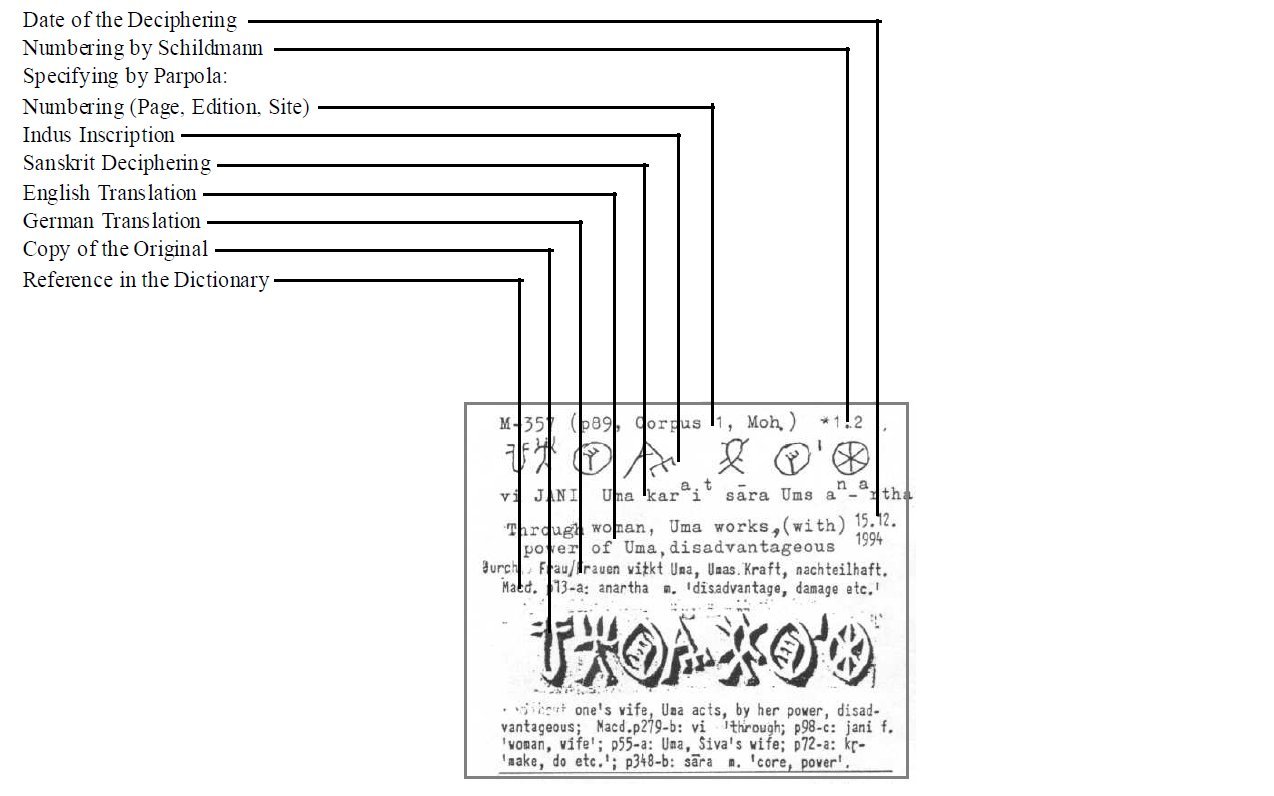
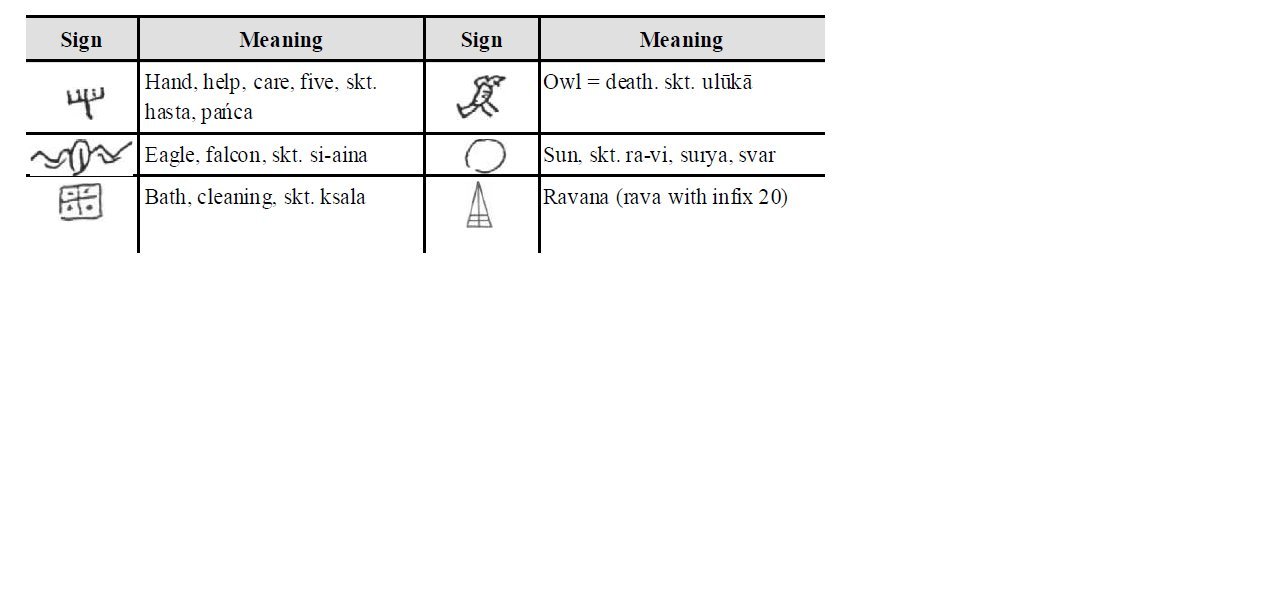
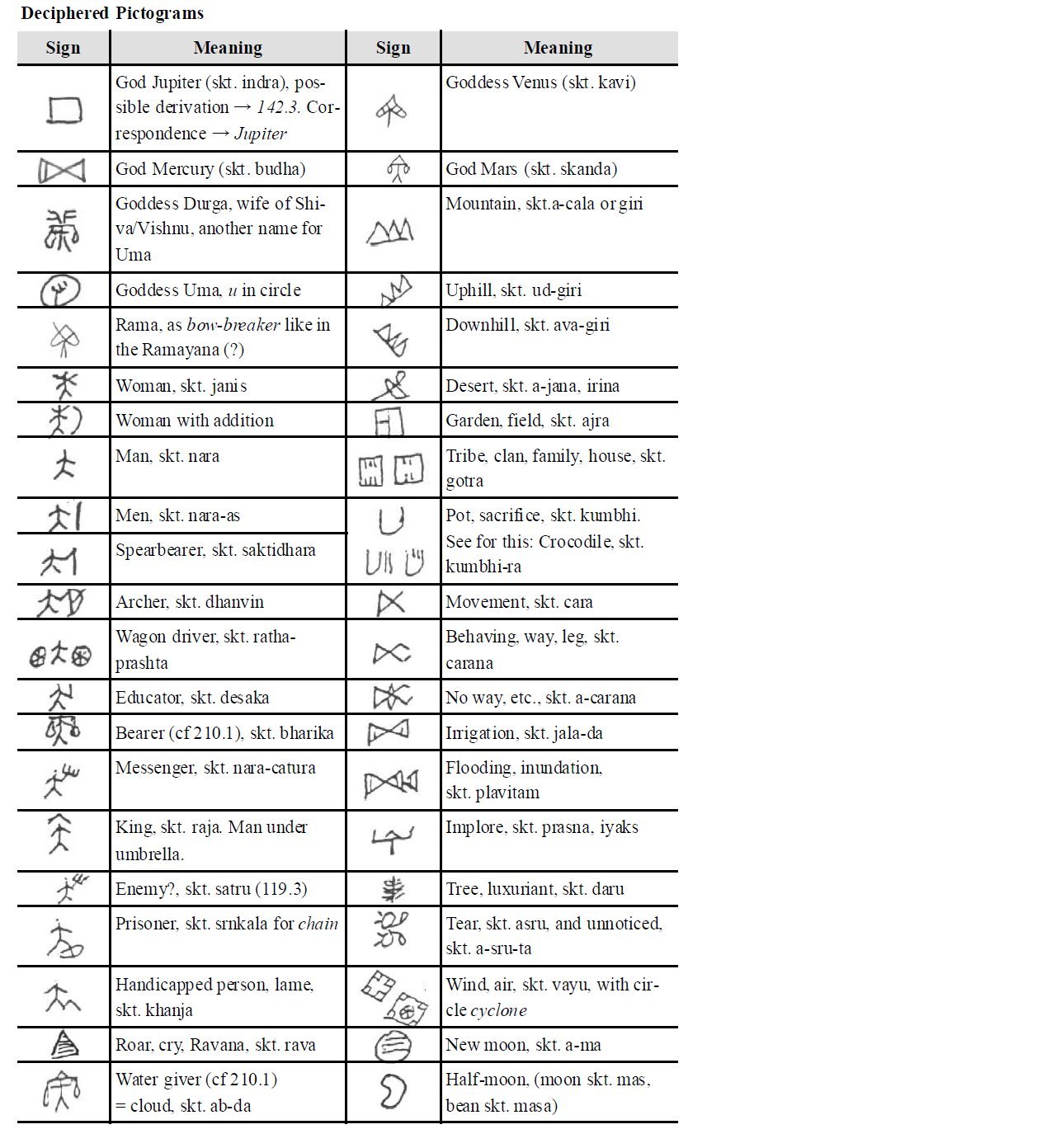
Indus Script is pictorial script for Sanskrit-Dravidian Mixed linguistic class. Pictures were utilized to write in Sanskrit-Dravidian language.
Unicorn with seat can be understood as Aksho-desaka-psu-ava. Eye of Teacher
Bull: Vrisha-bha in indus language
Rabit: sa in indus language (sanskrit Saasa)
i think some body had already diciphered indus script in this manner
-
Just one intution to support the theory that the fish sign represented stars. Maybe stars were used as directions on sea. and Fish was a staple diet in the sea.
hello admin...'m not a big expert in this...but let me just share what i think...
In my opinion that symbol represents a star...if it was just a fish-min they could 've put it horizontally.but its suppose to represent a star...vin(sky)-min(fish)=star..i guess thats why they put it pointing vertically to denote the sky...vinmin means star in tamil.
and in tamil six stars are very special they r called karthigai pengal..(six ladies who raised lord karthikeya).this six stars 've much importance in dravidian culture.
Enjoyed reading. Nice summary for non-experts. All external links seem broken though.
Thanks for telling me about that. I'm already fixing it now.
Fish and star interpretation
fish is a sea vessel i.e. Boat
And Star is landmark of the boat or identification of boat and proceeding by other identification of place
If you notice other symbol like tree in bubble kind shape is slow wind and open tree shape is fast wind, bow to the left is like direction of wind.
III stands for 3 people on the boat
II stands for time spent on the boat
inverted U or V Shape vessel is for Food
It's not a unicorn but a young bull. You can tell by the hocks. I've been looking at other seals the age of the bull and the marks on each bull may depict the seniority of the person?
-

Just saw this. It's quite simple. The purpose of the seals is commerce only as suspected. They are like present day financial instruments. Except it was far more sophisticated. Here is why.
The Bearer of a document with these seals is entitled to money. BUT with conditions as below.
Depending on the seal used the money is paid to a known respected person but not the bearers. This was used in ships transport or the main agent.
Some are paid direct to bearer.
Some to a group of people with varying amounts like a payment for soldiers based on ranks and so on.
By the way It's not a unique or unknown system. It is used even now though govt. like to believe it has died out.
Read sections 2.7 and 2.8 here:
So in effect our pokey little civilization was a giant financial clearing house. Like say the present day SWIFT system.
So now you know their purpose.
The exact message or amount is coded using something like a one time key pad used in present day espionage. The key to be used would be known to the end user by seeing the type of icon on the seal.
One more thing. The reason they are still found is because their value would go up like present day gold prices or good company shares. So some people kept them in safe places to be encashed during distressed times.
Cheers.
see more

The question we have to ask is: how do you know this?
First of all, your attempt to connect the Indus script to speakers of Indo-Aryan language is misguided and makes no sense. Second, the prayers composed by Indo-Aryan speakers in India, including the Vedas, were written down long after they were composed, and aren't of demonstrably Harappan origins at all. Third, prayers and hymns do not represent scientific knowledge; they are only prayers and hymns. We would need really good, strong evidence to believe otherwise, which you haven't provided.
Fourth, the Indus script does seem to represent language. The only thing we don't know is exactly what language it is and how the system works *exactly*, but it certainly doesn't seem to consist of graphic elements representing scientific ideas.
Moreover, the Harappan civilisation was in contact with literate civilisations to the west, in both Egypt and Mesopotamia. I think that if they had discovered all of this scientific knowledge, we wouldn't be hearing about it from crackpot Aryanists who think the "Aryan Invasion Theory" (which is no one's theory, and a complete straw man) is so threatening to their self-esteem. We'd be reading about it in inscriptions, we'd see evidence of it in the archaeological record, and we wouldn't be trying our best to misinterpret ancient writing.

Dear Al West,
The question you have asked is: "how do you know this?"
*A professor and Scientist can understand the importance of metaphors for demonstration and teaching. *The Vedic language is a symbolic coded language with vast ocean of knowledge in the background, where words are only indicator of the phenomena. The praise prayers are in the back ground to pay homage to nature and natural components.
The Vedic metaphors and symbols have been engraved on the seals, which were used for demonstration and teaching in higher Institutes of learning. The riddle symbols engraved on the seals were used for examination with their literary text in the Vedic hymns. The importance of the metaphors can be understood by the professor and subject expert in the concern subject.
the Gene technology by which the transgenic animals and plants are developed in the laboratory was common in Indus Valley. The gene technology was much more advanced as depicted on the copper tablets.
With regards
Dr.C.P.Trivedi
Indus Seals deciphered - Indus Vedic
Civilization
Dr. C.P.Trivedi
The new Interpretation of Indus Valley Vedic
symbols explore Indus Vedic Civilization, as also the Harappan
symbols do not represent a script, hence beyond the reach of Script
experts. It is not a script at all. It rejects Aryan invasion scientifically. His
book The Indus Vedic Genetics ISBN-13:
978-3659228094 has been published by Lap Lambert Academic
Publishing, Germany. He has explored the long awaited mystery of Indus Valley
as well the ancient discovery of DNA and Higgs Boson God particle has been termed as Hiranyagarbha Golden embryo in the Vedas.
Thesymbols on the seals explore origin and evolution of the creation from single
cosmic fundamental energy, the
life has evolved from single cell and DNA with photosynthesis and genetic
recombination. The genetic symbols explore the human development in
chronological order from pre-cosmic condition to evolution of the human species
in chronological order. In the light of most exciting discovery of the decade,
the DNA by Watson and Crick 1953, and Higgs God particle 2012 by Peter Higgs
and CERN scientists, it is the foundation of Vedas and Indus Valley.
The Indus Valley gene technology was much more advance with development of
transgenic plants and animals. The rich biodiversity zones in India and Africa
is its confirmative evidence. The transgenic animals and plants can be
developed for the domestic comfort, but it may create havoc. The DNA is Light
of Life with merits and demerits from generation to generation. The Vedic
Science is in the background of Indus city civilization. The Genetic symbols
explore Indus Valley - Vedic Civilization.
-
However, we should not blame scholars for their lack of progress for there are some major impediments to decipherment.
umashankar is the stupidest name ive ever heard
poooooooooooooooooooooooooooooooooo
poooooooooooooooooooooooooooooo
poooooooooooooooooooooooooooooooooooo
pppppppppppppppppppppppppppppppppppppppppooooooooooooooooooooooooo
ppppppppppppoooooooooooooooooooooooooooo
What I think of watching this seal is, it's a bull depicting the city...may be the city symbol...their is a boat or something in front of it....could be the symbol of sea port?
as per symbols above them ...I think its the value of the seal...may be fish be symbol for a fixed value like hundred or thousand...the straight vertical lines be mere numbers...that's how they counted ....?
it reads fresh milk, foods incorporated best before the 2nd planting day of the winter solstice and the year :)
lol looking at the seal now i can imagine it on the front of a milk carton just like we have a picture of a cow and farmer on a modern milk carton and the label or name of the producer and used by date above it :)
the seal above may say using a simple pictogram 'milk' and the text at the top may further explain the origin and use by date of the milk a simple pictogram for the illiterate within the society and a more in-depth description for the literate anyway sorry to waste your time but i think we should keep in mind that this language may have meant to be understood by both the literate and illiterate people within the society
or the six vertical lines may represent in numerical value the sixth meaning of the word i.e if i was to try to say 'to' in a glyph i may add a vertical line in numeric sequence to explain which 'to' i mean so as in ' leaf' i might draw the glyph 'to' as ---> and use vertical lines such as' II ' so it would read ---> II to explain that 'too' as apposed to 'to' or 'two' is meant and the hat may represent a notation of more than one like adding an 's' to a word like fish's.
as for symbols such as the "fish" may this symbol have more than one meaning such as in the English language i.e to, too, two and that any additives to these symbols may represent a variation of such a symbol such as the "roof" above the fish or the added "6" symbol, i.e the fish and the "6" symbol representing a sea faring people or people from the sea and the "hat" representing a sea fearing society's settlement and the lone symbol of the fish representing a biological or natural event for example
in many ancient societies there are references to at least two distinct and advanced societies this includes ancient Indian texts as well as texts from the middle east and Europe that existed before the early Babylonians
and that these languages that appeared at about the same time in the eastern regions and parts of the world were an attempt to reestablish a lost spoken and written language or an interpretation of
further i would like to suggest that this earlier society was made of many races with no one race predominant as these fruits and vegetables were found through out the world at a time when it was believed that many of these societies had not been in contact with each other dare i suggest an earlier age of man where science and technology was quite advanced and even at a level comparable to our own
hi this was good reading but, i would like to point out that foods had been modified from more basic plants[some even poisonous] such as maze and tomatoes long before the establishment of these societies and any of their technologies and would therefore conclude that any technology's that existed at this time came from an earlier period and in part some of these languages may be derived from interpretation of these societies languages and may in some part be a reference to this earlier society
you cant go to bed without a cup of tea, and maybe that's the reason that you talk in your sleep.
Where can I find an online, free chart of the 200 basic signs, or better, the 400 signs?
Some of the symbols remind me of Elder Futhark.
really cool infromation has provided by this site
Gopi lee
It's neat how similar the glyph on the far right of the stamp looks to the "kalc" rune from anglo-saxon runes.
the first depiction represents a person of higher consciousness.
the next depiction shows that same person next to six individual lines; this represents individuals who have not yet reached that level; possibly because they are separated, i.e., not working together
the last depiction represents what can happen when they combine, i.e., they can rise together to a higher state of consciousness
Right. Okay. Well, my question is: how do you know this?
The man who made this kind of seals, he had a rough design from his king authorities, he has to manufacture these seals. So this seals does not represent the ship or any location, These seals are in general distribution of their king's acknowledgement among their community. The seals were gifted to some outstanding people. The seal pictures depiction are the appraisal words (as like best award). The language and character depictions could be like ("best award") or best people awarded the cow, Buffalo, fish hunting, land and the other wealth.
Somehow i think i agree with you.
Thanks, the info helped to explain.
Sir, is there any website which is dedicated to decipher Indus Script that providing all the available Letters, Symbols, images taken from seals or anything else on one page? Pl. tell.
indus script for the sanskrit-dravidian mixed spoken language,I suppose.
here is not available ( Naaga Lipi Script ) this Scrript is before arya or next to harappa mahenjadaro
Thanks for the suggestion. It's quite difficult to find sufficient source material to do a proper writeup for a lot of Indian scripts. I'll see what I can do to dig some up.
A quick Google search says that Naga Lipi script is dated to about 1100 CE. I don't see how it could be of the same age as Harappa civilization.
|





Most of the artwork from this civilization was small and used as personal possessions. The first objects unearthed from Harappa and Mohenjo-Daro were small stone seals. These seals were inscribed with elegant portrayals of real and imagined animals and were marked with the Indus script writing. The seals suggest a symbolic or religious intent. Stone sculptures carved in steatite, limestone, or alabaster depict a male figure who may have represented a god. Pottery figures were shaped into humans and animals. Very few bronze figures have been recovered.