René Descartes: strictly geometric geometric to pass over into algebra .. A Pair of Perpendicular Lines

9:01 PM | BY ZeroDivide EDIT

Note:

Although the association of algebra and geometry was proposed even by the Greeks [8, p.84], and taken up anew as a program by Vihte, no satisfying procedure had been found to merge the two disciplines into one ( unti l the development of the Cartesian plane. Thus, Descartes was not the first to attempt to develop a coordinate plane, but his method has been the one that achieved the desired goal. Both the Greeks and Egyptians had developed a numerical coordinate system (driven by its relevance to astronomy and cartography), but with little mathematical development. 

 "Hipparchus (B.C. 150) and Ptolemy (150 A.D.), to name but two, both employed a system of latitude and longitude to locate stars on the celestial sphere.


The next person to significantly advance the creation of the coordinate system was Frangois Vihte (1540-1603). In his In artem analyticem isagoge (Introduction to the Analytical Art) published in 1591, Vihte announced a program to "[bring] together the a ncient geometrical methods of Euclid, Archimedes, Apollonius, and Pappus" [1, p.268], with ancient algebraic methods to produce his logistica speciosa, a way to formulate and solve algebraic problems.


Frangois Vihte

The Key to Geometry:
A Pair of Perpendicular Lines

Deepak Kandaswamy

René Descartes (1596-1650) is primarily associated with Philosophy: his Discourse on Method and Meditations have even led him to be called the "Father of Modern Philosophy." In his most celebrated argument, Descartes attempted to prove his own existence via the now hackneyed argument, "I think therefore I am." However, it should not be forgotten that René Descartes applied his system to investigations in physics and mathematics, with real success, playing a crucial role in the development of a link betw een algebra and geometry - now known as analytic geometry, a subject defined by Webster's New World Dictionary as "the analysis of geometric structures and properties principally by algebraic operations on variables defined in terms of position coordinates." Simply put, analytic geometry translates problems of geometry into ones of algebra. Prior to the Cartesian plane and analytic geometry, most mathematicians considered (synthetic) geometry and (diophantine) algebra to be two quite different fields of study. To anyone that has taken a high school course in analytic geometry, that notion s eems ridiculous, or even incomprehensible, but to mathematicians of 500 years ago or more, solving geometric problems using the methods of algebra probably seemed equally absurd.

In fact, as will be evident later in the paper, much of our tenth grade "vocabulary" (using x2 to represent the equation of a parabola, using terms a, b, c to denote indeterminate parameters, etc...) can trace their roots directly back to the work o f René Descartes, building on the algebra of the late 16th century.

How did it transpire that someone who had more interest in determining whether or not we live in a dream world than in, for example, determining the mean and extreme ratio mathematically, come to fundamentally change not only the way we do geometry, but also the way we think about geometry? To understand the answer, it will be useful to examine the life of René Descartes and the period in which he flourished.

Descartes' father was a lawyer and judge, and his parents belonged to the noblesse de robe, the social class of lawyers, between the bourgeoisie and the nobility. As such he received and excellent education, and had the financial resources to continue hi s studies at the Jesuit College of the town of La Flhche in Anjou [9, pp. 1-2]. Men are a product of their times, and René Descartes was no exception. After hearing that Galileo Galilei, among others, both pronounced, and persuasively argued, that the sun did not revolve around the Earth, but rather vice versa, and that, in addition , the earth made a complete revolution daily, Descartes began to question whether any of the senses could be trusted as a source of information. After all, his sense of motion clearly demonstrated that the Earth is stationary, while it was "truly" rotating and moving at a great speed through space. If his senses could be wrong in regard to something so basic, was not it possible to be equally mis taken in other fundamental areas as well? Nonetheless, according to Descartes "I concluded that I might take as a gen-eral rule the principle that all things which we very clearly and obviously conceive are true: only observing, however, that there is some difficulty in rightly determining the o bjects which we distinctly conceive." Descartes held knowledge up to a very severe standard. According to Descartes, the four rules of logic were:
1.) To accept as true only those conclusions which were clearly and distinctly known to be true.
2.) To divide difficulties under examination into as many parts as possible for their better solution.
3.) To conduct thoughts in order, and to proceed step by step from the simplest and easiest to know, to more complex knowledge.
4.) In every case to take a general view so as to be sure of having omitted nothing.
[9, p.16] Because of his severe standard, Descartes' quest for underlying truths blossomed into a distinct penchant for mathematics, where proofs were just that - undeniable knowledge. Descartes' fourth standard conveys more than just a hint of the mathematician a s well as the philosopher. Often in mathematics, solving a simple problem can be trivial. However, the formulation of a general rule to solve the problem can be infinitely more useful. Descartes seems to say in his fourth rule that the general case is the one of great importance, not the specific problem. Eventually Descartes published his ideas in a little book, or appendix, titled La Géomitrie, in 1637. Descartes major contribution in this book is considered to lie in the idea of a coordinate system, allowed problems that were considered to be strictly geometric to pass over into algebra. Although the association of algebra and geometry was proposed even by the Greeks [8, p.84], and taken up anew as a program by Vihte, no satisfying procedure had been found to merge the two disciplines into one ( unti l the development of the Cartesian plane. Thus, Descartes was not the first to attempt to develop a coordinate plane, but his method has been the one that achieved the desired goal. Both the Greeks and Egyptians had developed a numerical coordinate system (driven by its relevance to astronomy and cartography), but with little mathematical development. "Hipparchus (B.C. 150) and Ptolemy (150 A.D.), to name but two, both employed a system of latitude and longitude to locate stars on the celestial sphere." [9, p.85] The Greeks even employed a system that made use of two axes at a right angle. However, nothing systematic or permanent came out of the study of specific problems using two axes as part of the solution. Heath says that "the essential difference between t he Greek and modern method is that the Greeks did not direct their efforts to making the fixed lines of a figure as few as possible, but rather to expressing their equations between areas in as short and simple a form as possible." [10, p.26 bottom footno te] The first real development of a geometrical coordinate system comes in the work of Apollonios of Perga (ca. 240 - ca. 174 B.C.). Apollonios of Perga, or the "Great Geometer" as he was known, wrote a book called Conics, which, among other things, introduc ed the world to the terms parabola, ellipse, and hyperbola. In his Conics, Apollonius used a system of coordinates to solve problems regarding second-order curves (conic sections). [5, p. 211] The next person to significantly advance the creation of the coordinate system was Frangois Vihte (1540-1603). In his In artem analyticem isagoge (Introduction to the Analytical Art) published in 1591, Vihte announced a program to "[bring] together the a ncient geometrical methods of Euclid, Archimedes, Apollonius, and Pappus" [1, p.268], with ancient algebraic methods to produce his logistica speciosa, a way to formulate and solve algebraic problems. Among other things, this text uses consonants to repr esent given quantities and vowels to denote unknown quantities. This led to Vihte's nickname, "The father of modern algebra." The degree of Descartes' originality remains a subject of controversy, as will be addressed at greater length below, a controversy that has persisted in the three and a half centuries since his death. In Descartes' La Géomitrie, he uses the letters a, b , c, etc., to express already known magnitudes and x, y, z, etc., for unknown ones. Later on, Descartes unveils what appears to be the birth of a fixed set of coordinate systems in a passage begining, "Let AB, AD, EF, GH, ...be any number of straight lines given in position..." [10, p.26] Smith points out here "it should be noted that t hese lines are given in position but not in length. They thus become lines of reference or coordinate axes, and accordingly they play a very important part in the development of analytic geometry. In this connection we may quote as follows: 'Among the p redecessors of Descartes we reckon, besides Apollonius, especially Vihte, Oresme, Cavalieri, Roberval, and Fermat, the last the most distinguished in the field; but nowhere, even by Fermat, had any attempt been made to refer several curves of different or ders simultaneously to one system of coordinates, which at most possessed special significance for one of the curves. It is exactly this thing which Descartes systematically accomplished.' [3, p.229-230] However, Scott does not agree with this assessmen t, as will be seen below. Another person who played a key role in the creation of analytic geometry was Pierre Fermat (1601 - 1665), although it is unclear whether or not Descartes knew of Fermat's work (a subject to which we shall return), Ad Locos Planos et Solidos Isagoge. In an effort to recover some of the lost proofs of Apollonius, Fermat used a system of coordinates to refer to various curves. There was a large advance in the use of the coordinate system between Apollonios and Fermat. "In [Fermat's] published works, too, there is incontrovertible evidence that he had hit upon the idea of expressing the nature of curves by means of algebraic eq uations. How clearly in fact, he had grasped the fundamental principles of analytic geometry becomes evident after a study of the opening pages of the Isagoge, the substance of which is as follows: 'Whenever two unknown quantities are found in a final equation we have a locus and the extremity of one of them describes a right angle line or a curve. The straight line is simple and unique; the curves are infinite in number and embrace the circle, par abola, ellipse, etc...'[9, p.86] Fermat goes on to list various equations of geometric interest, such as the equation of a straight line through the origin (x/y = b/d), the equation of any straight line (b/s = (a-x)/y), the equation of certain types of circle (a2-x2=y2), the equation of certain types of ellipse (a2-x2=ky2), and the equations of certain types of hyperbola (a2+x2=ky2). These formulas should leave no doubt that Fermat understood the underlying principles of analytical geometry, and helped lay the foundation for its develop ment. The ideas with which La Géomitrie had to deal, at least potentially, were of three types according to the formulation of J.F. Scott [9, pp.88-89]: 1. The employment of coordinates as a mere instrument of description 2. Algebra and geometry collaborate on single problems 3. Transference of system and structure By analyzing these individually we can see how influential they were in the development of analytic geometry, and consider more carefully which of them are actually attributable to Descartes, according to Scott. The first item, according to Scott, consti tutes the most visible connection between Descartes' work and the Cartesian plane. In La Géomitrie, Descartes uses a system of coordinates adapted to each problem. When studying multiple curves, he uses a system of lines to unify all the separate coordi nate systems into one giant system. This account clashes with the opinion of Fink and Smith, according to whom Descartes' coordinate system was set up in advance for a general set of curves, not a particular one. As far as the second point, it is the most important in Descartes' work. Using algebra to solve geometric problems greatly enhanced the flexibility of geometry. This became a legitimate way to solve a problem, and as is often found in mathematics, the m ore ways there are to approach a class of problems, the better. An example of this given at the outset in La Géomitrie was the solution of a problem of Pappus (ca. 300 A.D.), which Descartes claimed had not been completely solved by anyone [9, p.97]. In a letter to his friend Mersenne, Descartes wrote, "J'y risous un e question qui par le timoignage de Pappus n'a p{ estre trouvie par qucun des Anciens, et l'on peut dire qu'elle ne l'a p{ estre non plus par aucun des Modernes." ("I solve a problem which defeated the ancients and the moderns alike.") Pappus' problem reads, "There being three, or four, or a greater number of right lines given in position in a plane, it is first required to find the position of a point from which we can draw as many other right lines, one to each of the given lines, mak ing a known angle with it, such that the rectangle contained by two of these drawn from this point has a given proportion either to the square on the third, if there are only three, or to the rectangle contained by the other two, if there are four. Or if there are five, the product of the remaining two lines so drawn has a given proportion to the product of the remaining two and another line, and so on." [9, p. 97] Descartes originally attempted to solve this problem using pure geometry, and was unable to. This aided Descartes in his pursuit to find another method to solve the problem. Using his newly developed analytic methods, Descartes wrote in a letter to his friend that he was able to solve the problem in just five or six weeks. Unsurprisingly, Sir Isaac Newton was the first one to solve this problem using methods of pure geometry [9, p. 97]. As to the third point that Scott raises in regard to the major achievements in La Géomitrie, it appears to be rather similar to the second, and possibly not necessary. As Scott puts it, "The structure of a whole region of geometrical theory is transferre d to a region of algebraical theory, where it brings about an instructive rearrangement of the matter and raises algebraical problems which otherwise might not have imposed themselves" [9, 89]. Among the achievements of La Géomitrie, there are many methods that are still used today. Descartes proposes a method of simultaneously handling several unknown quantities at once. Also introduced is a clearer distinction between real and imaginary root s, that helped lead to modern mathematics. Scott also says, "It is a momentous liberation when Descartes throws aside the dimensional restrictions of [Vihte] and lets the arithmetical second power a2 measure a length as well as an actual square, and the arithmetical first power a measure a square as well as an actual length." [9, p.89] In La Géomitrie, Descartes views curves of degree 2n and 2n-1 as having the same complexity, and thus as closely related. Scott even claims, "Descartes notes that this number is independent to the choice of organic coordinates. In modern language it is an invariant under change of axes. Here is a first case of invariance (A celebrated later case is Relativity). When employing coordinates we are forced to make an arbitrary choice of axes and even of the type of coordinates, and in this way we impart an arbitrary element into our methods" [9, p. 90]. Scott summarized the work of Descartes under four headings: 1.) He makes the first step towards a theory of invariants, which at later stages derelativises the system of reference and removes its arbitrariness. 2.) Algebra makes it possible to recognize the typical problems in geometry and to bring together problems which in geometrical dress would not appear to be related at all. 3.) Algebra imports into geometry the most natural principles of division and the most natural hierarchy of method. 4.) Not only can questions of solvability and geometrical possibility be decided elegantly, quickly and fully from the parallel algebra, without it they cannot be decided at all. [9, pp.92-93] Much of the work that is thus accredited to René Descartes is the subject of controversy. His reputation came under attack while he was alive, attacks which have been renewed in the 350 years since his death. Even at the time of his publication of La Gi omitrie, Descartes was forced to defend himself against claims that the work was in large part derived from the work of Pierre de Fermat and Frangois Vihte. There is no doubt that Fermat compiled his work in 1629, eight years before Descartes published La Géomitrie. However, this work of Fermat did not appear in print until 1679 (posthumously, in Opera Varia), approximately thirty years after Descartes' deat h. The question then is whether or not Descartes had access to his fellow countryman's compilation prior to it being published. Fermat gave his papers to M. Despagnet around 1629, but it is unclear whether or not Despagnet circulated these works farther . Descartes did not remain silent about such allegations. He vehemently defended himself, saying even that he had nothing to learn from his contemporary mathematicians, because they were unable to solve the ancient problems. "...and in particular he [Desc artes] leaves his readers in no doubt that he did not rate the achievements of Fermat very highly." [9, p.87]

One may wonder whether maybe the opposite was true: could Fermat have "borrowed" from Descartes? This possibility can be excluded. According to Scott, who appears to be a partisan of Descartes, Fermat's letters revealed his character to be of the highest moral caliber. One may also argue that had Fermat been familiar with Descartes' work, he would likely have adopted Descartes' notation, far superior to his own. There is in any case no evidence that Fermat ever saw Descartes' work prior to its public ation, much less prior to his own work in 1629, nor were any such allegations ever made. Scott comes to the conclusion that "It seems not impossible, therefore, that Descartes and Fermat had each made considerable progress in the new methods unconscious of what had been achieved by the other." [9, p.88] He asserts that history has numerous examples of discoveries of great importance that were made simultaneously and independently. Frangois Vihte was another mathematician whom Descartes has been ac-cused of robbing. In Vihte's In Artem Analyticam Isagoge (1591), he uses a notational system to represent algebraic equations similar to the one employed by Descartes in La Géomitrie. T his has led to speculation that much of Descartes' accomplishments were merely restatements of work Vihte had done 45 years earlier. "But Descartes' clumsy cossic notation, derived in all probability from Clavius' (a 16th and 17th century teacher at the Jesuit Collegio Romano in Rome) Algebra, which he had studied while in college, indicates that he was not familiar with Vihte's work a t this point, for Vihte's notation is clearly superior, and had he been familiar with it he could not have favored that of Clavius. Descartes was obliged to rediscover these relations, to formulate the problems in his own terms, and to develop his own me ans to solving the problem, something he was to do in a way that went far beyond Vihte's pioneering work" [5, pp. 98-99]. On the other hand, had Descartes wanted to take credit for another's ideas, it is doubtful that he would have been so overt as blatan tly to copy Vihte's notation. In this regard, Descartes wrote, "As to the suggestion that what I have written could easily have been gotten from Vihte, the very fact that my treatise is hard to understand is due to my attempt to put nothing in it that I believed to be known by either him or by anyone else...I begin the rules of my algebra with what Vihte wrote at the very end of his book, De emendatione aequationum... Thus, I begin where he left off" [10, p. 10, first paragraph of footnote]. This does of course openly acknowledge fami liarity with Vihte.

One final person declared Descartes in no uncertain terms to be a plagiarist - John Wallis (1616-1703). Wallis repeatedly and very publicly said that the main principles of coordinate geometry had already been published in Artis Analyticf Praxis by Thom as Harriot (1560-1621). Wallis wrote in Algebra (1685), a treatise designed to promote the ideas of Harriot, which were first published in 1631, that "Harriot hath laid the foundation on which Des Cartes hath built the greatest part of his Algebra or Ge ometry" [9, pp. 138-139]

"Whilst there appears little doubt that Descartes did not hesitate to avail himself of the knowledge of Harriot in his treatment of equations, it is difficult to find anything in Harriot's published works to suggest that he had devoted any attention to the subject of coordinate geometry." [7, p. 117]

How René Descartes came up with the ideas presented in his La Géomitrie is unclear. What is clear is that regardless of the source of these ideas, La Géomitrie is a work of great importance that fueled the adoption of the Cartesian plane and the develop ment of analytic geometry, allowing problems of geometry to be solved by algebraic methods.

It seems only fitting to end this paper the way Descartes ended his La Géomitrie - with a little humor and more than a little arrogance. "Et i'espere que nos neueux me sgauront gri, non seulement des choses que iay icy expliquies; mais aussy de celes que iay omises volontairemen [sic], affin de leur laisser le plaisir de les inuenter." Or as David Eugene Smith and Marcia L. Latham have it: "I hope that posterity will judge me kindly, not only as to the things which I have explained, but also as to those which I have intentionally omitted so as to leave to others the pleasure of discovery."

ANCIENT EGYPTIAN CREATION MYTHS: FROM WATERY CHAOS TO COSMIC EGG

11:23 PM | BY ZeroDivide EDIT


ANCIENT EGYPTIAN CREATION MYTHS: FROM WATERY CHAOS TO COSMIC EGG

July 13, 2021

Glencairn Museum News | Number 5, 2021

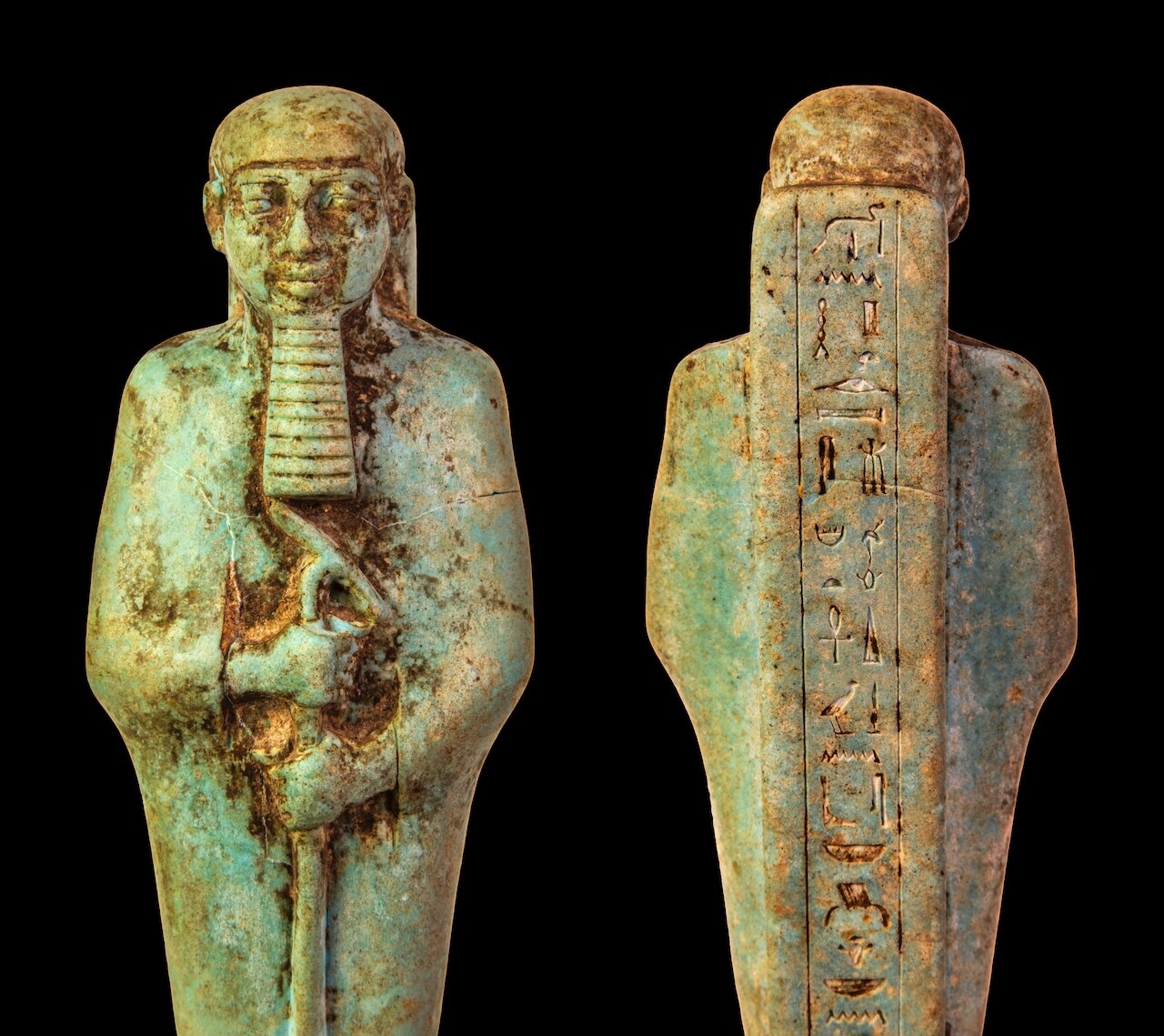
Front view of brown-spotted faience statuette on the left, reverse view on the right.

In the single column of text on the back of this faience figurine of Ptah, the god is recognized as a creator god and referred to as “the one who made heaven and who gave birth to craftsmanship.” The text further tells us that Ptah will offer life, prosperity, health, and all happiness to the owner/dedicator of the statuette.

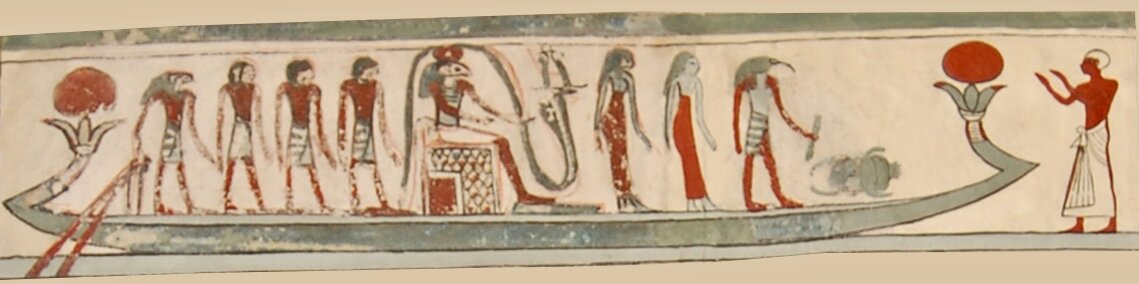
The Egyptian pantheon was filled with deities who inhabited the heavens but whose influence was experienced on earth. In the Pyramid Texts of the Old Kingdom, which first appeared on the interiors of the pyramids of the kings of the Fifth Dynasty of the Old Kingdom (c. 2500–2350 BCE), we learn that the Egyptians regarded the sky as a dwelling place of their gods and a location connected to the afterlife. Just as their daily life depended upon the Nile River, the Egyptians envisioned this heavenly realm as a landscape that divine beings navigated in sacred boats (Figure 1).

A boat viewed from the side, with eight people (one of whom is sitting) and a scarab beetle inside it. The boat sails toward one standing person who is gesturing a greeting.

Figure 1. A scene of the divine figures in a solar boat from the stela of Pebeh (EA8466). Image © The Trustees of the British Museum.

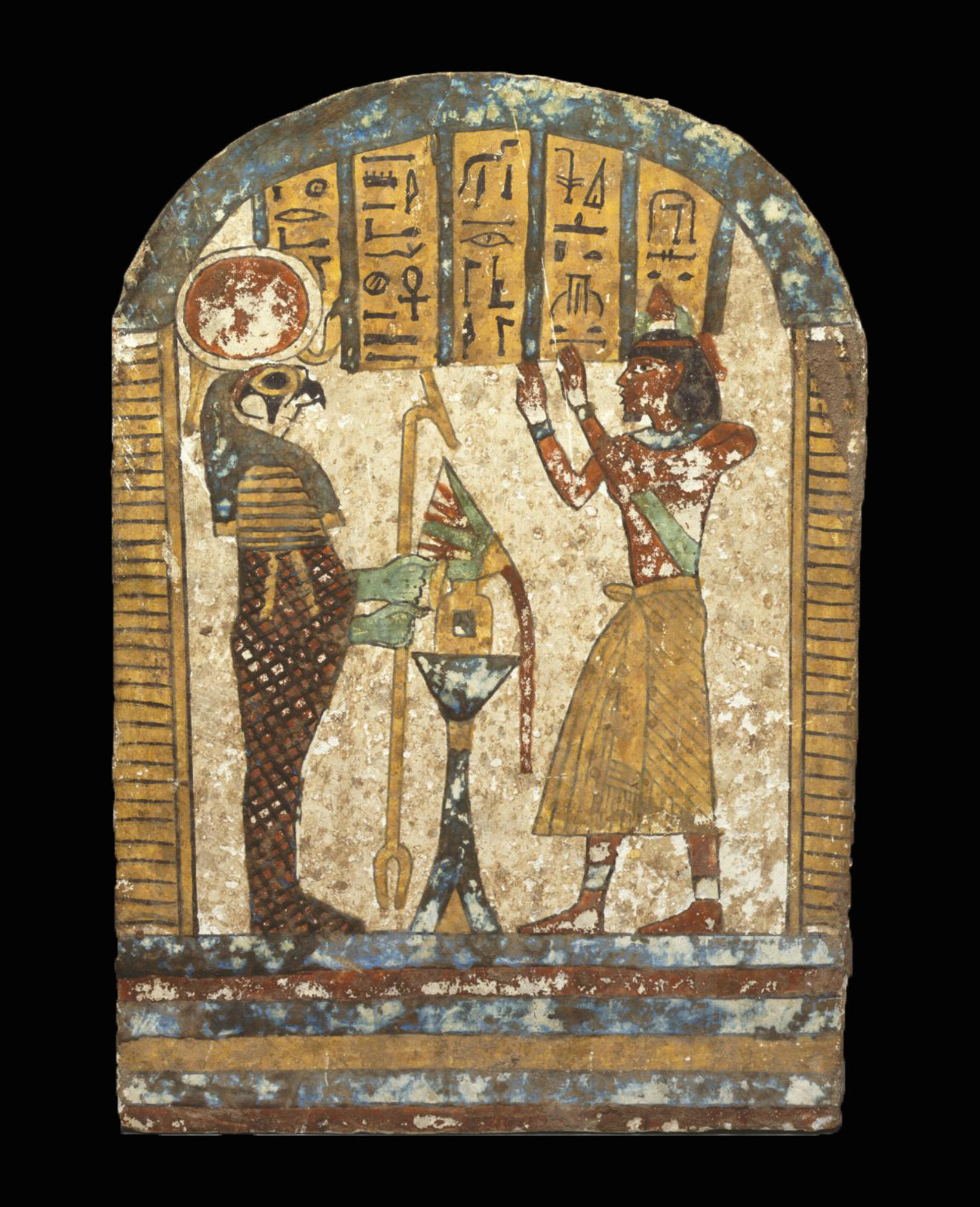
Figure 2. The falcon-headed sun god Re is adored by the priest Diefankh (UPMAA E2044). Image courtesy of the Penn Museum.

Figure 2. The falcon-headed sun god Re is adored by the priest Diefankh (UPMAA E2044). Image courtesy of the Penn Museum.

The sun god, Re, was of paramount importance to the ancient Egyptians, and the sun’s daily passage from east to west and its daily rising and setting served as a metaphor for the cycle of life—from birth, to adulthood, to death, to rebirth (Figure 2). The omnipresent sun in what was largely a desert environment may also explain the early Egyptians’ interest in solar concepts. At dusk, the sun god proceeded into the underworld (the Duat). New Kingdom funerary texts (1292–1075 BCE) and the associated images found on the walls of royal tombs record his nighttime journey. The sun god spent the twelve hours of the night traveling in the underworld, ultimately merging with Osiris, the primary funerary deity. The journey was treacherous, and the sun god faced his enemy, Apophis, a serpent who threatened him as he traveled in his solar boat nightly.

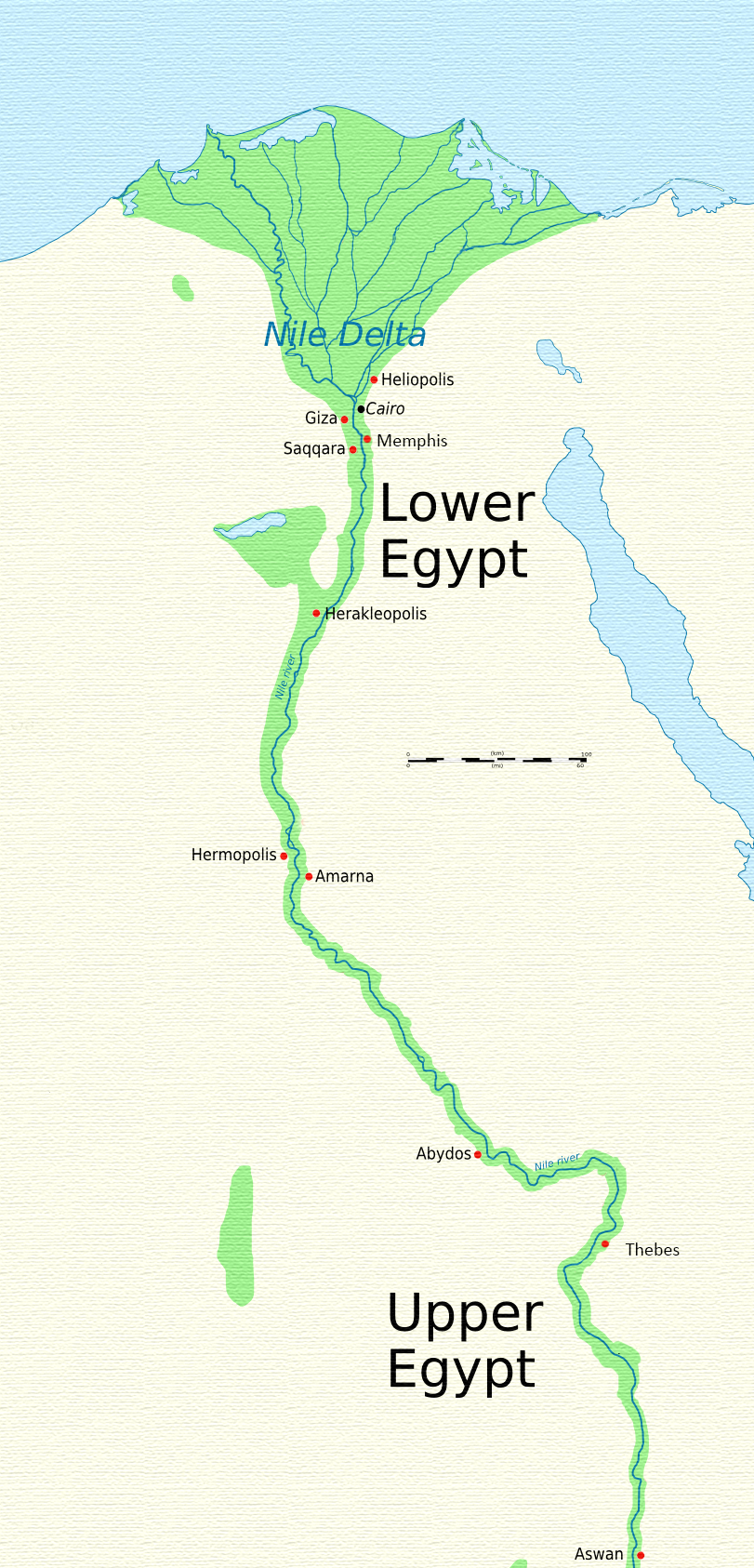
Another of Re’s important roles was as a creator god. The sun’s reappearance on the horizon at dawn each day was a symbol of the re-creation of the world. However, Re was not the sole creator god in Egyptian mythology. The Egyptians had several elaborate myths describing the origins of their world. Each of these creation stories was centered at a different city in ancient Egypt (Figure 3).

" "

Figure 3. Map of Upper and Lower Egypt.

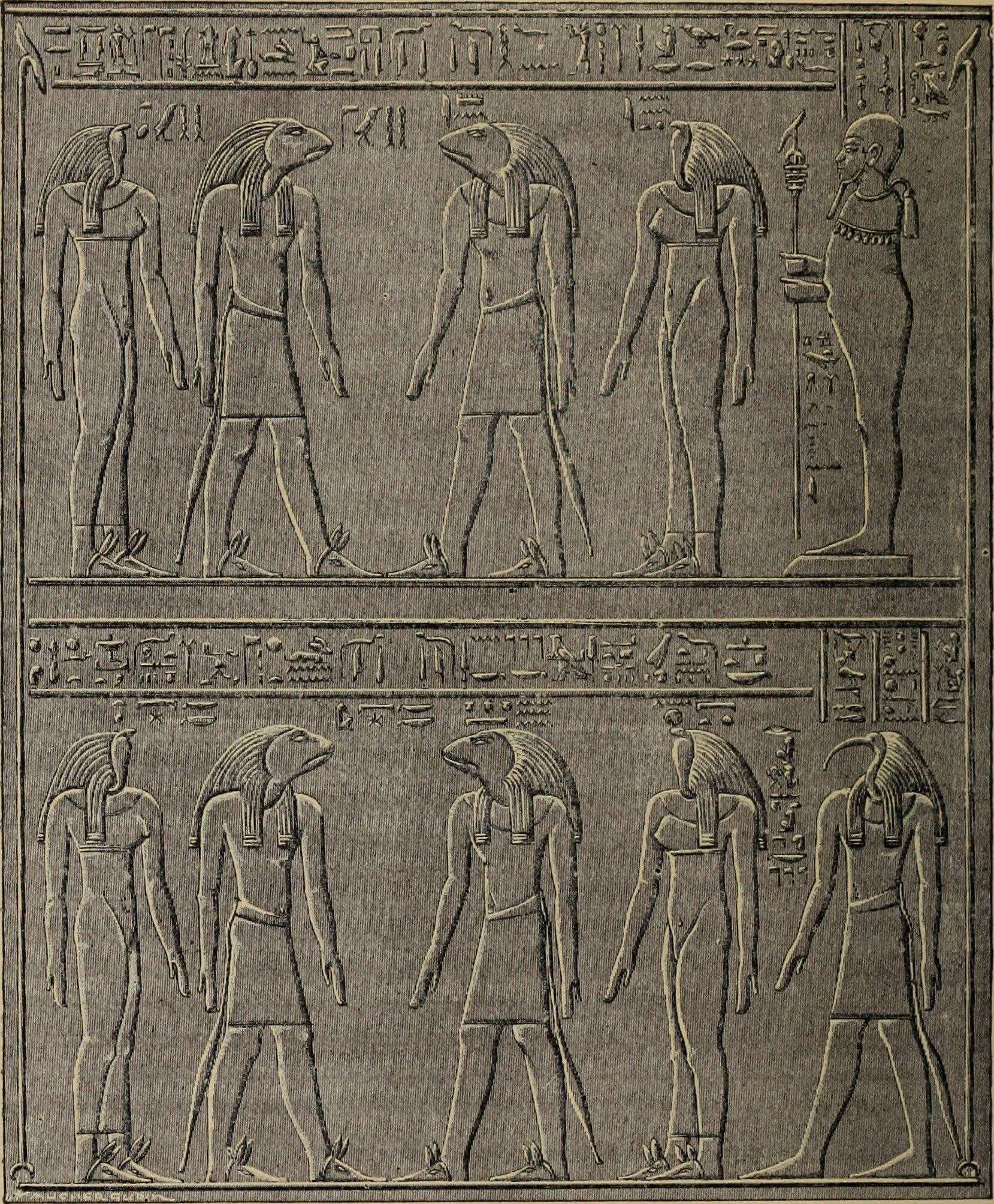
The Hermopolitan cosmology arose at the site of Hermopolis in Middle Egypt. Hermopolis was a city sacred to Thoth, the god of wisdom. The ancient Greeks equated Thoth with their god Hermes, which gives us the name Hermopolis, or “city of Hermes.” The ancient Egyptian name for this city was Khemnu, or “Eight-Town.” The number eight in this place-name makes references to the eight deities (the Ogdoad) who are the main characters in this version of the creation story. The Ogdoad consisted of four frog-headed male gods and their serpent-headed female counterparts (Figure 4). This divine group represented the dark, watery, unknown, and eternal state of the cosmos prior to creation. Nun and Naunet represented water. Heh and Hauhet expressed the notion of infinity. Kek and Kauket stood for darkness. Amun and Amaunet reflected the concept of hiddenness. These eight gods existed within the watery chaos of pre-creation.

Arranged in two horizontal rows, each row shows two male and two female masked figures standing as couples and facing each other. An additional figure stands on the far right of each row, facing the couples.

Figure 4. An illustration of the Ogdoad, drawn by Faucher-Gudin from a photograph by Béato.

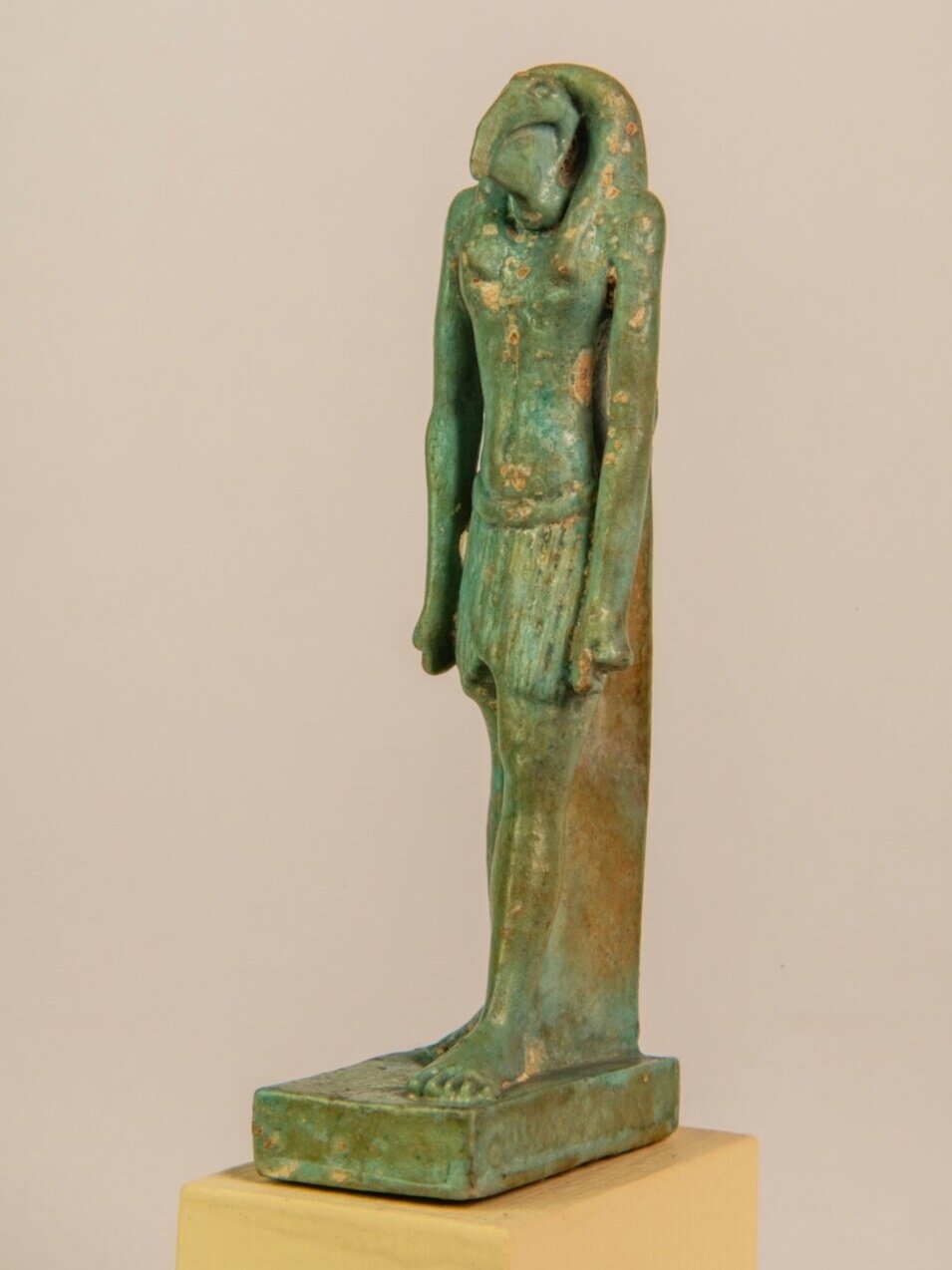
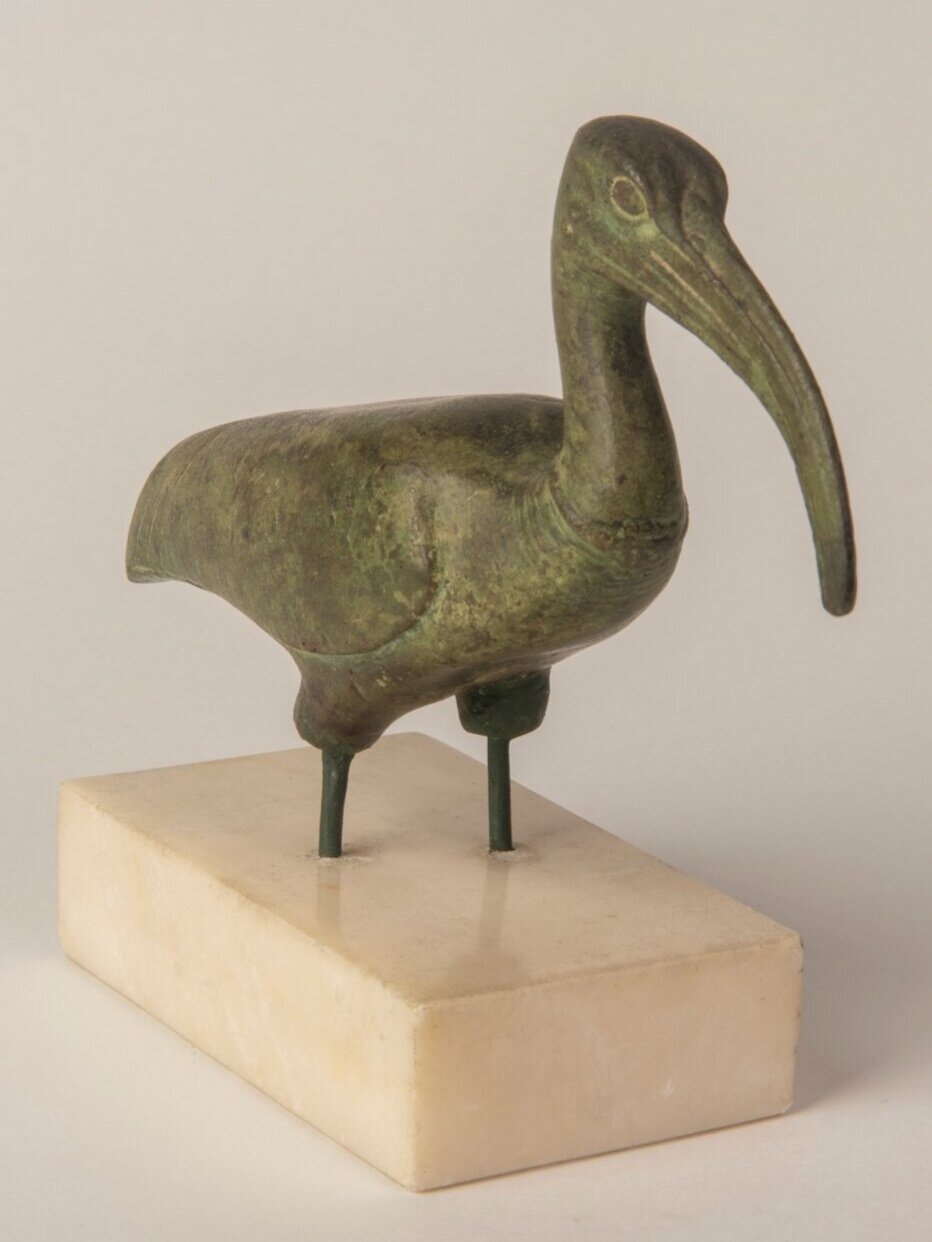
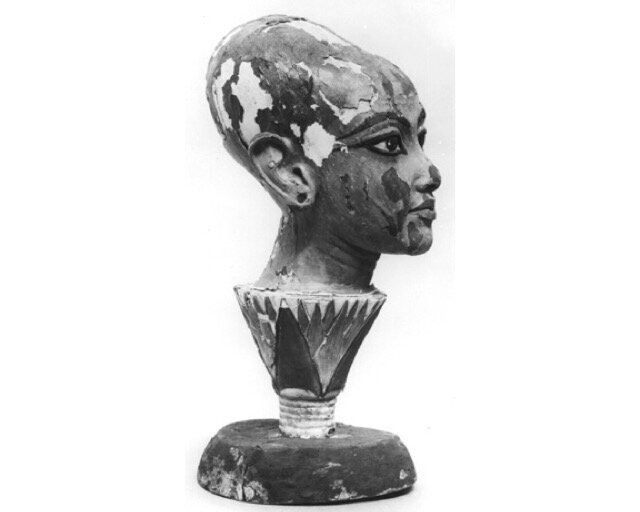
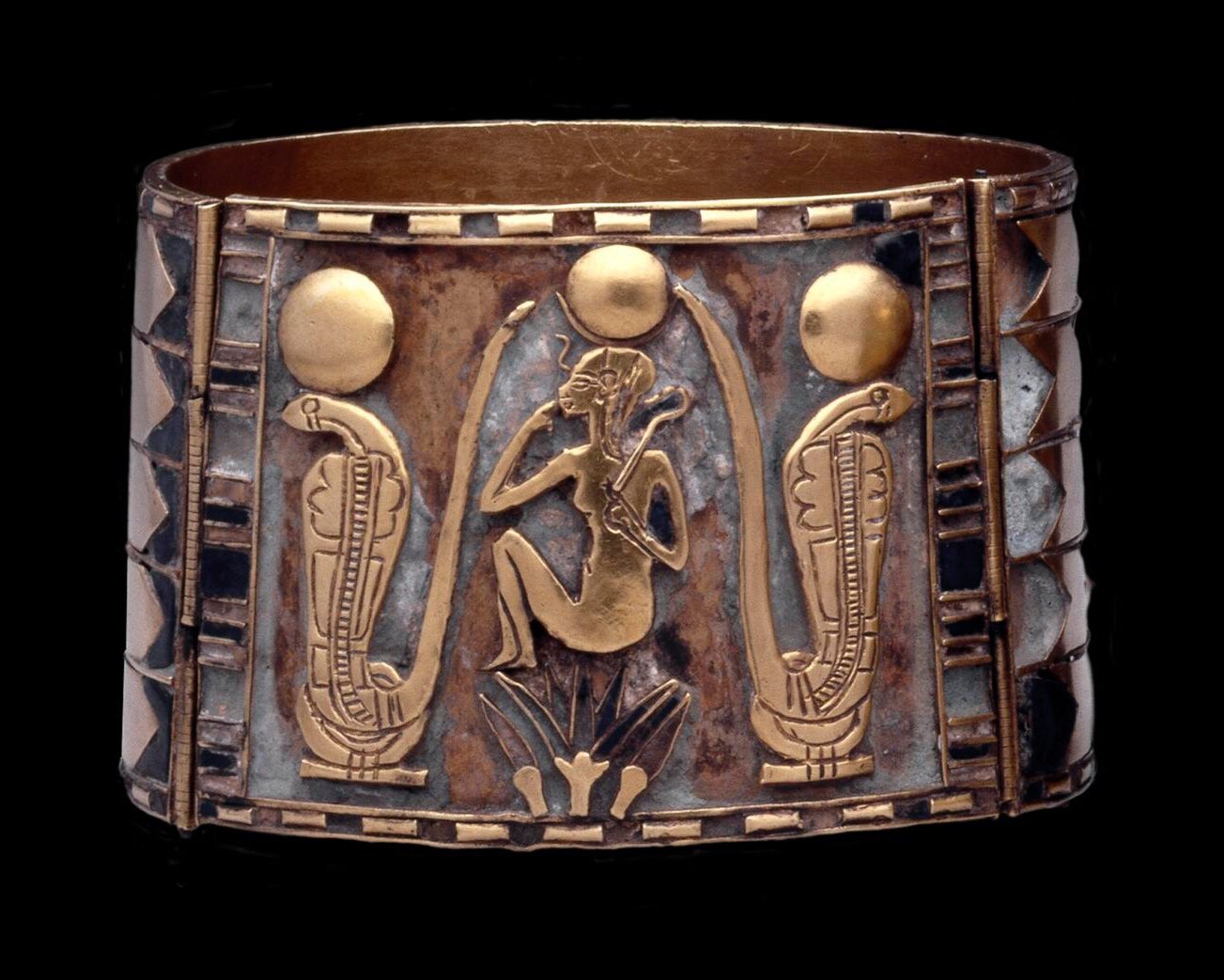
Within this unchanging “nothingness,” there was the potential for creation. The Egyptians believed that from these eight gods came a cosmic egg that contained the deity responsible for creating the rest of the world, including the primeval mound—the first land to arise out of the waters of pre-creation. In some versions of the myth, the egg was laid by a goose named “the Great Cackler,” while in other versions an ibis, the bird associated with the god Thoth, is responsible for the egg (Figures 5-6). Thoth’s appearance here in the myth is probably the work of the Hermopolitan priesthood, who wanted to recognize the importance of the city’s patron deity. After the mound appeared, a lotus blossom bloomed signaling the birth of the newborn sun god (Figure 7). After the sun made its first appearance, the rest of creation could follow. In some cases, this myth further describes a scarab beetle that emerges from the lotus. The scarab is often a solar symbol, and the texts describe how this beetle transforms into a child. When this child cried, his tears became humankind (Figure 8).

Brown-spotted, light green amulet.

Figure 5. An amulet representing the god Thoth as an ibis-headed man (Glencairn Museum E219).

Figure 6. A bronze statuette representing the god Thoth as an ibis (Glencairn Museum E1121).

Figure 6. A bronze statuette representing the god Thoth as an ibis (Glencairn Museum E1121).

Tutankhamun's head comes out of the center of a flower.

Figure 7. In this statuette from the tomb of Tutankhamun, the boy king is shown as the newborn sun god emerging from a lotus flower at the moment of creation (Cairo Museum JE 60723). Image courtesy of the Griffith Institute.

Figure 8. On this bracelet of Nimlot, the newborn sun god is shown as a child seated atop a lotus flower (EA14595). Image © The Trustees of the British Museum.

Figure 8. On this bracelet of Nimlot, the newborn sun god is shown as a child seated atop a lotus flower (EA14595). Image © The Trustees of the British Museum.

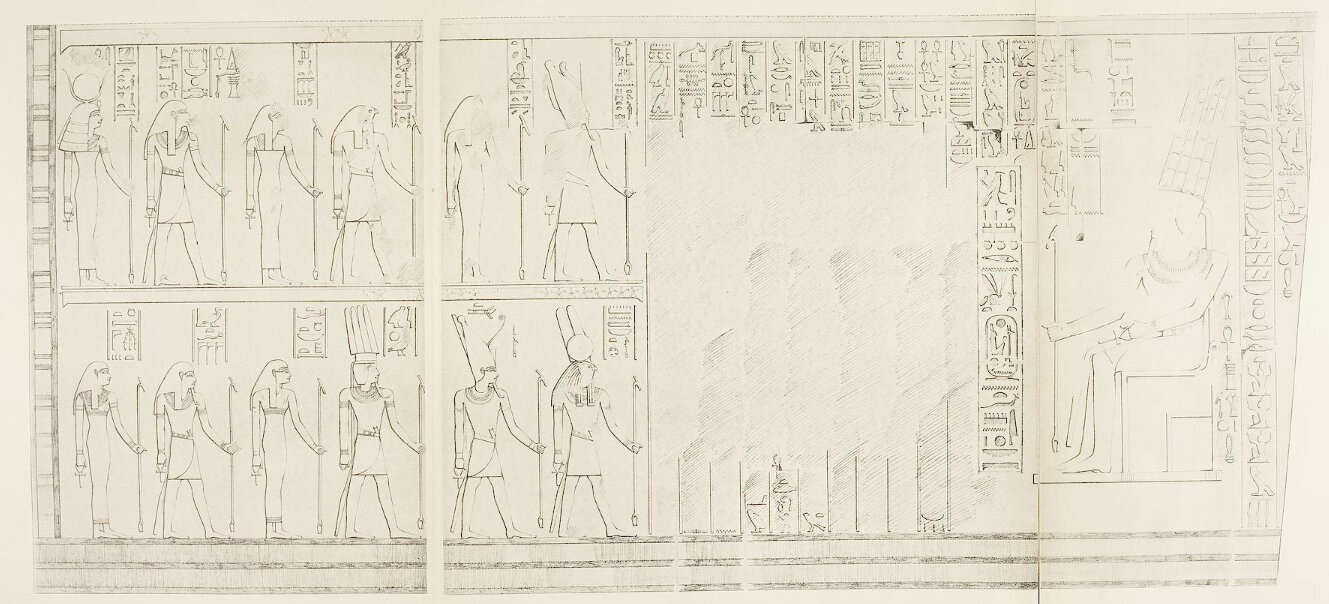
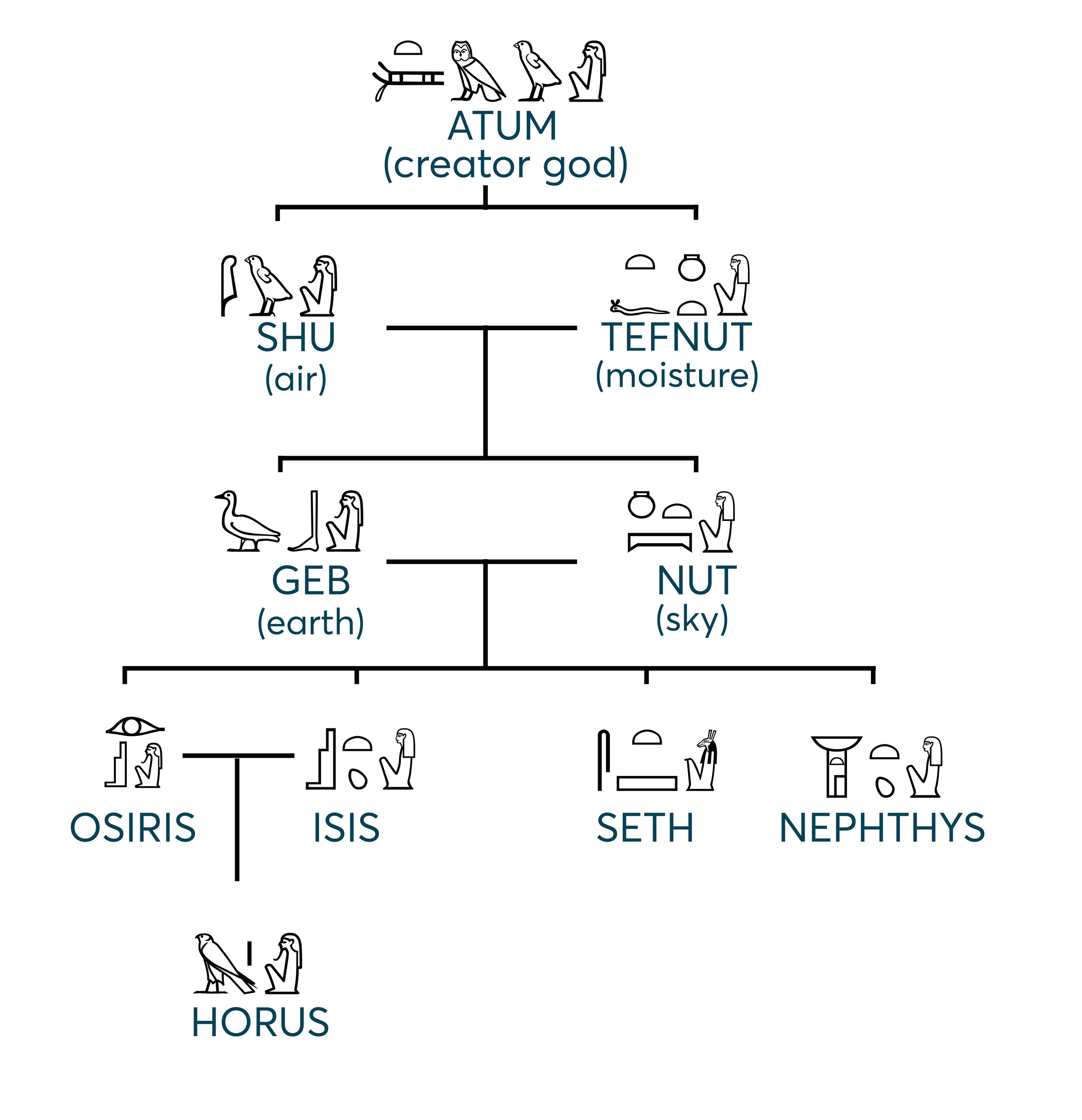
The importance of the sun in the creation of the world is highlighted in another creation myth that makes reference to a collective of gods known as the Heliopolitan Ennead (Figure 9). These nine deities (the Ennead) are mentioned in the Old Kingdom Pyramid Texts. This myth seems to have originated at the city of Iunu (or Heliopolis, meaning “City of the Sun” in Greek). Here, the creation of the world begins with a creator god named Atum (or Re-Atum). Just as we see with the Hermopolitan version of creation, there is a chaotic, watery state of pre-creation, in which Atum resides before he is born. Atum is self-created and arises in the shape of an obelisk-like pillar (the benben) in Heliopolis. He engenders by means of his own bodily fluids. To begin the creation of the world, Atum spits out a pair of divine beings: Shu, the god of air, and Tefnut, his female counterpart, the goddess of moisture (Figure 10).

Twelve male and female figures stand in two horizontal lines on the left, separated from a seated Amun Re on the right by an open space partially filled with columns of hieroglyphs.

Figure 9. An illustration of a relief from the mortuary temple of Hatshepsut at Deir el Bahri showing the members of the Ennead before Amun Re. This drawing appears in E. Naville, The Temple of Deir el Bahari, volume 2, London: Egypt Exploration Fund, 1896, pl. xlvi.

Brown-spotted, light green amulet.

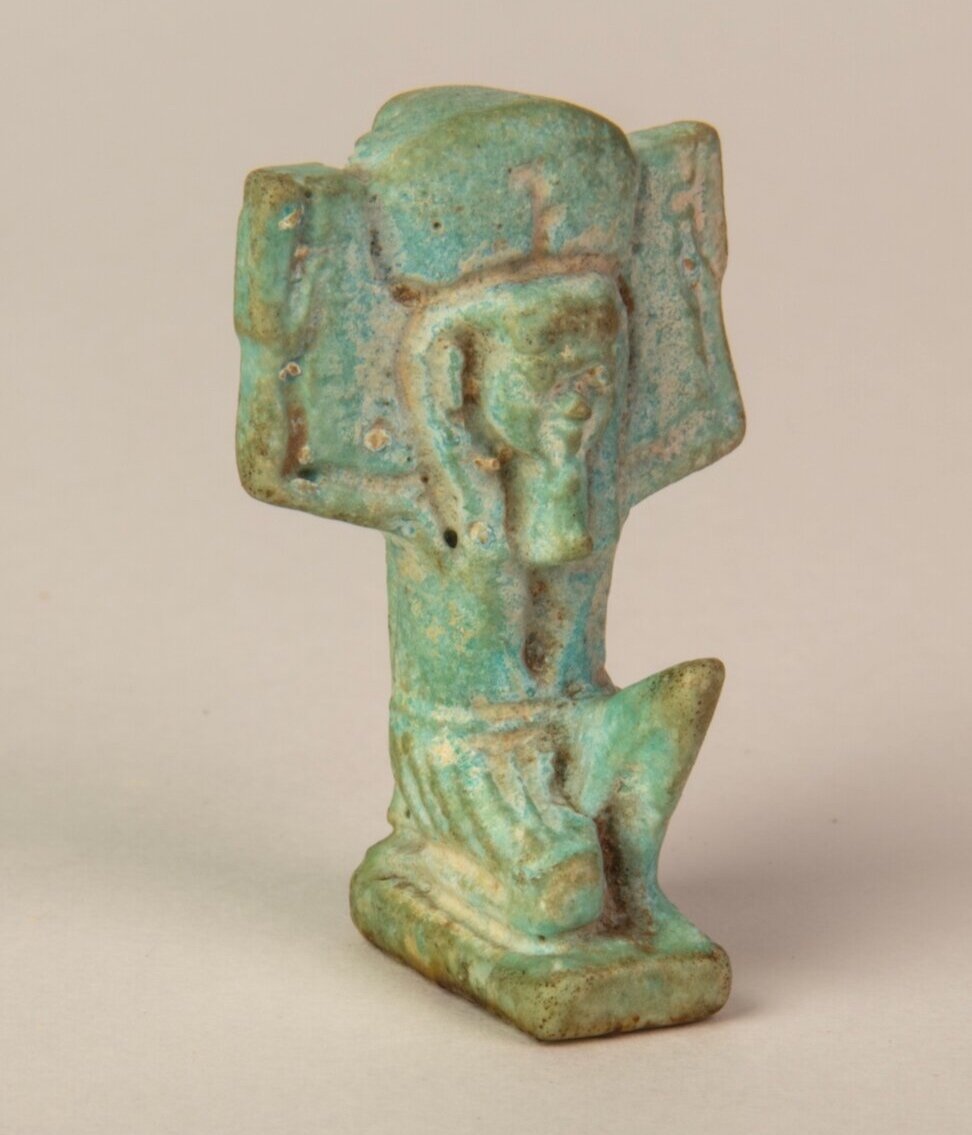
Figure 10. A faience amulet of the god Shu shown with upraised arms lifting up the sky (Glencairn Museum E453).

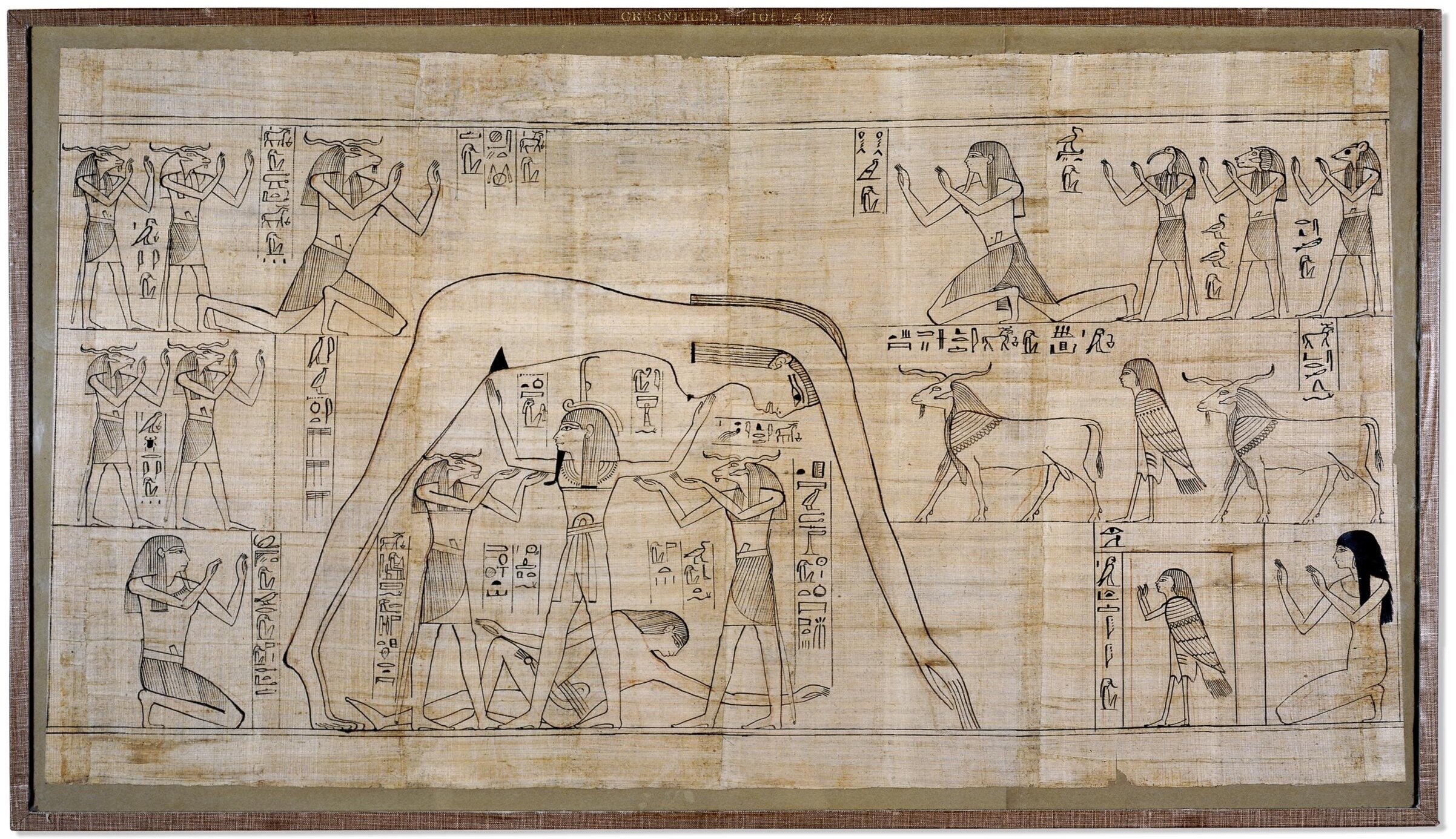
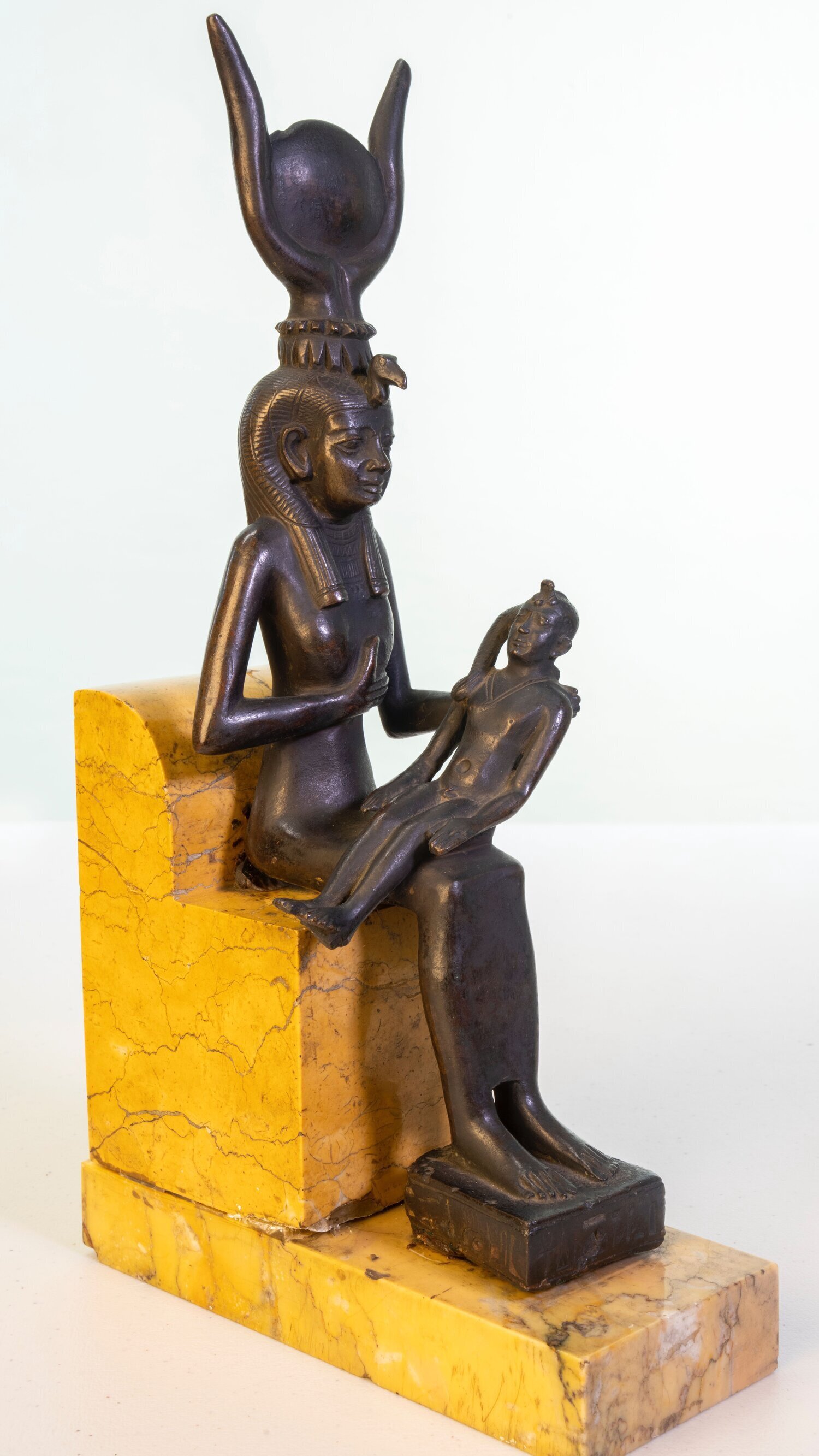
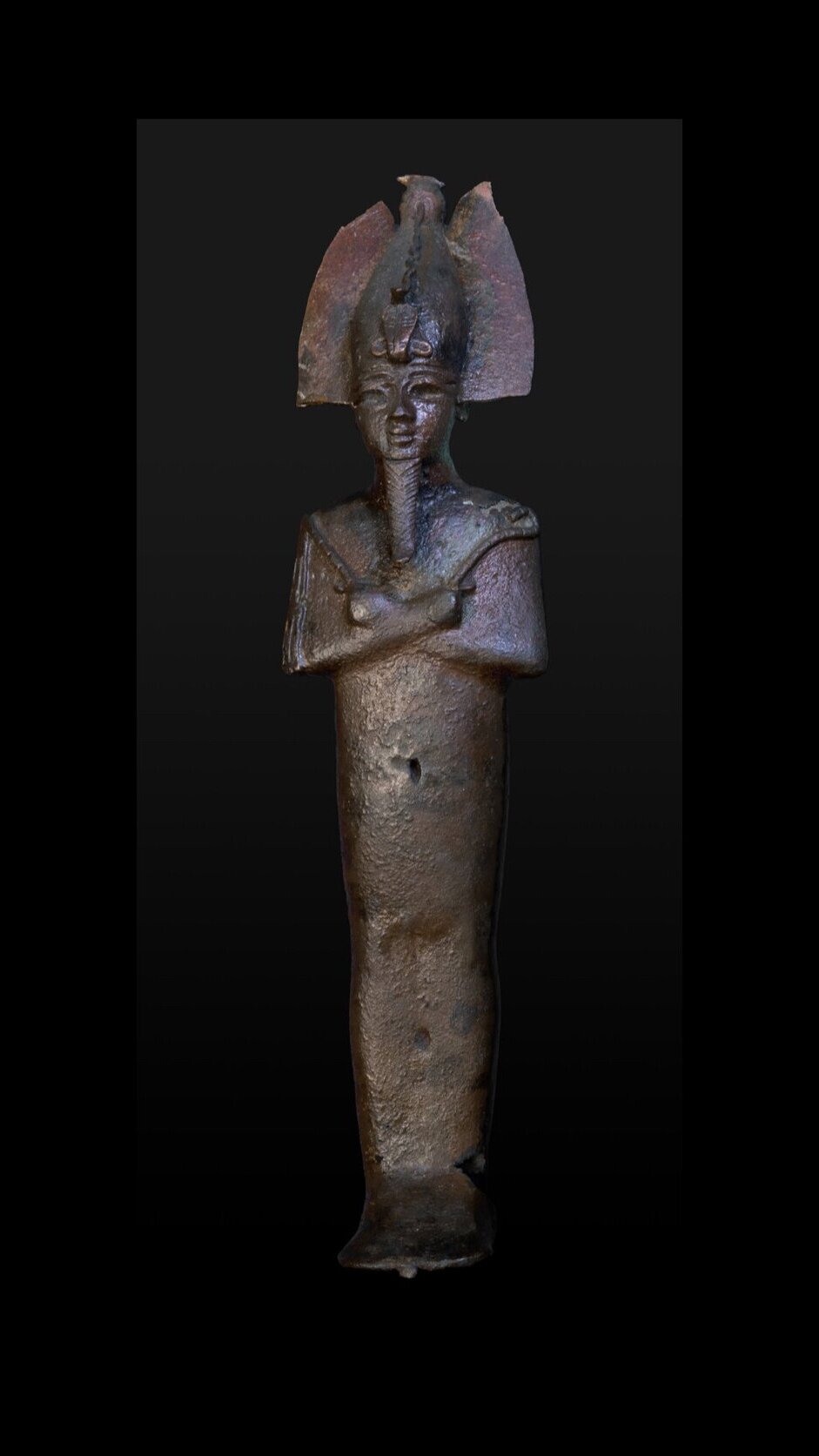
Shu and Tefnut in turn produce a second generation of gods. Their son, Geb, is the god of the earth, and his sister-wife, Nut, is the sky goddess. With this second generation, the Egyptian cosmos comes into existence and all the elements necessary for life on earth—the sun, air, moisture, land, and sky—are now in place. The iconography of Geb and Nut together is particularly evocative (Figure 11). Geb appears as a human male lying on the ground. Arched above him, separated by their father Shu, stretches the figure of his sister-wife Nut, often shown as a nude female whose body is covered in stars. The Egyptians envisioned her arms and legs as the pillars of the sky and each of her limbs as indicators of the four cardinal points. Before their separation by their father, Geb and Nut were able to produce another generation of gods: Isis, Osiris, Seth, and Nephthys. Isis (Figure 12) and Osiris (Figure 13) in turn produced Horus. (It is interesting to consider that the Heliopolitan genealogy can also be viewed as the family tree of the Egyptian king (Figure 14). Each king was considered a representative of Horus while he was alive, and was then associated with the god Osiris, the king of the dead, after his death.) 

" "

Figure 11. The Egyptian version of the cosmos as seen on this drawing from the Book of the Dead of Nestanebetisheru. Here Shu, the god of air, separates the earth god Geb from the sky goddess Nut (EA10554,87). Image © The Trustees of the British Museum.

Isis sits on a yellow stone throne, with Horus on her lap.

Figure 12. Figurine of Isis, member of the Heliopolitan Ennead, suckling Horus (Glencairn Museum E1164).

Osiris stands with his arms crossed across his chest.

Figure 13. Figurine of Osiris, member of the Heliopolitan Ennead (Glencairn Museum E74).

Five generations of the Heliopolitan Ennead, beginning with Atum, the creator god, and ending with Horus.

Figure 14. The family tree of the Heliopolitan Ennead.

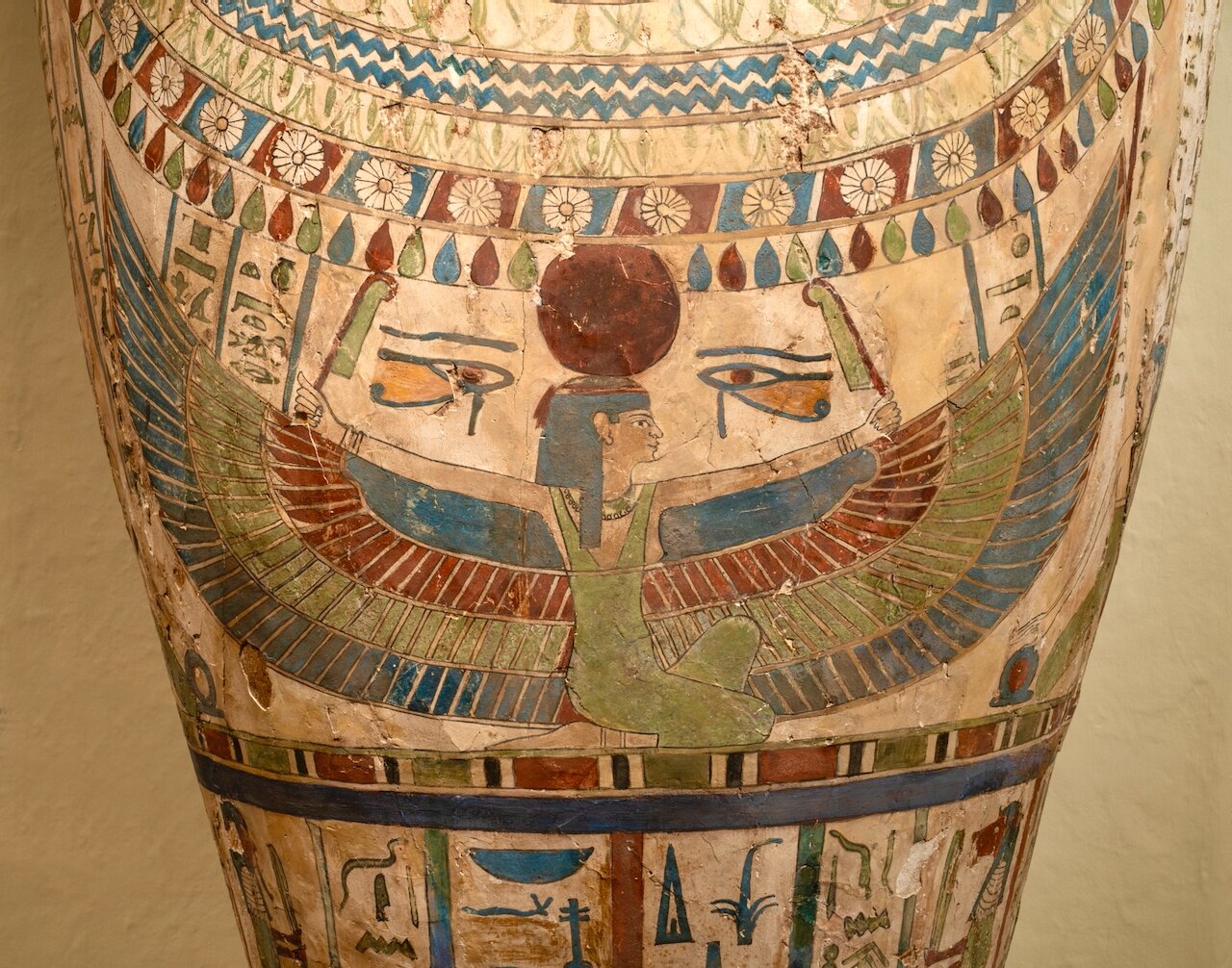
In addition to their roles in the creation of the cosmos, members of the Ennead are involved in other cycles of life and rebirth. For example, the sky goddess Nut is believed to give birth to the sun each day, and in some traditions she also gives birth to the stars. When observing the nighttime sky, the Egyptians may have noticed that the outer arm of the Milky Way resembled a female form and identified this celestial feature with the goddess Nut. As a goddess responsible for the sun’s daily rebirth, Nut was also accorded a role in the resurrection of the dead. Representations of Nut on the ceilings of New Kingdom (1539–1075 BCE) royal tombs show the goddess with the sun entering her mouth and passing through her star-covered body during the night, to be reborn in the morning. She often appears on the inside lids of sarcophagi, protecting the deceased until he or she, like the sun god Re, would be reborn. Nut can also appear on the lids of coffins as a woman with wings spread protectively across the chest of the deceased (Figure 15).

Nun wears green and kneels while looking to the right, colorful wings held wide on her splayed arms.

Figure 15. The goddess Nut on the lid of the coffin of Sema-tawy-iirdis (Glencairn Museum E1267).

A third version of the creation of the cosmos can be found in a text known as the Memphite Theology. Memphis was one of the most important cities in ancient Egyptian history. Situated along the Nile at the point where the Nile River branches out into the Nile Delta, Memphis was Egypt’s first capital city. Throughout Egypt’s long history, Memphis remained an important religious and administrative center even during times when its status as the country’s capital city had shifted. According to the historian Manetho, Memphis was founded by the legendary king Menes around 3200 BCE. The divine triad who protected the city consisted of Ptah, his consort Sekhmet, and their child, Nefertem (Figure 16). Ptah was the patron deity of craftsmen, and in the Memphite version of creation he plays the role of the primary creator god (see also lead photo above).

Three dark brown statuettes of varying heights.

Figure 16. Members of the Memphite triad, the patron deities of Memphis (Glencairn Museum E113, E967, E905).

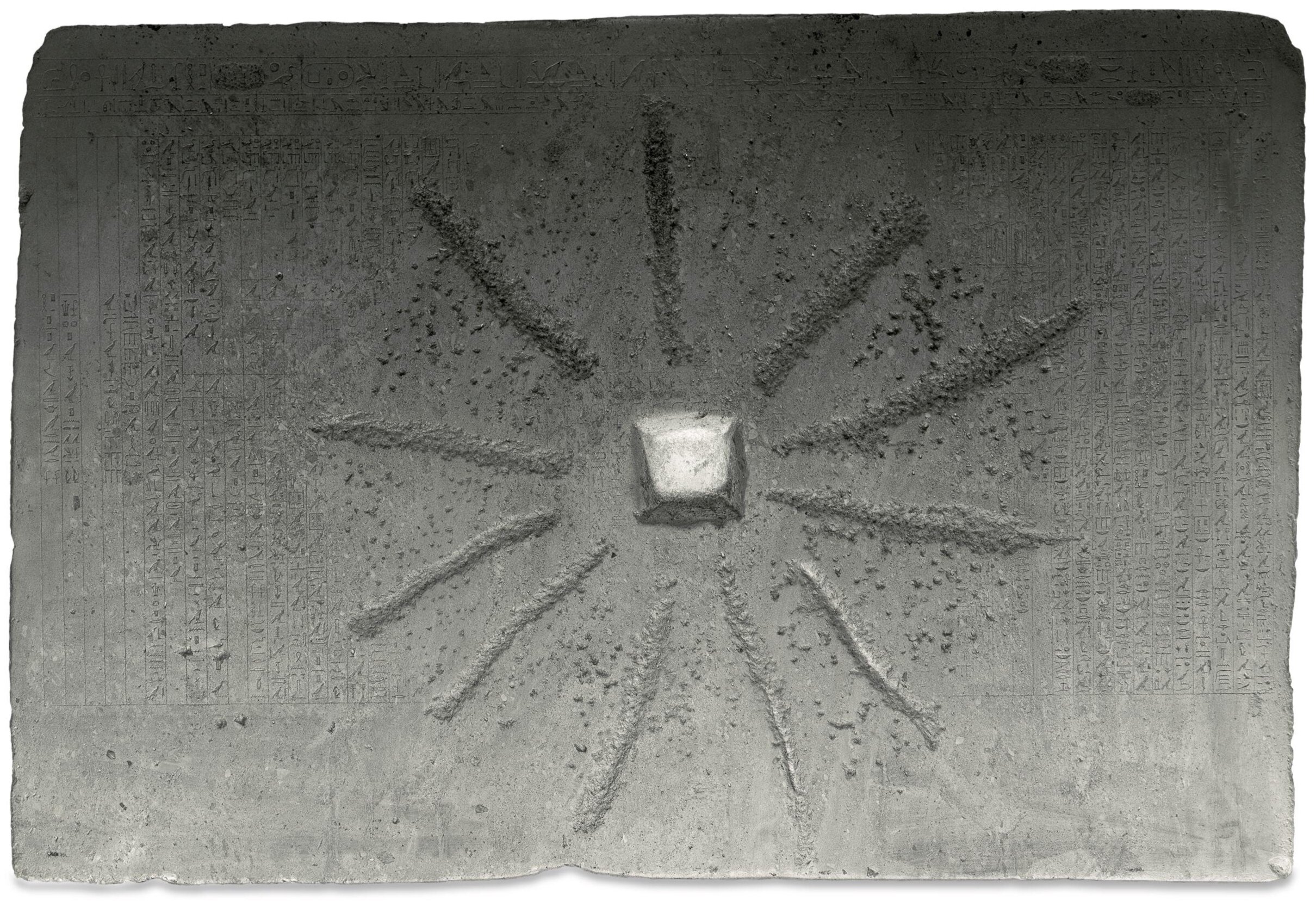
Unlike the versions of creation expressed in the Hermopolitan and Heliopolitan creation myths, which have been reconstructed from various ancient religious texts, the Memphite creation myth is preserved on a single document known as the Shabaka Stone, which is now preserved in the British Museum (Figure 17). The text inscribed on this monument relates how King Shabaka, a Nubian pharaoh of Egypt’s 25th Dynasty (705–690 BCE), found a worm-eaten papyrus in the library of the Temple of Ptah at Memphis. Realizing how important the damaged document was, Shabaka purportedly ordered that the words be carved anew in stone to preserve them. In this text Ptah (Figure 18) is credited with the creation of the world. He creates by means of thought and words: “Sight, hearing, breathing—they report to the heart, and it makes every understanding come forth. As to the tongue, it repeats what the heart has devised. Thus all the gods were born and his Ennead was completed. For every word of the god came about through what the heart devised and the tongue commanded.” The text describes how Ptah was responsible for the creation of all the gods and the establishment of their worship throughout Egypt:

“He gave birth to the gods.
He made the towns,
He established the nomes,
He placed the gods in their shrines,
He settled their offerings,
He established their shrines,
He made their bodies according to their wishes.
Thus the gods entered into their bodies,
Of every wood, every stone, every clay,
Everything that grows upon him
In which they came to be.
Thus were gathered to him all the gods and their kas,
Content, united with the Lord of the Two Lands.”

A grey rectangle stone, covered in hieroglyphic text. Eleven mostly straight carved lines radiate out from a square divot in the center, obscuring some of the text.

Figure 17. The Shabaka Stone, a basalt slab inscribed with the text of the Memphite Theology. The stone was later used as a millstone, which explains some of the damage to its surface (EA498). Image © The Trustees of the British Museum.

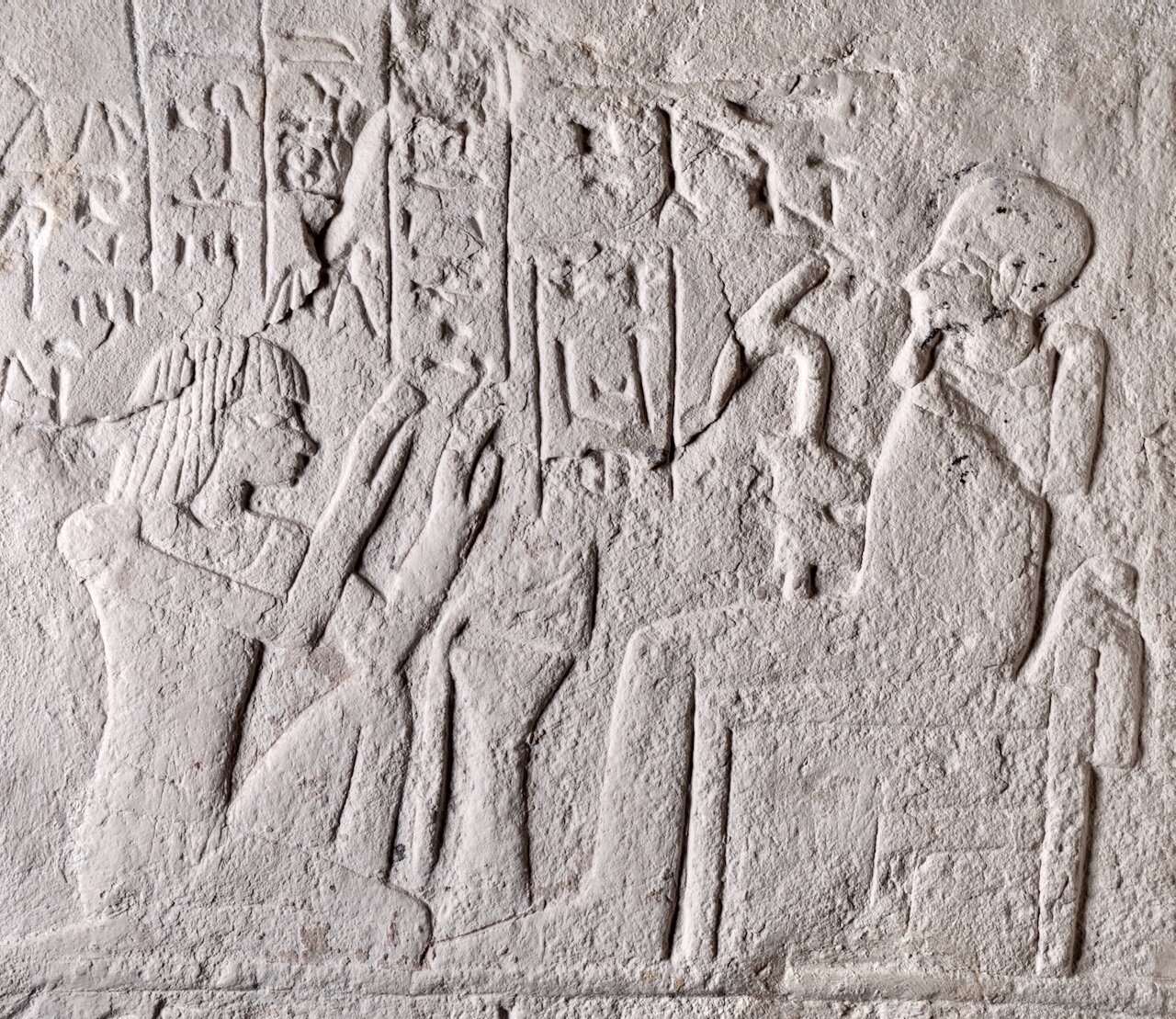
Ptah sits on a throne facing left. A person kneels before him with raised hands. Hieroglyphic text is above the supplicant.

Figure 18. A representation of the god Ptah on the stela of Maienhekau (Glencairn Museum E1266). Ptah is shown with his characteristic skull cap.

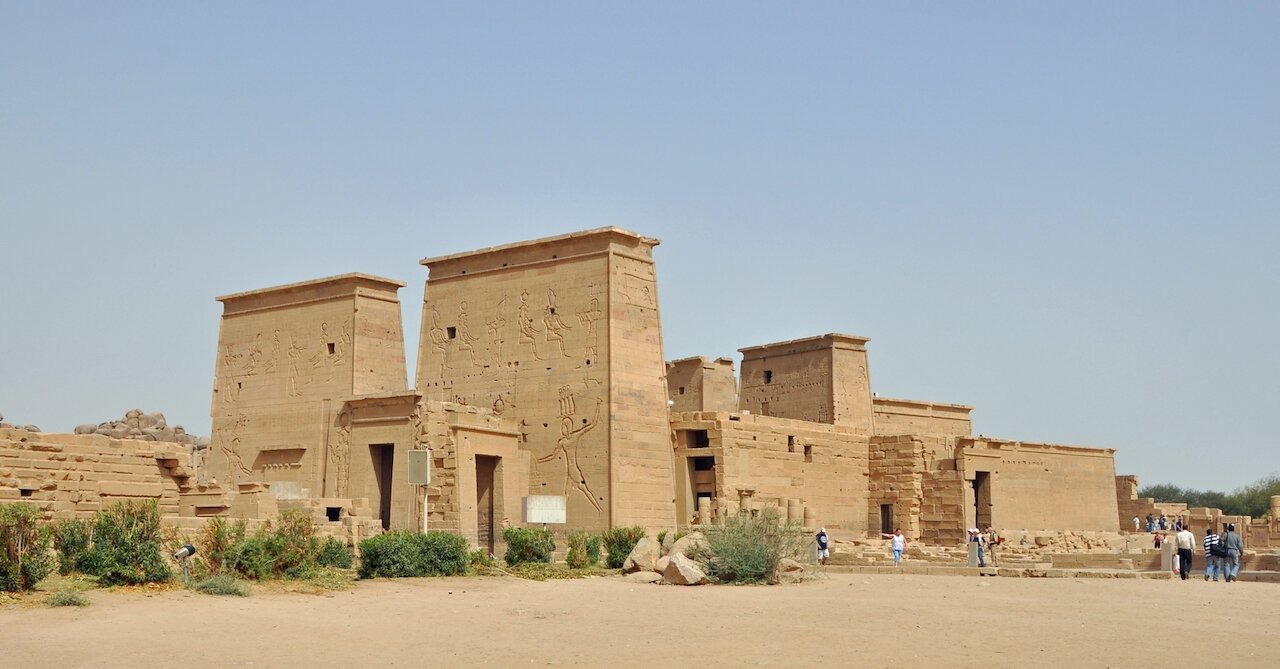
Reference to the moment of creation is not only seen in Egyptian texts. Most temples have architectural features that mimic elements of the cosmos at the beginning of creation. A large gateway called a pylon usually fronts a temple (Figure 19). The form of the pylon consists of two tapering towers joined by a lower section. The shape of the pylon imitates the hieroglyph for the word “horizon” (akhet), represented as two hills with a sun disk in the center. Further adding to the solar imagery, a pair of obelisks often stands before the entrance to the temple. An obelisk is a four-sided standing stone that tapers as it rises and ends in a small pyramid called a “pyramidion.” Obelisks were sacred to the sun god and were a symbol of the sun related to the benben, which calls to mind the primordial mound described in the Heliopolitan and Hermopolitan creation myths.

People walk around the outside of a large, sand-colored building.

Figure 19. A view of the temple pylon at Philae Temple. Photo courtesy of Marc Ryckaert. 

Two sand-colored columns stand before the backdrop of a deep blue sky and more temple remains.

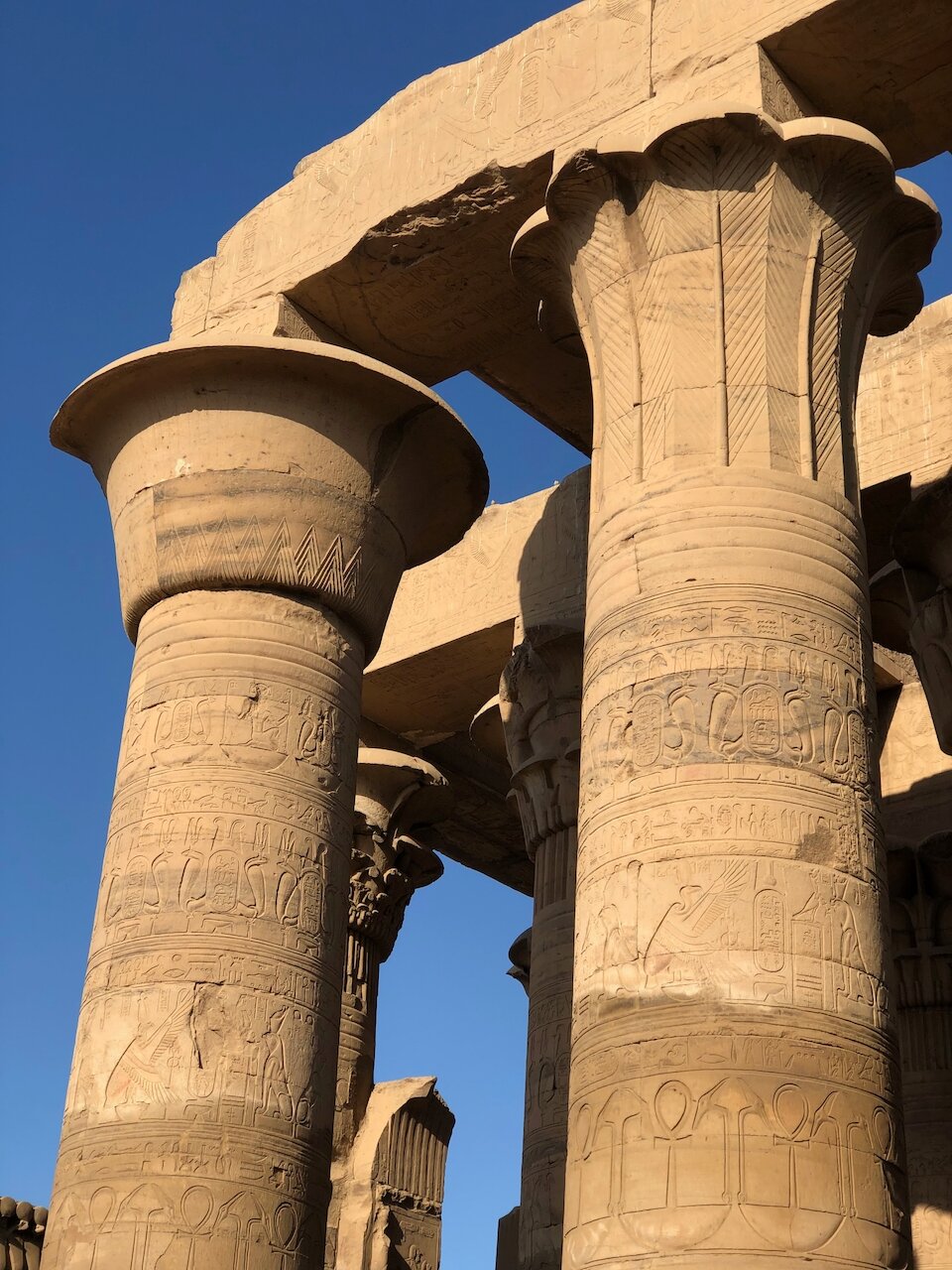
Figure 20. A view of papyriform and lotiform columns in the temple of Kom Ombo. Photo courtesy of Marie Thérèse Hébert & Jean Robert Thibault.

Each temple was a microcosm of the world wherein the creation was repeated on a daily basis. Beyond the entrance pylon, the typical temple contained one or more open courts, a hypostyle hall, and, at the innermost space, the sanctuary. The columns found throughout the temple often had capitals that are papyriform or lotiform in design, echoing the marshy plants that emerged on the primeval mound (Figure 20). The dark sanctuary or shrine that housed the image of the temple’s resident god imitated the mound upon which creation began. When priests carried out the morning rituals and opened the god’s shrine, they reenacted the very moment of creation, and the temple’s resident deity took the position of the creator god. Many temple precincts are also bounded by walls whose bricks are laid in a wavy design, perhaps symbolizing the chaotic waters of pre-creation which are held at bay by the creation of the (primordial) mound upon which the temple structure was built.

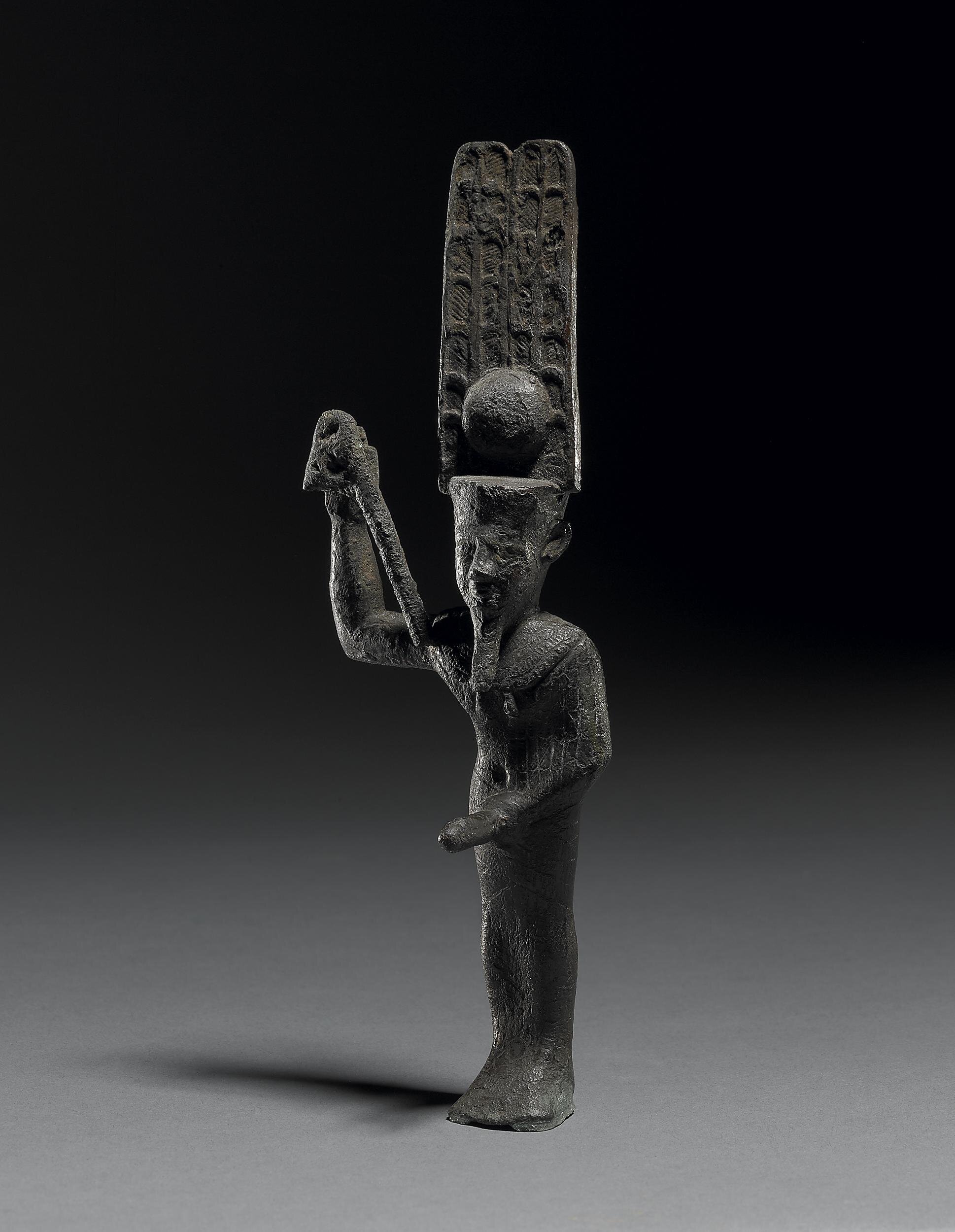
In addition to the creator gods depicted in the three main creation myths, there are other deities who were also considered creator gods such as Min, Amun, Khnum, and the Aten. One of Egypt’s earliest known deities was the god Min (Figure 21). Depictions of him appear as early as the Predynastic Period. Three colossal statues of Min dating to around 3300 BCE were excavated by W.M.F. Petrie at the site of Coptos. These statues, while fragmentary, originally depicted this god with the erect phallus that became standard for his representations. As a god connected with fertility and creation, Min is usually shown in this distinctive ithyphallic pose. He grasps a flail in one upraised arm and wears a tall plumed crown very similar to that of Amun-Re.

A statuette of Min, his right arm raised and holding a flail, and wearing a headdress that is approximately two thirds his height.

Figure 21. The god Min (EA60045). Image © The Trustees of the British Museum.

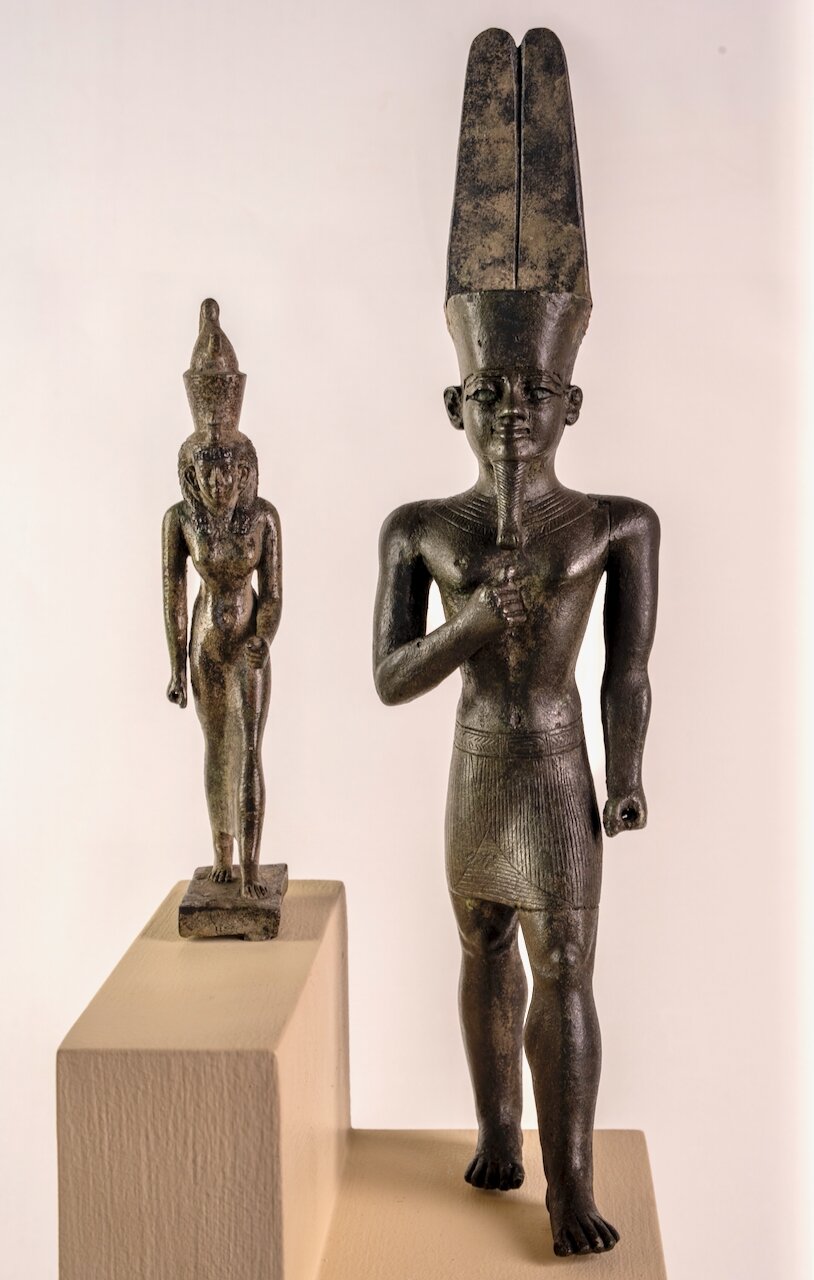
A member of the Hermopolitan Ogdoad, Amun’s name means “the hidden one.” During the Middle Kingdom (c. 1945-1640 BCE) this god became increasingly important, and by the New Kingdom he rose to prominence as a state god and was given the epithet “king of the gods.” Amun, together with his consort Mut, and their child, Khonsu, comprise the Theban triad, the patron deities of the city of Thebes (Figure 22). At the same time, Amun (or his combined form, Amun-Re) became thought of as a creator god in his own right. Amun was usually shown as a human, and when he was in the form of Amun-Re he wore a crown with two tall plumes. The ram and the goose were animals sacred to him. 

" "

Figure 22. A bronze statuette of the god Amun (right, Glencairn Museum E1165) and his consort Mut (Glencairn Museum E1145).

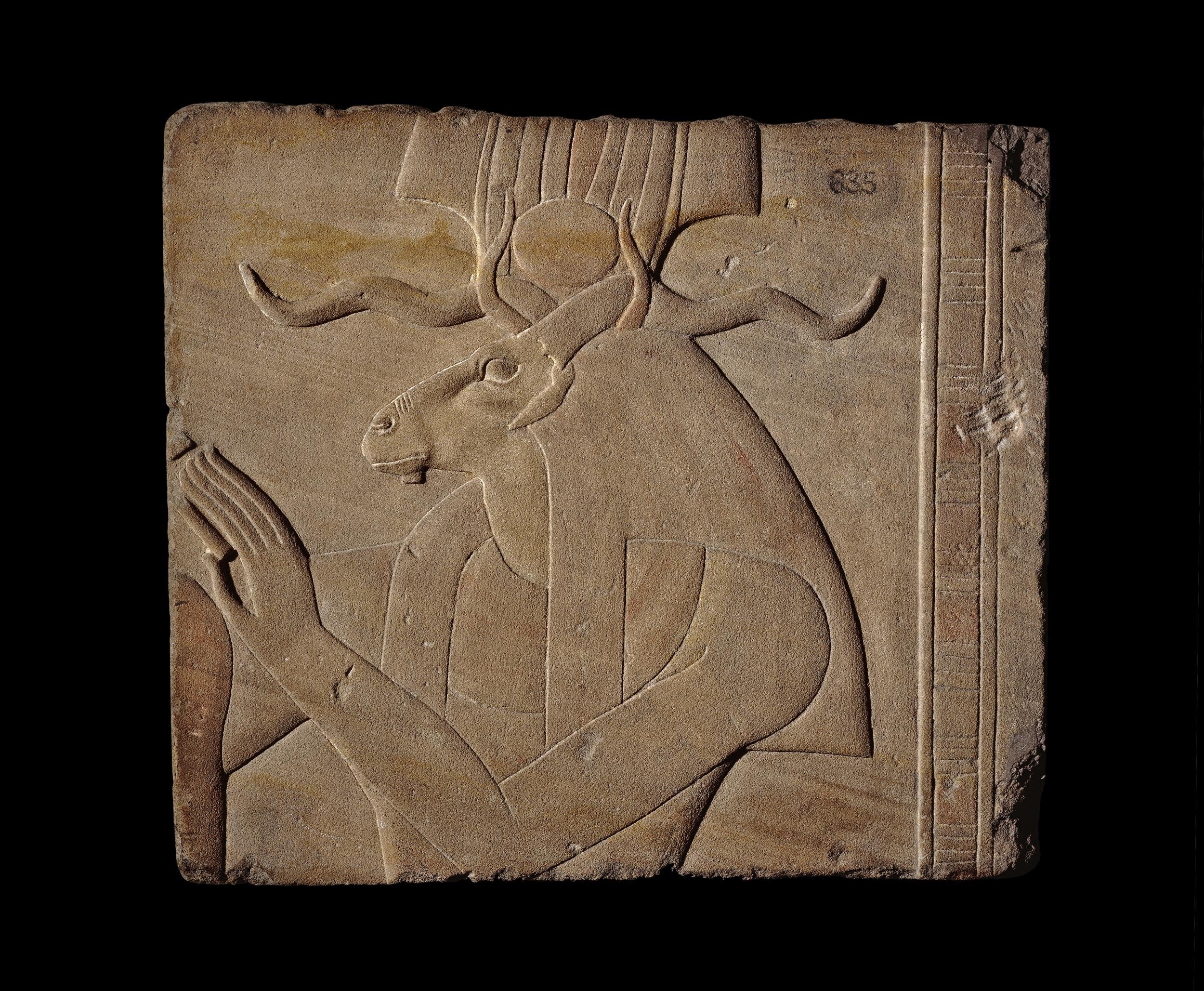
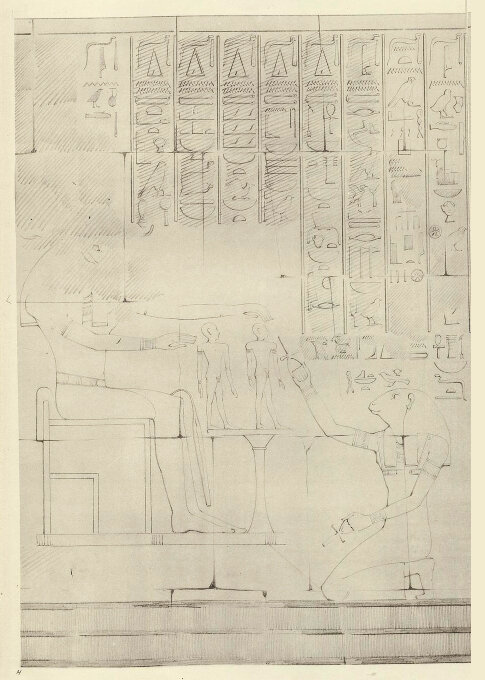
The ram-headed god Khnum is described in the Coffin Texts, a collection of funerary spells composed around 1991-1786 BCE, as a creator of humans and animals (Figure 23). By the reign of the female pharaoh Hatshepsut (reigned 1479-1458 BCE), Khnum is described as a god who is responsible for fashioning gods, humans, and animals on a potter’s wheel (Figure 24).

" "

Figure 23. Relief showing the ram-headed god Khnum (EA635). Image © The Trustees of the British Museum.

Khnum sits at a potter’s wheel, while a masked person kneels opposite her. Hieroglyphic text fills the space above them.

Figure 24. An illustration of a relief from the mortuary temple of Hatshepsut at Deir el Bahri showing Khnum creating Hatshepsut and her ka on a potter’s wheel. This drawing appears in E. Naville, The Temple of Deir el Bahari, volume 2, London: Egypt Exploration Fund, 1896, pl. xlviii.

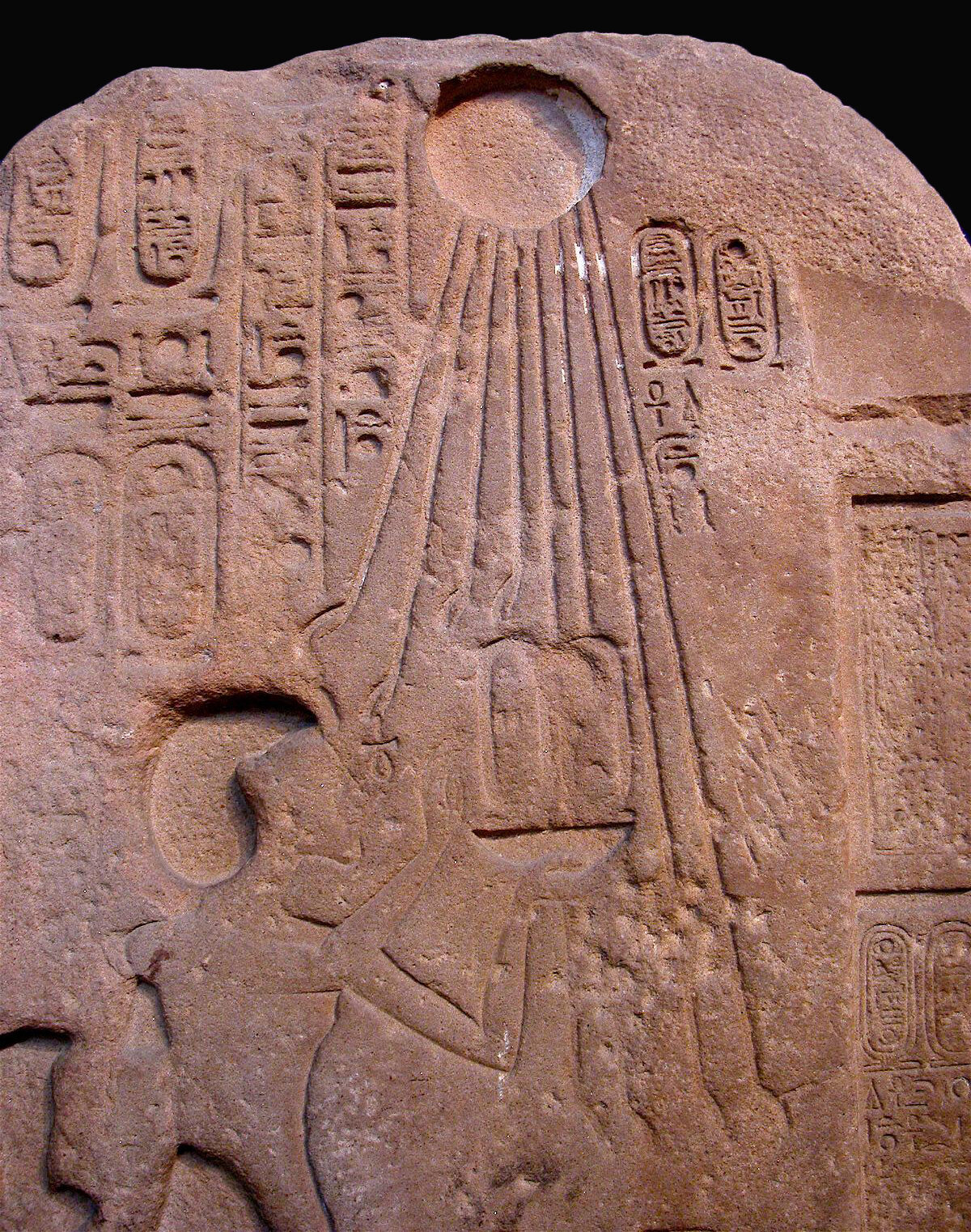
Figure 25. The Aten appears at the top of this relief fragment above a figure of King Akhenaten. Unlike other Egyptian deities, the Aten does not take a human or animal form. This deity is shown as a sun disk with rays that end in tiny hands (UPMAA E16230). Image courtesy of the Penn Museum.

Figure 25. The Aten appears at the top of this relief fragment above a figure of King Akhenaten. Unlike other Egyptian deities, the Aten does not take a human or animal form. This deity is shown as a sun disk with rays that end in tiny hands (UPMAA E16230). Image courtesy of the Penn Museum.

During the Amarna Period, when the pharaoh Akhenaten (reigned 1353-1336 BCE) changed the religious system from a polytheistic one to one that approached monotheism, his chosen deity, the Aten, naturally took position as creator god (Figure 25). The Aten was a solar deity, and his role in creation is celebrated in hymns composed during this period. In one version, the Aten is praised and described as follows. (It is interesting to note that scholars have long observed the similarity of this hymn to the phraseology of Psalm 104 in the Bible):

“How numerous are your works, though hidden from sight.
Unique god, there is none beside him.
You mold the earth to your wish, you and you alone.
All people, herds and flocks,
All on earth that walk on legs,
All on high that fly with their wings.
And on the foreign lands of Khar and Kush, the land of Egypt
You place every man in his place,
you make what they need,
so that everyone has his food,
his lifespan counted.”

This religious experiment did not last long beyond the death of Akhenaten. By the beginning years of the reign of Tutankhamun, the traditional religious system with its many gods had been restored and the Aten returned to being just one of many solar deities in the Egyptian pantheon. 

As we can see, there was no one single creation story in Egyptian religious tradition. There were several different ways in which the Egyptians explained the origin of the world. These various traditions were not mutually exclusive. They often complimented and intersected each other, yet distinctions can be drawn amongst the various creation myths, which helps to distinguish one from the other.

Jennifer Houser Wegner, PhD
Associate Curator, Egyptian Section, Penn Museum
University of Pennsylvania

Select Bibliography

Andrews, Carol. 1994. Amulets of ancient Egypt. London: The British Museum Press.

Lichtheim, Miriam. 1976. Ancient Egyptian literature: a book of readings. Vol. 2. The New Kingdom. Berkeley/London.

O’ Rourke, Paul. 2001. “Khnum.” In Donald B. Redford (ed.). The Oxford Encyclopedia of Ancient Egypt, vol. 2: 231-232. Oxford: Oxford University Press.

Romanosky, Eugene. 2001. “Min.” In Donald B. Redford (ed.). The Oxford Encyclopedia of Ancient Egypt, vol. 2: 413-415. Oxford: Oxford University Press.

Schlögl, Hermann A. 2001. “Aten.” In Donald B. Redford (ed.). The Oxford Encyclopedia of Ancient Egypt, vol. 1: 1156-158. Oxford: Oxford University Press.

Simpson, William Kelly (ed.) 2003. The literature of ancient Egypt: an anthology of stories, instructions, stelae, autobiographies, and poetry, third ed. New Haven; London: Yale University Press.

Tobin, Vincent A. 2001. “Amun and Amun-Re.” In Donald B. Redford (ed.). The Oxford Encyclopedia of Ancient Egypt, vol. 1: 82-85. Oxford: Oxford University Press.

Tobin, Vincent A. 2001. “Myths: Creation Myths.” In Donald B. Redford (ed.). The Oxford Encyclopedia of Ancient Egypt, vol. 2: 469-472. Oxford: Oxford University Press.

Wilkinson, Richard H. 2003. The complete gods and goddesses of ancient Egypt. London: Thames & Hudson.

A complete archive of past issues of Glencairn Museum News is available online here.