

NOTES: (unless otherwise noted, all biblical references are from the Book of Genesis)
- Terah: from Ur of the Chaldeans; has three sons; wife not named (11:26-32; cf. Luke 3:34).
- Haran: dies in Ur before his father dies; wife not named; son Lot, daughters Milcah & Iscah (11:27-28).
- Nahor: marries Milcah, daughter of his brother Haran (11:29); have eight sons, incl. Bethuel (22:20-24).
- Abram: main character of Gen 12–25; recipient of God's promises; name changed to ABRAHAM (17:5); sons Ishmael (by Hagar) and Isaac (by Sarah); after Sarah's death, takes another wife, Keturah, who has six sons (25:1-4), including Midian, ancestor of the Midianites (37:28-36).
- Lot: son of Haran, thus nephew of Abram, who takes care of him (11:27–14:16; 18:17–19:29); wife and two daughters never named; widowed daughters sleep with their father and bear sons, who become ancestors of the Moabites and Ammonites (19:30-38).
- Sarai: Abram's wife, thus Terah's daughter-in-law (11:29-31); Abram also calls her his "sister," which seems deceptive in one story (12:10-20); but in another story Abram insists she really is his half-sister (his father's daughter by another wife; 20:1-18); originally childless, but in old age has a son, Isaac (16:1–21:7); name changed to SARAH (17:15); dies and is buried in Hebron (23:1-20).
- Hagar: Sarah's Egyptian slave-girl; mother of Abram's first son, Ishmael; much conflict with Sarah after his birth; even more after the birth of Sarah's son, Isaac (16:1–21:21).
- Ishmael: first-born son of Abraham, by Hagar (16:1–17:27); wife or wives never named, but has 12 sons (25:12-16), the ancestors of 12 tribes of Ishmaelites (37:25-28). - see below
- Isaac: second son of Abraham, by wife Sarah, despite her old age (17:15-21; 21:1–35:29); marries Rebekah, who has twin sons, Esau & Jacob.
- Betheul: youngest son of Nahor & Milcah; wife unnamed; father of Rebekah (22:23) and Laban (24:29).
- Rebekah: daughter of Bethuel (22:23); becomes wife of Isaac (24:15–25:20); favors their younger son.
- Laban: son of Bethuel, brother of Rebekah; has extensive interactions with Jacob (24:29–31:55).
- Esau: elder twin son of Isaac & Rebekah (25:25); names of wives differ in two traditions (26:34 & 28:9 vs. 36:2-3); one is a daughter of Ishmael; his sons are ancestors of the Edomites (36:1-43).
- Jacob: younger twin son of Isaac & Rebekah (25:26); conflicts with Esau (25:27–27:46); marries Leah and Rachel, daughters of his uncle Laban (27:43–29:30); name changed to ISRAEL (32:28); has 12 sons (with two wives + two slave-girls), ancestors of the Israelites or "12 Tribes of Israel" (29:31–49:33). - see below
- Curiosity about the ages of the Patriarchs:
- Abraham lived 175 years (Gen 25:7), which equals 7 x 5²
- Isaac lived 180 years (Gen 35:28), which equals 5 x 6²
- Jacob lived 147 years (Gen 47:28), which equals 3 x 7²
The Bible says very little else about the "Twelve Tribes of Ismaelites" aside from naming the twelve sons of Ishmael in Gen 25:12-16 and again in 1 Chron 1:29-31.
- Gen 25:12-16 – "These are the descendants of Ishmael, Abraham's son, whom Hagar the Egyptian, Sarah's slave-girl, bore to Abraham./ These are the names of the sons of Ishmael, named in the order of their birth: Nebaioth, the firstborn of Ishmael; and Kedar, Adbeel, Mibsam, / Mishma, Dumah, Massa, / Hadad, Tema, Jetur, Naphish, and Kedemah. / These are the sons of Ishmael and these are their names, by their villages and by their encampments, twelve princes according to their tribes."
- 1 Chron 1:29-31 – "These are their genealogies: the firstborn of Ishmael, Nebaioth; and Kedar, Adbeel, Mibsam, / Mishma, Dumah, Massa, Hadad, Tema, / Jetur, Naphish, and Kedemah. These are the sons of Ishmael."
- Adbeel, Massa, Kedemah - not mentioned anywhere else in the Bible
- Mibsam & Mishma - not mentioned elsewhere, but different people with the same name appear in 1 Chron 4:25-26
- Hadad - not mentioned elsewhere, but several other biblical characters are named Hadad, Ben-Hadad, Hadadezer, etc.
- Other biblical references to some of the sons of Ishmael (aside from Gen 25:12-16 and 1 Chr 1:29-31)
- Nebaioth - also in Gen 28:9; 36:3; Isa 60:7
- Kedar - also in Ps 120:5; Prov 21:4; Songs 1; Isa 21:16; 21:17; 42:11; 60:7; Jer 2:10; 49:28; Ezek 27:21
- Dumah - also in Josh 15:52; Isa 21:11
- Tema - also in Job 6:19; Isa 21:14; Jer 25:23
- Jetur & Naphish - also in 1 Chron 5:19
The Hebrew Bible describes the "Twelve Tribes of Israel" as descendants of the twelve sons of Jacob (also named Israel), with four different mothers. The births of the twelve sons (and the significance of their names) are described in chronological order in the book of Genesis (29:31–30:24 & 35:16-20). The Bible contains several different listings of the twelve tribes. Each tribe has its own characteristics and eventually obtains its own territory:
- Reuben is the first-born son, and thus sometimes exercises a leadership role among his brothers; but he later loses favor and prominence.
- The tribe of Joseph (through his sons Manasseh and Ephraim) becomes the largest and most prominent by the time the Israelites enter the Promised Land and divide it among themselves.
- The tribe of Levi is uniquely important, not only because of Moses and Aaron, but since they become the priestly tribe (all the sons of Levi are priests, while members of any other tribe cannot be priests). The Levites do not receive a separate territory of their own, but rather live scattered among all the other tribes, where they serve as priests for the whole people.
- Although the first king of Israel (Saul) is from the tribe of Benjamin, the tribe of Judah becomes known as the royal tribe, due to the promise God makes to King David that his descendants will rule over Israel forever (2 Sam 7).
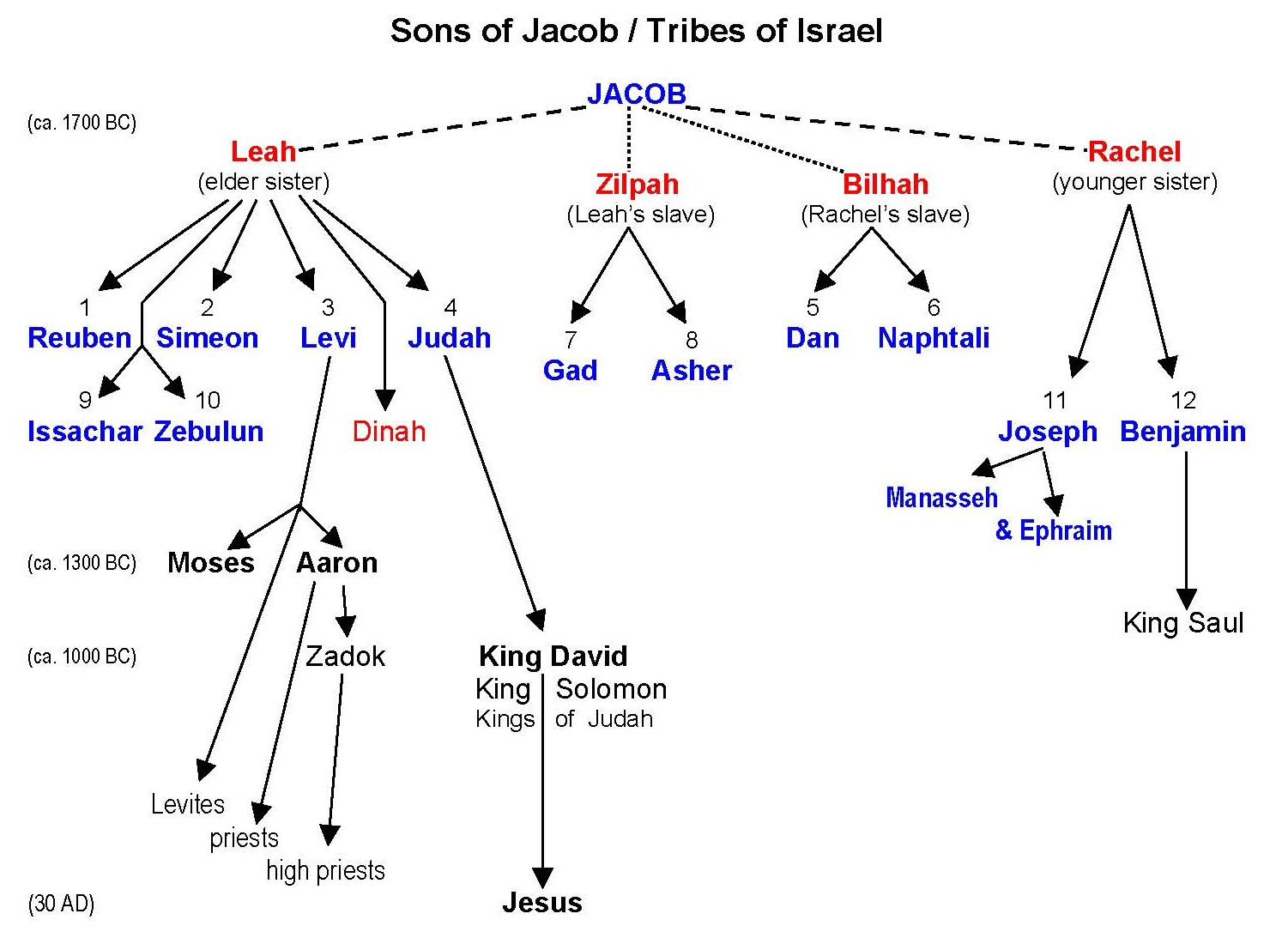
Click here for a PDF version of this chart (on page 2)
Notes:
- Jacob's twelve sons are first mentioned in the order of their births, in Genesis 29:31–30:24 & 35:16-20.
- Leah (elder wife): 1) Reuben, 2) Simeon, 3) Levi, 4) Judah; later also 9) Issachar, 10) Zebulun
- Bilhah (Rachel's slave): 5) Dan, 6) Naphtali
- Zilpah (Leah's slave): 7) Gad, 8) Asher
- Rachel (younger wife): 11) Joseph, 12) Benjamin
- Manasseh & Ephraim – sons of Joseph, whose descendants figure prominently in the later history of Israel
- Moses and Aaron – leaders of the Israelites at the time of their migration out of Egypt and wandering in the Sinai desert
- Kings David & Solomon – the two greatest rulers of the united Kingdom of Israel, from about 1100 to 930 BCE
- Tribe of Levi – becomes known as the “priestly tribe,” since all cultic & temple officials had to belong to this tribe
- Tribe of Judah – becomes known as the “royal tribe,” since all later Kings of Judah were descendants of King David